River Lapwing

River Lapwing

Vanellus duvaucelii

Silhouette: Rebecca Groom · PhyloPic

LCNTNear ThreatenedVUENCR
Daily sighting probability ~10% · With luck
at Royal Manas National Park

In 3 days ~30% in a week ~50%

109 Verified sightings at Royal Manas National Park From 2019 to 2026
3,471 In all 11 parks
November Best month
☀️ Diurnal When it's spotted

About the River Lapwing

The river lapwing (Vanellus duvaucelii) is a lapwing species which breeds from the Indian subcontinent eastwards to Southeast Asia. It range includes much of northern and northeastern India, and extends through Southeast Asia to Vietnam. It appears to be entirely sedentary. Formerly also called spur-winged lapwing, this name is better reserved for one of the "spur-winged plovers" of old, Vanellus spinosus of Africa, whose scientific name it literally translates. The masked lapwing of Australasia was at one time also called "spur-winged plover" (and still is in New Zealand), completing the name confusion.

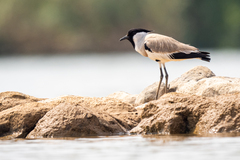
This species resembles the closely related spur-winged lapwing of Africa, and has sometimes been considered conspecific. The species name commemorates Alfred Duvaucel. The river lapwing is 29–32 cm long. It has a black crest, crown, face and central throat and grey-white neck sides and nape. It has a grey-brown breast band and white underparts with a black belly patch. The back is brown, the rump is white and the tail is black. This is a striking species in flight, with black primaries, white under wings and upper wing secondaries, and brown upper wing coverts.... Wikipedia →

Sounds

Call0:18

Thailand · 2025

© Greg Irving · XC973823 · CC BY-NC-SA 4.0

Alarm call0:37

Laos · 2024

© Bram Piot · XC883932 · CC BY-NC-SA 4.0

Song0:36

India · 2007

© David Farrow · XC37587 · CC BY-NC-SA 3.0

Global Distribution

Parks Where Found

# Park Country Daily sighting probability
1 Royal Bardia National Park 🇳🇵 Nepal
~50%
2 Chitwan National Park 🇳🇵 Nepal
~50%
3 Jim Corbett National Park 🇮🇳 India
~30%
4 Satpura National Park 🇮🇳 India
~30%
5 Kaziranga National Park 🇮🇳 India
~20%
6 Manas National Park 🇮🇳 India
~20%
7 Namdapha National Park 🇮🇳 India
~10%
8 Royal Manas National Park 🇧🇹 Bhutan
~10%
9 Bandhavgarh National Park 🇮🇳 India
<5%
10 Ranthambore National Park 🇮🇳 India
<5%
11 Kanha National Park 🇮🇳 India
<5%

Cities Where Found

# City Country Daily sighting probability
1 Agra 🇮🇳 India
~30%
2 Prayagraj 🇮🇳 India
~20%
3 Varanasi 🇮🇳 India
~10%
4 Kathmandu 🇳🇵 Nepal
~10%
5 Lucknow 🇮🇳 India
<5%
6 Bhubaneshwar 🇮🇳 India
<5%
7 New Delhi 🇮🇳 India
<5%
8 Dehradun 🇮🇳 India
<5%

Before you go

What are the chances of seeing a River Lapwing in Royal Manas National Park?

With luck

About 10% of wildlife watchers report a River Lapwing sighting in Royal Manas National Park on a given day, based on 109 verified sightings from GBIF citizen-science data from 2019 to 2026. It is the 142nd most-seen of the 388 birds we can rate there. Over three days the chance rises to about 30%, and over a week to about 50%, if each day is a fresh chance.

When is the best time to see a River Lapwing in Royal Manas National Park?

November

In that month about 30% of wildlife watchers report a River Lapwing in Royal Manas National Park on a given day, against under 5% in March and October, the lowest months. That is one of Royal Manas National Park's driest months, with about 15 mm of rain against 930 mm in July. August and September have too few records to rate.

What time of day is best to see a River Lapwing?

Between 7 and 10 am

Across all the parks we cover, that three-hour window holds the most River Lapwing sightings with a recorded time, and about 9 in 10 of them come between 6 am and 6 pm: it is a daytime animal.

Where does the River Lapwing sighting chance come from?

GBIF citizen-science records

It is estimated from how often the River Lapwing is recorded against all the birds logged in Royal Manas National Park (109 verified sightings from 2019 to 2026), calibrated against known sighting rates. Figures are rounded to the nearest 10% because citizen-science data supports honest approximations, not decimals, and months with records from fewer than five people show "—". How it works.

← Back to Royal Manas National Park