Irrawaddy Squirrel

Irrawaddy Squirrel

Callosciurus pygerythrus

Silhouette: Kai Caspar · PhyloPic

LCLeast ConcernNTVUENCR
Daily sighting probability ~40% · Likely
at Royal Manas National Park

In 3 days ~80% in a week >90%

8 Verified sightings at Royal Manas National Park From 2019 to 2026
37 In all 3 parks
February Best month
🌅 Crepuscular When it's spotted

About the Irrawaddy Squirrel

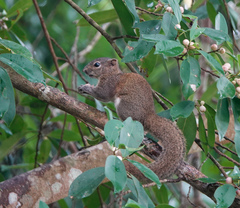
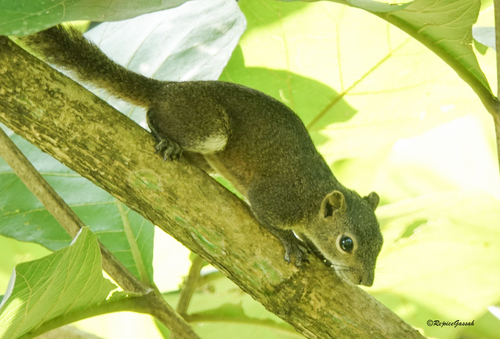
The Irrawaddy squirrel (Callosciurus pygerythrus) or hoary-bellied Himalayan squirrel is a species of rodent in the family Sciuridae. Irrawaddy squirrels vary in fur color, with some squirrels being greyish-brown and reddish-brown, and some squirrels being grizzled. Some squirrels have dark tips on their tails and pale hip patches. Its head to body length is about 20 centimeters and its tail length is about 20 centimeters as well. Irrawaddy squirrels weigh approximately 45 grams.

It is native to Bangladesh, China, India, Myanmar, and Nepal. Most squirrels that live in Myanmar live west of the Irrawaddy River. Irrawaddy squirrels can live in several types of forests, including deciduous broad-leaved woodland, coniferous evergreen forests, mixed agricultural areas, and secondary growth forests. They can also live in lowlands and lower mountainous regions, at around 1500 meters. It is threatened by habitat loss.

Irrawaddy squirrels mainly eat nuts, seeds, fruits, bark, lichen, and various types of vegetation, however, they may occasionally eat insects and small vertebrates. Wikipedia →
Sounds

Uncertain0:30

India · 2024

© Lars Lachmann · XC1045493 · CC BY-NC-SA 4.0

Alarm call0:39

Myanmar · 2025

© Ding Li Yong · XC1043716 · CC BY-NC-ND 4.0

Global Distribution

Parks Where Found

# Park Country Daily sighting probability
1 Kaziranga National Park 🇮🇳 India
~50%
2 Manas National Park 🇮🇳 India
~40%
3 Royal Manas National Park 🇧🇹 Bhutan
~40%

Cities Where Found

# City Country Daily sighting probability
1 Dhaka 🇧🇩 Bangladesh
~40%
2 Yangon 🇲🇲 Myanmar
~40%
3 Guwahati 🇮🇳 India
~40%

Before you go

What are the chances of seeing an Irrawaddy Squirrel in Royal Manas National Park?

Likely

About 40% of wildlife watchers report an Irrawaddy Squirrel sighting in Royal Manas National Park on a given day, based on 8 verified sightings from GBIF citizen-science data from 2019 to 2026. It is the 4th most-seen of the 11 mammals we can rate there. Over three days the chance rises to about 80%, and over a week to over 90%, if each day is a fresh chance.

When is the best time to see an Irrawaddy Squirrel in Royal Manas National Park?

February

In that month about 70% of wildlife watchers report an Irrawaddy Squirrel in Royal Manas National Park on a given day, against under 5% in March, the lowest month. That is one of Royal Manas National Park's driest months, with about 65 mm of rain against 930 mm in July. July to October have too few records to rate.

What time of day is best to see an Irrawaddy Squirrel?

Between 2 and 5 am

Across all the parks we cover, that three-hour window holds the most Irrawaddy Squirrel sightings with a recorded time, and about half of them come between 6 am and 6 pm: it is most active around dawn and dusk.

Is Royal Manas National Park the best place to see an Irrawaddy Squirrel?

3rd of 3

Of the 3 parks where we can rate Irrawaddy Squirrel sightings, Royal Manas National Park ranks 3rd at about 40%. The best odds are in Kaziranga National Park (India, about 50%) and Manas National Park (India, about 40%).

Where does the Irrawaddy Squirrel sighting chance come from?

GBIF citizen-science records

It is estimated from how often the Irrawaddy Squirrel is recorded against all the mammals logged in Royal Manas National Park (8 verified sightings from 2019 to 2026), calibrated against known sighting rates. Figures are rounded to the nearest 10% because citizen-science data supports honest approximations, not decimals, and months with records from fewer than five people show "—". How it works.

← Back to Royal Manas National Park