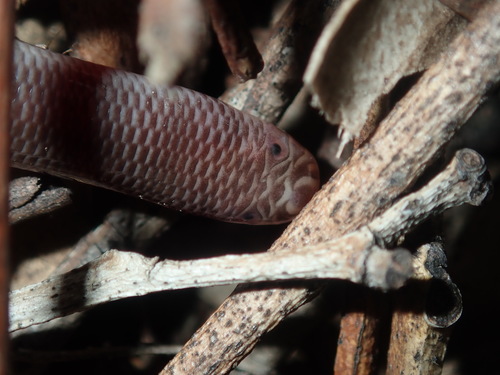
Blackish Blind Snake

Blackish Blind Snake

Anilios nigrescens

Silhouette: Jessica Tingle · PhyloPic

LCLeast ConcernNTVUENCR Endemic
Daily sighting probability ~10% · With luck
at Royal National Park

In 3 days ~30% in a week ~50%

11 Verified sightings at Royal National Park From 2019 to 2026
25 In all 2 parks
August Best month
☀️🌙 Day & Night When it's spotted

About the Blackish Blind Snake

The blackish blind snake (Anilios nigrescens) is a species of snake in the Typhlopidae family native to south-eastern Australia. It is a small burrowing snake with small dark eyes, a forked tongue and smooth scale around its body which permits them to travel through soil. They can grow to a size of 23 inches, with the largest recorded at 32 inches. Colour is brown/purplish on top, with a light shade of pink on the belly. The tail features a pointed tip which is a harmless spur. They can be mistaken for earthworms. Blind snakes move in a side-to-side motion on the ground, but underground they slither with tunnels made by insects.

The species lives most of its life underground feeding on ants, termites and their larvae. To find their food they flick their tongue to pick up the scent of an ant or termite trail and follow it back to the nest, where they rake the ants into their mouth using their upper jaw and swallow the food whole. Wikipedia →

Global Distribution

Parks Where Found

# Park Country Daily sighting probability
1 Royal National Park 🇦🇺 Australia
~10%
2 Blue Mountains National Park 🇦🇺 Australia
~10%

Cities Where Found

# City Country Daily sighting probability
1 Sydney 🇦🇺 Australia
<5%

Closest Relatives at Royal National Park

No species of the same family or order lives in Royal National Park, so these are its closest relatives here: other reptiles.

Before you go

What are the chances of seeing a Blackish Blind Snake in Royal National Park?

With luck

About 10% of wildlife watchers report a Blackish Blind Snake sighting in Royal National Park on a given day, based on 11 verified sightings from GBIF citizen-science data from 2019 to 2026. It is the 27th most-seen of the 37 reptiles we can rate there. Over three days the chance rises to about 30%, and over a week to about 50%, if each day is a fresh chance.

When is the best time to see a Blackish Blind Snake in Royal National Park?

August–September and November

In those months about 20% of wildlife watchers report a Blackish Blind Snake in Royal National Park on a given day, against under 5% in February and April–July, the lowest months.

What time of day is best to see a Blackish Blind Snake?

Between 8 and 11 pm

Across all the parks we cover, that three-hour window holds the most Blackish Blind Snake sightings with a recorded time, and about 6 in 10 of them come between 6 am and 6 pm: it is seen both by day and at night.

Is Royal National Park the best place to see a Blackish Blind Snake?

Yes

Of the 2 parks where we can rate Blackish Blind Snake sightings, Royal National Park has the highest daily chance: about 10%. Next come Blue Mountains National Park (Australia, about 10%).

Where does the Blackish Blind Snake sighting chance come from?

GBIF citizen-science records

It is estimated from how often the Blackish Blind Snake is recorded against all the reptiles logged in Royal National Park (11 verified sightings from 2019 to 2026), calibrated against known sighting rates. Figures are rounded to the nearest 10% because citizen-science data supports honest approximations, not decimals, and months with records from fewer than five people show "—". How it works.
← Back to Royal National Park