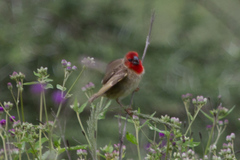
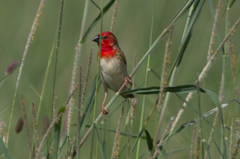
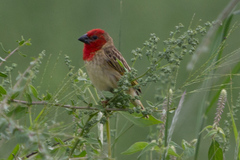
Cardinal Quelea

Cardinal Quelea

Quelea cardinalis

Silhouette: Sheatherius · PhyloPic

LCLeast ConcernNTVUENCR
Daily sighting probability <5% · Rare
at Ruaha National Park

In 3 days ~10% in a week ~20%

5 Verified sightings at Ruaha National Park From 2019 to 2026
559 In all 17 parks
February Best month
☀️ Diurnal When it's spotted

About the Cardinal Quelea

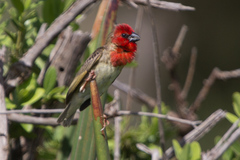
The cardinal quelea (Quelea cardinalis) is a species of bird in the family Ploceidae. It is found in Burundi, Democratic Republic of the Congo, Ethiopia, Kenya, Malawi, Rwanda, South Sudan, Tanzania, Uganda, and Zambia. The cardinal quelea is a small (about 10 centimetres or 3.9 inches long) sparrow-like bird with a short heavy black bill, that breeds in colonies. The male in breeding plumage has a red head extending onto the breast but not onto the streaked nape. The female has a yellowish face, brow stripes and throat. The non-breeding plumage of the male resembles that of the female, but retains some red on its head.

Gustav Hartlaub was the first to describe the cardinal quelea, giving it the scientific name Hyphantica cardinalis in 1880, based on specimens that were collected by Emin Pasha near Lado in South-Sudan during 1879. In 1951, Hans von Boetticher regarded the cardinal quelea and red-headed quelea sufficiently different from the red-billed quelea to create a new genus Queleopsis. Its name in Swahili is kwelea kidari-chekundu.

Based on recent DNA-analysis, the red-headed quelea forms a clade with the cardinal quelea, and this... Wikipedia →

Sounds

Song0:42

Kenya · 2015

© Rory Nefdt · XC247230 · CC BY-NC-SA 4.0

Call0:30

Zambia · 2006

© Derek Solomon · XC41310 · CC BY-NC-ND 2.5

Global Distribution

Parks Where Found

# Park Country Daily sighting probability
1 Nairobi National Park 🇰🇪 Kenya
~10%
2 Mkomazi National Park 🇹🇿 Tanzania
~10%
3 Akagera National Park 🇷🇼 Rwanda
<5%
4 Kidepo Valley National Park 🇺🇬 Uganda
<5%
5 Tsavo West National Park 🇰🇪 Kenya
<5%
6 Serengeti National Park 🇹🇿 Tanzania
<5%
7 Tsavo East National Park 🇰🇪 Kenya
<5%
8 Tarangire National Park 🇹🇿 Tanzania
<5%
9 Lake Manyara National Park 🇹🇿 Tanzania
<5%
10 Ruaha National Park 🇹🇿 Tanzania
<5%
11 Ngorongoro Conservation Area 🇹🇿 Tanzania
<5%
12 Masai Mara National Reserve 🇰🇪 Kenya
<5%
13 Samburu National Reserve 🇰🇪 Kenya
<5%
14 Amboseli National Park 🇰🇪 Kenya
<5%
15 Lake Mburo National Park 🇺🇬 Uganda
<5%
16 Murchison Falls National Park 🇺🇬 Uganda
<5%
17 Kibale National Park 🇺🇬 Uganda
<5%

Before you go

What are the chances of seeing a Cardinal Quelea in Ruaha National Park?

Rare

Under 5% of wildlife watchers report a Cardinal Quelea sighting in Ruaha National Park on a given day, based on 5 verified sightings from GBIF citizen-science data from 2019 to 2026. It is the 260th most-seen of the 276 birds we can rate there. Over three days the chance rises to about 10%, and over a week to about 20%, if each day is a fresh chance.

When is the best time to see a Cardinal Quelea in Ruaha National Park?

February and July

In those months about 10% of wildlife watchers report a Cardinal Quelea in Ruaha National Park on a given day, against under 5% in March–June and August–January, the lowest months.

What time of day is best to see a Cardinal Quelea?

Between 7 and 10 am

Across all the parks we cover, that three-hour window holds the most Cardinal Quelea sightings with a recorded time, and about 8 in 10 of them come between 6 am and 6 pm: it is a daytime animal.

Is Ruaha National Park the best place to see a Cardinal Quelea?

10th of 17

Of the 17 parks where we can rate Cardinal Quelea sightings, Ruaha National Park ranks 10th at under 5%. The best odds are in Nairobi National Park (Kenya, about 10%), Mkomazi National Park (Tanzania, about 10%) and Akagera National Park (Rwanda, under 5%).

Where does the Cardinal Quelea sighting chance come from?

GBIF citizen-science records

It is estimated from how often the Cardinal Quelea is recorded against all the birds logged in Ruaha National Park (5 verified sightings from 2019 to 2026), calibrated against known sighting rates. Figures are rounded to the nearest 10% because citizen-science data supports honest approximations, not decimals, and months with records from fewer than five people show "—". How it works.

← Back to Ruaha National Park