Violet Wood Hoopoe

Violet Wood Hoopoe

Phoeniculus damarensis

Silhouette: Jon Hill (Photo by DickDaniels: http://en.wikipedia.org/wiki/File:Green_Woodhoopoe_RWD7.jpg) · PhyloPic

LCLeast ConcernNTVUENCR
Daily sighting probability ~10% · With luck
at Samburu National Reserve

In 3 days ~20% in a week ~50%

89 Verified sightings at Samburu National Reserve From 2019 to 2026
490 In all 7 parks
April Best month
☀️ Diurnal When it's spotted

About the Violet Wood Hoopoe

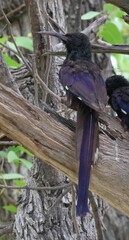
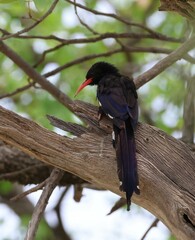
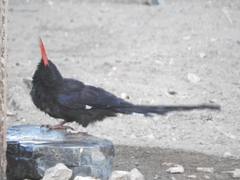
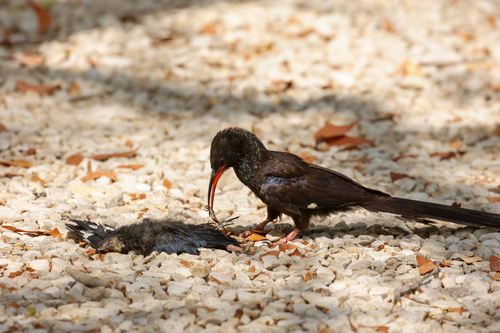
The violet wood hoopoe (Phoeniculus damarensis) is a species of bird in the family Phoeniculidae. It is found in Angola, Kenya, Namibia, and Tanzania. It looks similar to the black-billed wood hoopoe but with a red beak and a green throat. It has coppery and violet mantle feathers.

The violet wood hoopoe was formally described in 1901 by the Scottish ornithologist William Robert Ogilvie-Grant under the binomial name Irrisor damarensis. The specific epithet is from Damaraland in Namibia. The violet wood hoopoe is now one of five species placed in the genus Phoeniculus that was introduced in 1821 by the Polish zoologist Feliks Paweł Jarocki.

Two subspecies are recognised: The subspecies P. d. granti has sometimes been considered as a separate species as its distribution is separated by a very large distance from that of the nominate race. The violet wood hoopoe was formerly considered to be conspecific with the green wood hoopoe (Phoeniculus purpureus). It has been argued that the violet wood hoopoe should be considered as a distinct species because of its... Wikipedia →

Sounds

Duet0:17

Namibia · 1967

© Nature sounds by Simply Birding · XC651910 · CC BY-NC-ND 4.0

Call1:14

Namibia · 2016

© Peter Boesman · XC346957 · CC BY-NC-ND 4.0

Group duetting0:29

Namibia · 2008

© Paul Noakes · XC20485 · CC BY-NC-ND 2.5

Global Distribution

Parks Where Found

# Park Country Daily sighting probability
1 Meru National Park 🇰🇪 Kenya
~20%
2 Etosha National Park 🇳🇦 Namibia
~10%
3 Samburu National Reserve 🇰🇪 Kenya
~10%
4 Waterberg Plateau Park 🇳🇦 Namibia
~10%
5 Nairobi National Park 🇰🇪 Kenya
~10%
6 Tsavo East National Park 🇰🇪 Kenya
<5%
7 Tsavo West National Park 🇰🇪 Kenya
<5%

Before you go

What are the chances of seeing a Violet Wood Hoopoe in Samburu National Reserve?

With luck

About 10% of wildlife watchers report a Violet Wood Hoopoe sighting in Samburu National Reserve on a given day, based on 89 verified sightings from GBIF citizen-science data from 2019 to 2026. It is the 161st most-seen of the 341 birds we can rate there. Over three days the chance rises to about 20%, and over a week to about 50%, if each day is a fresh chance.

When is the best time to see a Violet Wood Hoopoe in Samburu National Reserve?

April

In that month about 20% of wildlife watchers report a Violet Wood Hoopoe in Samburu National Reserve on a given day, against under 5% in March, June, September and December–January, the lowest months. That is one of Samburu National Reserve's wettest months, with about 95 mm of rain against 5 mm in September.

What time of day is best to see a Violet Wood Hoopoe?

Between 7 and 10 am

Across all the parks we cover, that three-hour window holds the most Violet Wood Hoopoe sightings with a recorded time, and about 9 in 10 of them come between 6 am and 6 pm: it is a daytime animal.

Is Samburu National Reserve the best place to see a Violet Wood Hoopoe?

3rd of 7

Of the 7 parks where we can rate Violet Wood Hoopoe sightings, Samburu National Reserve ranks 3rd at about 10%. The best odds are in Meru National Park (Kenya, about 20%) and Etosha National Park (Namibia, about 10%).

Where does the Violet Wood Hoopoe sighting chance come from?

GBIF citizen-science records

It is estimated from how often the Violet Wood Hoopoe is recorded against all the birds logged in Samburu National Reserve (89 verified sightings from 2019 to 2026), calibrated against known sighting rates. Figures are rounded to the nearest 10% because citizen-science data supports honest approximations, not decimals, and months with records from fewer than five people show "—". How it works.
← Back to Samburu National Reserve