Barasingha

Barasingha

Rucervus duvaucelii

Silhouette: Steven Traver · PhyloPic

LCNTVUVulnerableENCR
Daily sighting probability ~20% · Possible
at Satpura National Park

In 3 days ~60% in a week ~90%

6 Verified sightings at Satpura National Park From 2019 to 2026
205 In all 4 parks
March Best month
🌅 Crepuscular When it's spotted

About the Barasingha

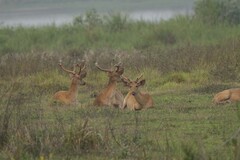
The barasingha (Rucervus duvaucelii), sometimes barasinghe, also known as the swamp deer, is a deer species distributed in the Indian subcontinent. Populations in northern and central India are fragmented, and two isolated populations occur in southwestern Nepal. It has been extirpated in Pakistan and Bangladesh, and its presence is uncertain in Bhutan.

The specific name commemorates the French naturalist Alfred Duvaucel. The swamp deer differs from all other Indian deer species in that the antlers carry more than three tines. Because of this distinctive character it is designated bārah-singgā, meaning "twelve-horned" in Hindi. Mature stags usually have 10 to 14 tines, and some have been known to have up to 20.

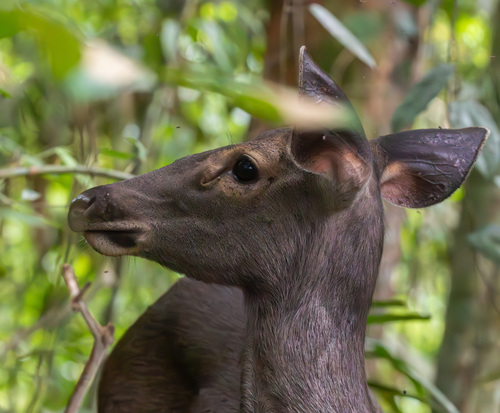
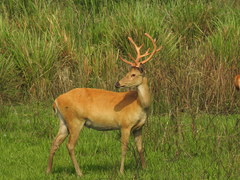
The barasingha is a large deer with a shoulder height of 44 to 46 in (110 to 120 cm) and a head-to-body length of nearly 6 ft (180 cm). Its hair is rather woolly and yellowish brown above but paler below, with white spots along the spine. The throat, belly, inside of the thighs and beneath the tail is white. In summer, the coat becomes bright rufous-brown. The neck is maned. Females are paler than males. Young are spotted. Average antlers measure 30 in... Wikipedia →

Sounds

Call0:47

Nepal · 2023

© Marc Anderson · XC959801 · CC BY-NC-ND 4.0

Global Distribution

Parks Where Found

# Park Country Daily sighting probability
1 Kaziranga National Park 🇮🇳 India
~80%
2 Kanha National Park 🇮🇳 India
~80%
3 Royal Bardia National Park 🇳🇵 Nepal
~50%
4 Satpura National Park 🇮🇳 India
~20%

Zoos & Centres Where Found

# Zoo / Centre Country
1 ZooParc de Beauval 🇫🇷 France In captivity
2 Ostrava Zoo 🇨🇿 Czechia In captivity
3 Nandankanan Zoological Park 🇮🇳 India In captivity
4 Natural Bridge Wildlife Ranch 🇺🇸 United States In captivity
5 San Diego Zoo Safari Park 🇺🇸 United States In captivity
6 Assam State Zoo cum Botanical Garden 🇮🇳 India In captivity
7 Safari World 🇹🇭 Thailand In captivity
8 Sanjay Gandhi Biological Park 🇮🇳 India In captivity
9 Chongqing Zoo 🇨🇳 China In captivity
10 Audubon Zoo 🇺🇸 United States In captivity
11 Mysore Zoo 🇮🇳 India In captivity
12 National Zoo of Malaysia 🇲🇾 Malaysia In captivity
13 Mesker Park Zoo and Botanic Garden 🇺🇸 United States In captivity
14 Bayou Safari Wildlife Park 🇺🇸 United States In captivity
15 Thiruvananthapuram Zoo 🇮🇳 India In captivity
16 Sriayuthaya Lion Park 🇹🇭 Thailand In captivity
17 Mundomar 🇪🇸 Spain In captivity
18 Nawab Wajid Ali Shah Prani Udyan 🇮🇳 India In captivity
19 Safari Zoo Camp 🇨🇦 Canada In captivity

Before you go

What are the chances of seeing a Barasingha in Satpura National Park?

Possible

About 20% of wildlife watchers report a Barasingha sighting in Satpura National Park on a given day, based on 6 verified sightings from GBIF citizen-science data from 2019 to 2026. It is the 12th most-seen of the 15 mammals we can rate there. Over three days the chance rises to about 60%, and over a week to about 90%, if each day is a fresh chance.

When is the best time to see a Barasingha in Satpura National Park?

March and June

In those months about 40% of wildlife watchers report a Barasingha in Satpura National Park on a given day, against under 5% in February and May, the lowest months. August has too few records to rate.

What time of day is best to see a Barasingha?

Between 3 and 6 am

Across all the parks we cover, that three-hour window holds the most Barasingha sightings with a recorded time, and about 6 in 10 of them come between 6 am and 6 pm: it is most active around dawn and dusk.

Which relatives of the Barasingha live in Satpura National Park?

Same family: Cervidae

The closest relatives of the Barasingha that you can see in Satpura National Park (family Cervidae, Deer) are Sambar (about 60%) and Axis Deer (about 40%), with each one's daily chance of a sighting.

Where does the Barasingha sighting chance come from?

GBIF citizen-science records

It is estimated from how often the Barasingha is recorded against all the mammals logged in Satpura National Park (6 verified sightings from 2019 to 2026), calibrated against known sighting rates. Figures are rounded to the nearest 10% because citizen-science data supports honest approximations, not decimals, and months with records from fewer than five people show "—". How it works.

← Back to Satpura National Park