African Pied Hornbill

African Pied Hornbill

Lophoceros fasciatus

Silhouette: Charles J. Sharp and T. Michael Keesey · PhyloPic

LCLeast ConcernNTVUENCR
Daily sighting probability ~60% · Likely
at Semuliki National Park

In 3 days >90%

285 Verified sightings at Semuliki National Park From 2019 to 2026
346 In all 4 parks
August Best month
☀️ Diurnal When it's spotted

About the African Pied Hornbill

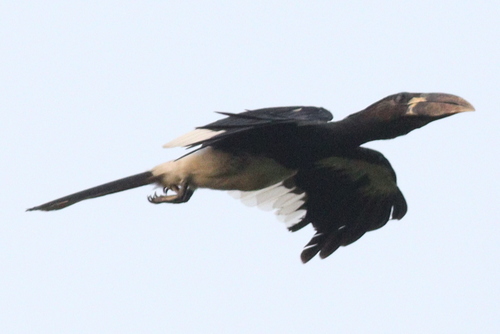
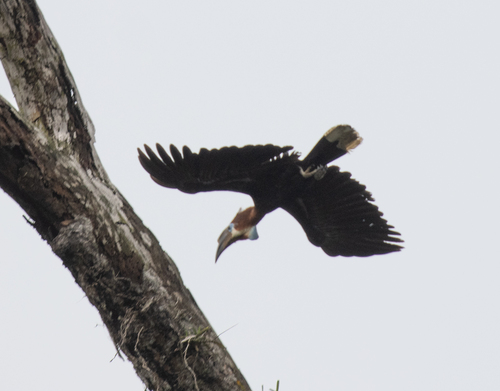
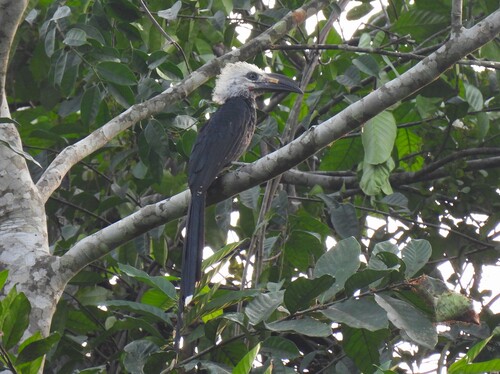
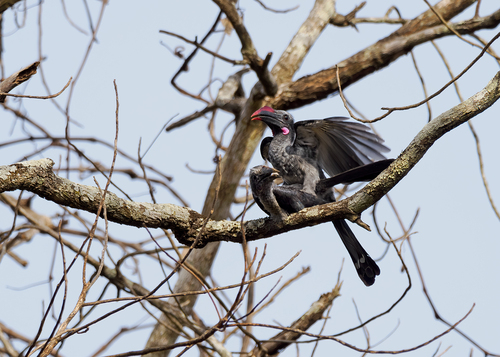
The Congo pied hornbill (Lophoceros fasciatus) is a bird of the hornbill family, a family of tropical near-passerine birds found in the Old World. The Congo pied hornbill is native to the Congo Basin. This is a bird of mainly forest habitats. The female lays up to four white eggs in a tree hole, which is blocked off during incubation with a cement made of mud, droppings and fruit pulp. There is only one narrow aperture, just big enough for the male to transfer food to the mother and the chicks.

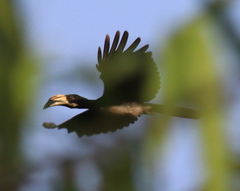
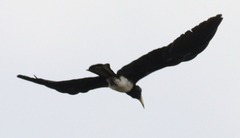
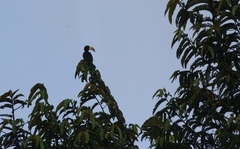
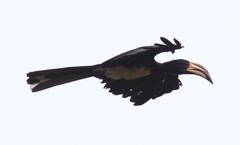
This is a large bird, 54 centimetres (21 in) in length. It has mainly black plumage, with white belly and tail tip. The long, curved black and yellow bill has a medium-sized casque. The sexes are similar, but the female has a smaller casque. Immature birds are duller, have a smaller bill, and no casque. The flight is undulating.

The Congo pied hornbill is omnivorous and eats fruit and insects. It feeds mainly in trees and is attracted to oil palms. This conspicuous and gregarious bird advertises its presence with its whistling pii-pii-pii-pii- call.

When the chicks and the female are too big to fit in the nest, the mother breaks out and rebuilds the wall. Then... Wikipedia →

Sounds

Uncertain0:17

Gabon · 2022

© BurBenj · XC1120012 · CC BY-NC-SA 4.0

Call0:25

Congo (Democratic Republic) · 2021

© Frederik Van de Perre · XC620804 · CC BY-NC-SA 4.0

Song0:07

Cameroon · 2019

© Andres Angulo Rubiano · XC530238 · CC BY-NC-SA 4.0

Global Distribution

Parks Where Found

# Park Country Daily sighting probability
1 Semuliki National Park 🇺🇬 Uganda
~60%
2 Taï National Park 🇨🇮 Ivory Coast
~50%
3 Odzala-Kokoua National Park 🇨🇬 Republic of the Congo
~20%
4 Kibale National Park 🇺🇬 Uganda
<5%

Cities Where Found

# City Country Daily sighting probability
1 Abidjan 🇨🇮 Côte d'Ivoire
~20%
2 Yaoundé 🇨🇲 Cameroon
~20%
3 Lagos 🇳🇬 Nigeria
~10%
4 Accra 🇬🇭 Ghana
~10%
5 Kumasi 🇬🇭 Ghana
~10%
6 Kampala 🇺🇬 Uganda
~10%
7 Serrekunda 🇬🇲 Gambia
~10%

Zoos & Centres Where Found

# Zoo / Centre Country
1 Bird Paradise 🇸🇬 Singapore In captivity
2 Rainforest Wild Asia 🇸🇬 Singapore In captivity

Before you go

What are the chances of seeing an African Pied Hornbill in Semuliki National Park?

Likely

About 60% of wildlife watchers report an African Pied Hornbill sighting in Semuliki National Park on a given day, based on 285 verified sightings from GBIF citizen-science data from 2019 to 2026. It is the 5th most-seen of the 280 birds we can rate there. Over three days the chance rises to over 90%, if each day is a fresh chance.

When is the best time to see an African Pied Hornbill in Semuliki National Park?

August

In that month about 80% of wildlife watchers report an African Pied Hornbill in Semuliki National Park on a given day, against about 50% in January, April and November, the lowest months. That is one of Semuliki National Park's wettest months, with about 120 mm of rain against 5 mm in January.

What time of day is best to see an African Pied Hornbill?

Between 8 and 11 am

Across all the parks we cover, that three-hour window holds the most African Pied Hornbill sightings with a recorded time, and about 9 in 10 of them come between 6 am and 6 pm: it is a daytime animal.

Is Semuliki National Park the best place to see an African Pied Hornbill?

Yes

Of the 4 parks where we can rate African Pied Hornbill sightings, Semuliki National Park has the highest daily chance: about 60%. Next come Taï National Park (Ivory Coast, about 50%) and Odzala-Kokoua National Park (Republic of the Congo, about 20%).

Which relatives of the African Pied Hornbill live in Semuliki National Park?

Same genus: Lophoceros

The closest relatives of the African Pied Hornbill that you can see in Semuliki National Park (genus Lophoceros, Whistling Hornbills) are Red-billed Dwarf Hornbill (about 50%) and Crowned Hornbill (about 10%), with each one's daily chance of a sighting.

Where does the African Pied Hornbill sighting chance come from?

GBIF citizen-science records

It is estimated from how often the African Pied Hornbill is recorded against all the birds logged in Semuliki National Park (285 verified sightings from 2019 to 2026), calibrated against known sighting rates. Figures are rounded to the nearest 10% because citizen-science data supports honest approximations, not decimals, and months with records from fewer than five people show "—". How it works.

← Back to Semuliki National Park