Black-casqued Hornbill

Black-casqued Hornbill

Ceratogymna atrata

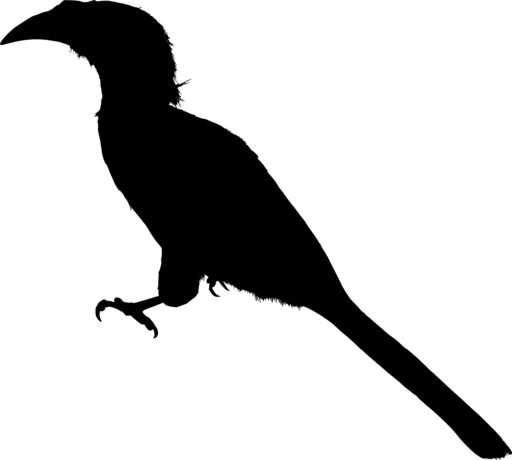
Silhouette: Charles J. Sharp and T. Michael Keesey · PhyloPic

LCNTNear ThreatenedVUENCR
Daily sighting probability ~60% · Likely
at Semuliki National Park

In 3 days ~90% in a week >90%

255 Verified sightings at Semuliki National Park From 2019 to 2026
307 In all 4 parks
July Best month
☀️ Diurnal When it's spotted

About the Black-casqued Hornbill

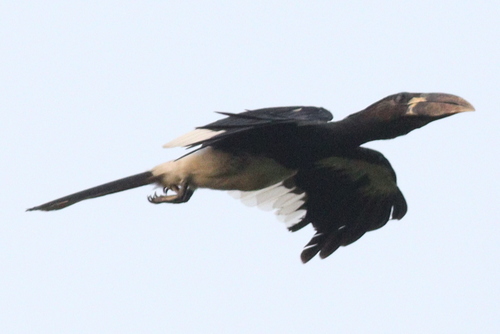
The black-casqued hornbill (Ceratogymna atrata), or black-casqued wattled hornbill, is a species of hornbill in the family Bucerotidae. It is found fairly commonly across sub-Saharan Africa, being known from Sierra Leone and Liberia in Western Africa (as well as most of the West African nations along the Gulf of Guinea), south to Angola and east to the Democratic Republic of the Congo and western Uganda. They are currently considered of near threatened, and their population is declining.

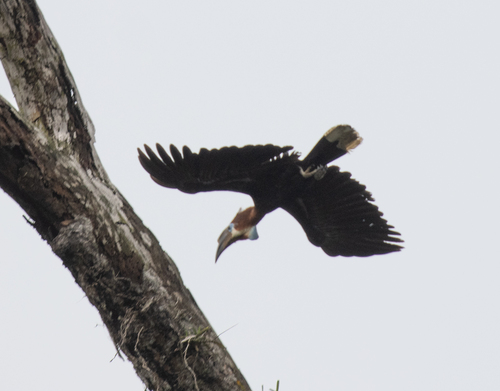
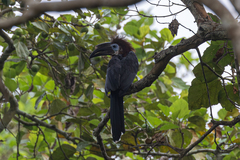
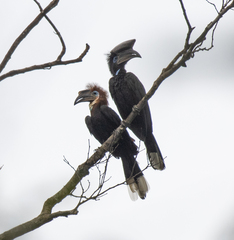
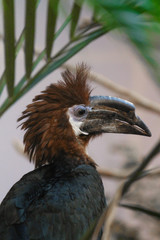
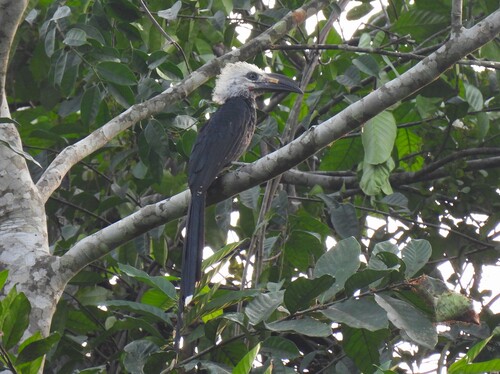
The black-casqued hornbill is a large, mostly black bird with bare-skinned blue wattles and skin around their eyes. Adult birds are typically between 60 and 70 cm (24 and 28 in) long, and can be distinguished from the similar yellow-casqued hornbill by the white scales found in their plumage. They are readily identifiable as a member of the hornbill family by the eponymous casque structure that the birds develop on their beaks as they mature.

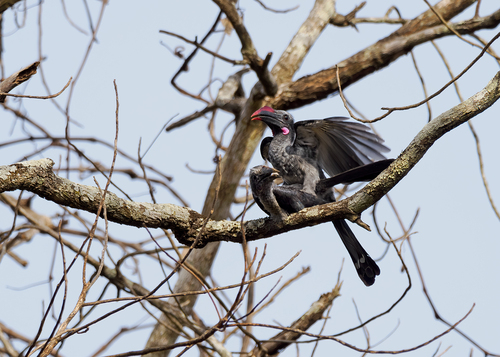
Like many bird species, black-casqued hornbills exhibit sexual dimorphism. The males are larger, with black heads, and a larger casque. The females have brown hood of feathers. Both male and female birds have a powerful, "braying" call, which... Wikipedia →

Sounds

Recording0:18

Gabon · 2023

© BurBenj · XC1133116 · CC BY-NC-SA 4.0

Call0:50

Angola · 2025

© Niall Perrins · XC1032706 · CC BY-NC-SA 4.0

Song0:27

Congo (Brazzaville) · 1994

© A. Bennett Hennessey · XC601945 · CC BY-NC-SA 4.0

Global Distribution

Parks Where Found

# Park Country Daily sighting probability
1 Semuliki National Park 🇺🇬 Uganda
~60%
2 Taï National Park 🇨🇮 Ivory Coast
~30%
3 Odzala-Kokoua National Park 🇨🇬 Republic of the Congo
~30%
4 Bwindi Impenetrable National Park 🇺🇬 Uganda
<5%

Cities Where Found

# City Country Daily sighting probability
1 Miami 🇺🇸 United States
<5%

Zoos & Centres Where Found

# Zoo / Centre Country
1 Lisbon Oceanarium 🇵🇹 Portugal In captivity
2 Zoo Miami 🇺🇸 United States In captivity
3 Badoca Safari Park 🇵🇹 Portugal In captivity
4 Nanjing Hongshan Forest Zoo 🇨🇳 China In captivity
5 Suzhou Shangfangshan Forest Zoo 🇨🇳 China In captivity
6 Seville Zoo 🇪🇸 Spain In captivity
7 Zoológico Los Coyotes 🇲🇽 Mexico In captivity
8 Reserva Zoológica Oasys MiniHollywood 🇪🇸 Spain In captivity
9 Jardin zoologique tropical 🇫🇷 France In captivity
10 The Zoo Wild Life Park 🇦🇪 United Arab Emirates In captivity
11 World of Birds Wildlife Sanctuary and Monkey Park 🇿🇦 South Africa In captivity
12 Zoo Lagos 🇵🇹 Portugal In captivity
13 Johor Zoo 🇲🇾 Malaysia In captivity
14 Zoo de Lourosa 🇵🇹 Portugal In captivity
15 Aquatopia 🇧🇪 Belgium In captivity
16 Vogelpark Turnersee 🇦🇹 Austria In captivity

Before you go

What are the chances of seeing a Black-casqued Hornbill in Semuliki National Park?

Likely

About 60% of wildlife watchers report a Black-casqued Hornbill sighting in Semuliki National Park on a given day, based on 255 verified sightings from GBIF citizen-science data from 2019 to 2026. It is the 10th most-seen of the 280 birds we can rate there. Over three days the chance rises to about 90%, and over a week to over 90%, if each day is a fresh chance.

When is the best time to see a Black-casqued Hornbill in Semuliki National Park?

July

In that month about 80% of wildlife watchers report a Black-casqued Hornbill in Semuliki National Park on a given day, against about 40% in March and October–November, the lowest months.

What time of day is best to see a Black-casqued Hornbill?

Between 8 and 11 am

Across all the parks we cover, that three-hour window holds the most Black-casqued Hornbill sightings with a recorded time, and about 9 in 10 of them come between 6 am and 6 pm: it is a daytime animal.

Is Semuliki National Park the best place to see a Black-casqued Hornbill?

Yes

Of the 4 parks where we can rate Black-casqued Hornbill sightings, Semuliki National Park has the highest daily chance: about 60%. Next come Taï National Park (Ivory Coast, about 30%) and Odzala-Kokoua National Park (Republic of the Congo, about 30%).

Which relatives of the Black-casqued Hornbill live in Semuliki National Park?

Same family: Bucerotidae

The closest relatives of the Black-casqued Hornbill that you can see in Semuliki National Park (family Bucerotidae, Hornbills) are Piping Hornbill (about 80%), African Pied Hornbill (about 60%) and Red-billed Dwarf Hornbill (about 50%), with each one's daily chance of a sighting.

Where does the Black-casqued Hornbill sighting chance come from?

GBIF citizen-science records

It is estimated from how often the Black-casqued Hornbill is recorded against all the birds logged in Semuliki National Park (255 verified sightings from 2019 to 2026), calibrated against known sighting rates. Figures are rounded to the nearest 10% because citizen-science data supports honest approximations, not decimals, and months with records from fewer than five people show "—". How it works.

← Back to Semuliki National Park