Hartlaub's Duck

Hartlaub's Duck

Pteronetta hartlaubii

Silhouette: Sheatherius · PhyloPic

LCLeast ConcernNTVUENCR
Daily sighting probability ~10% · With luck
at Semuliki National Park

In 3 days ~20% in a week ~40%

33 Verified sightings at Semuliki National Park From 2019 to 2026
55 In all 2 parks
February Best month
☀️ Diurnal When it's spotted

About the Hartlaub's Duck

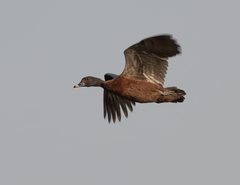
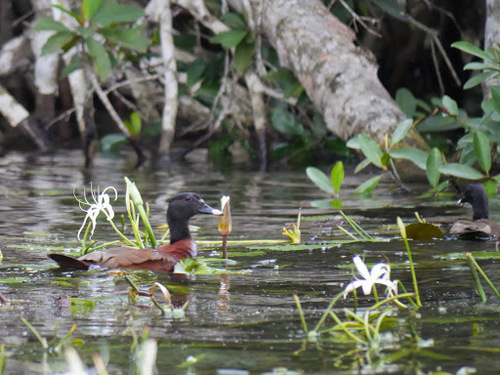
Hartlaub's duck (Pteronetta hartlaubii) is a dark chestnut-coloured duck of African forests. Formerly included in the paraphyletic "perching duck" assemblage, it was later moved to the dabbling duck assemblage. However, it is distinct from the "typical" dabbling ducks, and is placed in the monotypic genus Pteronetta. It is named after the German naturalist Gustav Hartlaub.

Analysis of mtDNA sequences of the cytochrome b and NADH dehydrogenase subunit 2 genes suggests that it belongs into a distinct clade together with the blue-winged goose (Cyanochen cyanoptera), another African species of waterfowl. More recent genetic evidence has confirmed this clade, and further points to their belonging to a larger group of diving ducks, with their closest relatives being a clade containing marbled duck (Marmaronetta angustirostris), white-winged duck (Asarcornis scutulata), and the widespread genera Netta and Aythya; with these, they are next closest to Australian wood duck (Chenonetta jubata) in Australia, blue duck (Hymenolaimus malacorhynchos) in New Zealand, and the pantropical comb ducks (Sarkidiornis).

On average, Hartlaub's ducks range from 56–58 centimetres... Wikipedia →
Global Distribution

Parks Where Found

# Park Country Daily sighting probability
1 Odzala-Kokoua National Park 🇨🇬 Republic of the Congo
~40%
2 Semuliki National Park 🇺🇬 Uganda
~10%

Zoos & Centres Where Found

# Zoo / Centre Country
1 Prague Zoo 🇨🇿 Czechia In captivity
2 Tierpark Berlin 🇩🇪 Germany In captivity
3 Ostrava Zoo 🇨🇿 Czechia In captivity
4 Zoo Pilsen 🇨🇿 Czechia In captivity
5 Oregon Zoo 🇺🇸 United States In captivity
6 Singapore Zoo 🇸🇬 Singapore In captivity
7 Philadelphia Zoo 🇺🇸 United States In captivity
8 Bird Paradise 🇸🇬 Singapore In captivity
9 Rainforest Wild Asia 🇸🇬 Singapore In captivity
10 Rákosův pavilon 🇨🇿 Czechia In captivity
11 Velemlokárium 🇨🇿 Czechia In captivity

Before you go

What are the chances of seeing a Hartlaub's Duck in Semuliki National Park?

With luck

About 10% of wildlife watchers report a Hartlaub's Duck sighting in Semuliki National Park on a given day, based on 33 verified sightings from GBIF citizen-science data from 2019 to 2026. It is the 149th most-seen of the 280 birds we can rate there. Over three days the chance rises to about 20%, and over a week to about 40%, if each day is a fresh chance.

When is the best time to see a Hartlaub's Duck in Semuliki National Park?

February

In that month about 20% of wildlife watchers report a Hartlaub's Duck in Semuliki National Park on a given day, against under 5% in March, May, August and October–December, the lowest months. That is one of Semuliki National Park's driest months, with about 15 mm of rain against 140 mm in May.

What time of day is best to see a Hartlaub's Duck?

Between 7 and 10 am

Across all the parks we cover, that three-hour window holds the most Hartlaub's Duck sightings with a recorded time, and about 8 in 10 of them come between 6 am and 6 pm: it is a daytime animal.

Is Semuliki National Park the best place to see a Hartlaub's Duck?

2nd of 2

Of the 2 parks where we can rate Hartlaub's Duck sightings, Semuliki National Park ranks 2nd at about 10%. The best odds are in Odzala-Kokoua National Park (Republic of the Congo, about 40%).

Where does the Hartlaub's Duck sighting chance come from?

GBIF citizen-science records

It is estimated from how often the Hartlaub's Duck is recorded against all the birds logged in Semuliki National Park (33 verified sightings from 2019 to 2026), calibrated against known sighting rates. Figures are rounded to the nearest 10% because citizen-science data supports honest approximations, not decimals, and months with records from fewer than five people show "—". How it works.

← Back to Semuliki National Park