
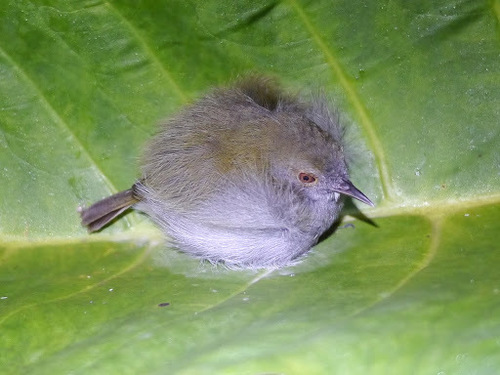
White-chinned Prinia

White-chinned Prinia

Schistolais leucopogon

Silhouette: Sheatherius · PhyloPic

LCLeast ConcernNTVUENCR
Daily sighting probability <5% · Rare
at Semuliki National Park

In 3 days <5% in a week ~10%

6 Verified sightings at Semuliki National Park From 2019 to 2026
1,471 In all 9 parks
January Best month
☀️ Diurnal When it's spotted

About the White-chinned Prinia

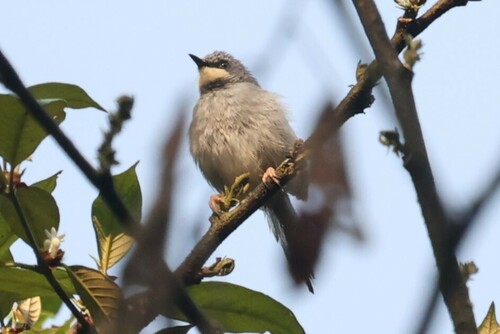
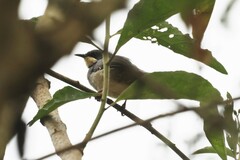
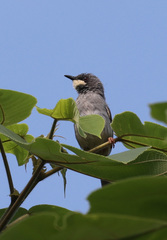
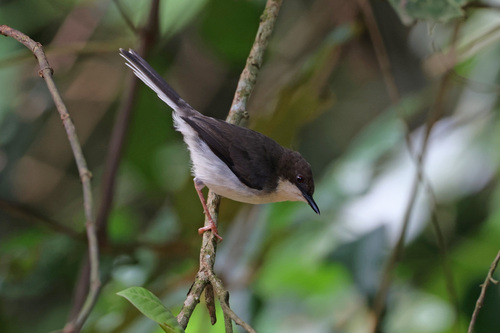
The white-chinned prinia (Schistolais leucopogon), also known as the white-chinned warbler, is a species of bird in the family Cisticolidae. The white-chinned prinia was described by the German ornithologist Jean Cabanis in 1875 and given the binomial name Drymoeca leucopogon. The specific epithet leucopogon is from the Ancient Greek leukos for "white" and pōgōn, "beard".

It is found in the African countries of Angola, Burundi, Cameroon, Central African Republic, Republic of the Congo, Democratic Republic of the Congo, Equatorial Guinea, Gabon, Kenya, Nigeria, Rwanda, South Sudan, Tanzania, Uganda, and Zambia. Its natural habitats are subtropical or tropical dry forest, subtropical or tropical moist lowland forest, subtropical or tropical moist montane forest, and subtropical or tropical moist shrubland. Wikipedia →

Sounds

Recording0:11

Gabon · 2022

© BurBenj · XC1133114 · CC BY-NC-SA 4.0

Call0:32

Burundi · 2025

© Bram Piot · XC972693 · CC BY-NC-SA 4.0

Song0:23

Tanzania · 2023

© isaac kilusu · XC789338 · CC BY-NC-SA 4.0

Global Distribution

Parks Where Found

# Park Country Daily sighting probability
1 Kibale National Park 🇺🇬 Uganda
~40%
2 Bwindi Impenetrable National Park 🇺🇬 Uganda
~30%
3 Nyungwe National Park 🇷🇼 Rwanda
~10%
4 Lake Mburo National Park 🇺🇬 Uganda
<5%
5 Akagera National Park 🇷🇼 Rwanda
<5%
6 Queen Elizabeth National Park 🇺🇬 Uganda
<5%
7 Semuliki National Park 🇺🇬 Uganda
<5%
8 Virunga National Park 🇨🇩 Democratic Republic of the Congo
<5%
9 Volcanoes National Park 🇷🇼 Rwanda
<5%

Cities Where Found

# City Country Daily sighting probability
1 Brazzaville 🇨🇬 Republic of the Congo
~10%
2 Kampala 🇺🇬 Uganda
<5%

Before you go

What are the chances of seeing a White-chinned Prinia in Semuliki National Park?

Rare

Under 5% of wildlife watchers report a White-chinned Prinia sighting in Semuliki National Park on a given day, based on 6 verified sightings from GBIF citizen-science data from 2019 to 2026. It is the 247th most-seen of the 280 birds we can rate there. Over three days the chance rises to under 5%, and over a week to about 10%, if each day is a fresh chance.

When is the best time to see a White-chinned Prinia in Semuliki National Park?

January

In that month about 10% of wildlife watchers report a White-chinned Prinia in Semuliki National Park on a given day, against under 5% in February to December, the lowest months. That is one of Semuliki National Park's driest months, with about 5 mm of rain against 140 mm in May.

What time of day is best to see a White-chinned Prinia?

Between 6 and 9 am

Across all the parks we cover, that three-hour window holds the most White-chinned Prinia sightings with a recorded time, and about 9 in 10 of them come between 6 am and 6 pm: it is a daytime animal.

Where does the White-chinned Prinia sighting chance come from?

GBIF citizen-science records

It is estimated from how often the White-chinned Prinia is recorded against all the birds logged in Semuliki National Park (6 verified sightings from 2019 to 2026), calibrated against known sighting rates. Figures are rounded to the nearest 10% because citizen-science data supports honest approximations, not decimals, and months with records from fewer than five people show "—". How it works.

← Back to Semuliki National Park