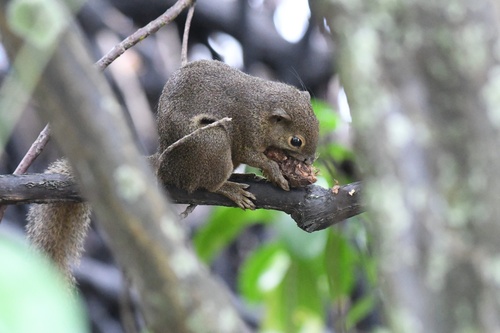
Large Treeshrew

Large Treeshrew

Tupaia tana

Silhouette: Margot Michaud · PhyloPic

LCLeast ConcernNTVUENCR
Daily sighting probability ~10% · With luck
at Sepilok

In 3 days ~40% in a week ~60%

12 Verified sightings at Sepilok From 2019 to 2026
18 In all 2 parks
March Best month
☀️ Diurnal When it's spotted

About the Large Treeshrew

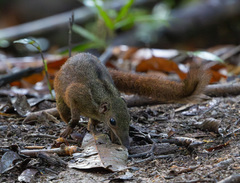
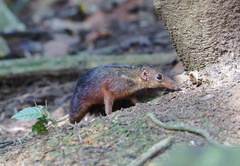
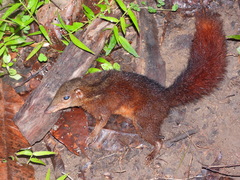
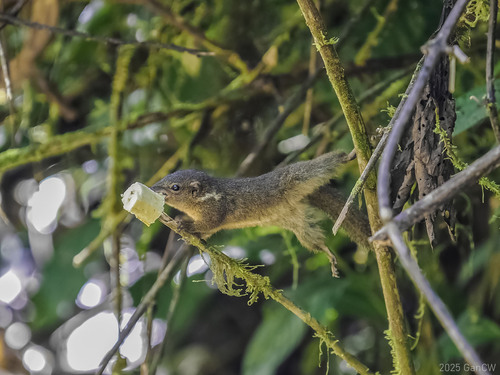
The large treeshrew (Tupaia tana) is a treeshrew species within the Tupaiidae. It is native to Sumatra and adjacent small islands, as well as in the lowlands and hills of Borneo. Large treeshrews are the most predominantly terrestrial of all treeshrew species. They are usually on the forest floor, the primary location for their foraging, although they spend part of their time in trees. T. tana has been described as mainly terrestrial based on field observations and their morphological traits. Large treeshrews are most abundant in primary tropical rainforest, but are also found in swamp forest and secondary growth forest. T. tana has many potential predators such as the marbled cat, leopard, and clouded leopard.

Large treeshrews contribute to the maintenance of their lowland rainforest ecosystem by dispersing seeds. Tupaia tana is slightly larger than the common treeshrew (T. glis). The dorsal fur is reddish brown, shading to nearly black at the rear. There is a black stripe running from the neck half to two-thirds of the way down the back until it disappears in the darker posterior fur.

The body size measurements of this species are: Head and body: 165... Wikipedia →

Global Distribution

Parks Where Found

# Park Country Daily sighting probability
1 Sepilok 🇲🇾 Malaysia
~10%
2 Kinabatangan Wildlife Sanctuary 🇲🇾 Malaysia
~10%

Before you go

What are the chances of seeing a Large Treeshrew in Sepilok?

With luck

About 10% of wildlife watchers report a Large Treeshrew sighting in Sepilok on a given day, based on 12 verified sightings from GBIF citizen-science data from 2019 to 2026. It is the 20th most-seen of the 23 mammals we can rate there. Over three days the chance rises to about 40%, and over a week to about 60%, if each day is a fresh chance.

When is the best time to see a Large Treeshrew in Sepilok?

March, May, August and November

In those months about 20% of wildlife watchers report a Large Treeshrew in Sepilok on a given day, against under 5% in April, October and December–February, the lowest months.

What time of day is best to see a Large Treeshrew?

Between 7 and 10 am

Across all the parks we cover, that three-hour window holds the most Large Treeshrew sightings with a recorded time, and about 8 in 10 of them come between 6 am and 6 pm: it is a daytime animal.

Is Sepilok the best place to see a Large Treeshrew?

Yes

Of the 2 parks where we can rate Large Treeshrew sightings, Sepilok has the highest daily chance: about 10%. Next come Kinabatangan Wildlife Sanctuary (Malaysia, about 10%).

Where does the Large Treeshrew sighting chance come from?

GBIF citizen-science records

It is estimated from how often the Large Treeshrew is recorded against all the mammals logged in Sepilok (12 verified sightings from 2019 to 2026), calibrated against known sighting rates. Figures are rounded to the nearest 10% because citizen-science data supports honest approximations, not decimals, and months with records from fewer than five people show "—". How it works.

← Back to Sepilok