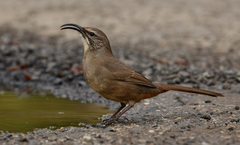
California Thrasher

California Thrasher

Toxostoma redivivum

Silhouette: Sheatherius · PhyloPic

LCLeast ConcernNTVUENCR
Daily sighting probability <5% · Rare
at Sequoia and Kings Canyon National Parks

In 3 days <5% in a week ~10%

28 Verified sightings at Sequoia and Kings Canyon National Parks From 2019 to 2026
438 In all 4 parks
April Best month
☀️ Diurnal When it's spotted

About the California Thrasher

The California thrasher (Toxostoma redivivum) is a large member of family Mimidae found primarily in chaparral habitat in California in the United States and Baja California in Mexico. It is the only species of the genus Toxostoma throughout most of its range.

The California thrasher is closely related to the crissal thrasher (Toxostoma crissale) and LeConte's thrasher (T. lecontei), and the three may form a superspecies. The phylogeography of the California thrasher has been explored through a study analyzing mitochondrial-DNA variation. The distribution of genealogical lineages within the species reflects a complex series of ecological and historical events that have shaped its current geographical distribution. The phylogeographic analysis sheds light on the evolutionary history and the distribution patterns of this bird across its range.

The California thrasher is about 32 cm (13 in) long and weighs up to 90 g (3.2 oz); it is the largest thrasher. It has a distinctive long, decurved beak and a long tail. It is generally deep grayish brown above with olive tones... Wikipedia →

Sounds

Song1:30

United States · 2024

© Ed Pandolfino · XC875436 · CC BY-NC-SA 4.0

Call1:03

United States · 2023

© Matthew L. Brady · XC842727 · CC BY-NC-SA 4.0

Drumming0:24

United States · 2020

© Steve Hampton · XC544576 · CC BY-NC-SA 4.0

Global Distribution

Parks Where Found

# Park Country Daily sighting probability
1 Joshua Tree National Park 🇺🇸 United States
~10%
2 Sequoia and Kings Canyon National Parks 🇺🇸 United States
<5%
3 Channel Islands National Park 🇺🇸 United States
<5%
4 Yosemite National Park 🇺🇸 United States
<5%

Cities Where Found

# City Country Daily sighting probability
1 San Diego 🇺🇸 United States
~10%
2 Los Angeles 🇺🇸 United States
~10%
3 San Francisco 🇺🇸 United States
<5%
4 Sacramento 🇺🇸 United States
<5%

Before you go

What are the chances of seeing a California Thrasher in Sequoia and Kings Canyon National Parks?

Rare

Under 5% of wildlife watchers report a California Thrasher sighting in Sequoia and Kings Canyon National Parks on a given day, based on 28 verified sightings from GBIF citizen-science data from 2019 to 2026. It is the 119th most-seen of the 152 birds we can rate there. Over three days the chance rises to under 5%, and over a week to about 10%, if each day is a fresh chance.

When is the best time to see a California Thrasher in Sequoia and Kings Canyon National Parks?

February and April

In those months about 10% of wildlife watchers report a California Thrasher in Sequoia and Kings Canyon National Parks on a given day, against under 5% in March and May–January, the lowest months.

What time of day is best to see a California Thrasher?

Between 7 and 10 am

Across all the parks we cover, that three-hour window holds the most California Thrasher sightings with a recorded time, and about 9 in 10 of them come between 6 am and 6 pm: it is a daytime animal.

Is Sequoia and Kings Canyon National Parks the best place to see a California Thrasher?

2nd of 4

Of the 4 parks where we can rate California Thrasher sightings, Sequoia and Kings Canyon National Parks ranks 2nd at under 5%. The best odds are in Joshua Tree National Park (United States, about 10%).

Where does the California Thrasher sighting chance come from?

GBIF citizen-science records

It is estimated from how often the California Thrasher is recorded against all the birds logged in Sequoia and Kings Canyon National Parks (28 verified sightings from 2019 to 2026), calibrated against known sighting rates. Figures are rounded to the nearest 10% because citizen-science data supports honest approximations, not decimals, and months with records from fewer than five people show "—". How it works.

← Back to Sequoia and Kings Canyon National Parks