Sooty Grouse

Sooty Grouse

Dendragapus fuliginosus

Silhouette: Sheatherius · PhyloPic

LCLeast ConcernNTVUENCR
Daily sighting probability <5% · Rare
at Sequoia and Kings Canyon National Parks

In 3 days ~10% in a week ~30%

370 Verified sightings at Sequoia and Kings Canyon National Parks From 2019 to 2026
2,538 In all 6 parks
June Best month
☀️ Diurnal When it's spotted

About the Sooty Grouse

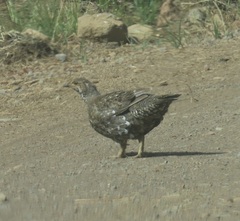
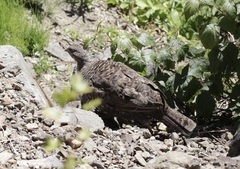
The sooty grouse (Dendragapus fuliginosus) is a species of forest-dwelling grouse native to North America's Pacific Coast Ranges. It is closely related to the dusky grouse (Dendragapus obscurus), and the two were previously considered a single species, the blue grouse.

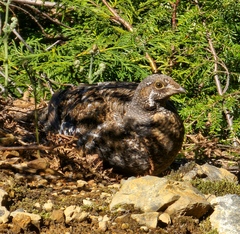
Adults have a long square tail, light gray at the end. Adult males are mainly dark with a yellow throat air sac surrounded by white, and a yellow wattle over the eye during display. Adult females are mottled brown with dark brown and white marks on the underparts. Females have longer skinnier necks than males. The males have stouter bodies than the females. The bird averages 40–50 cm (16–20 in) in length and weighs 750–1,300 g (1.65–2.87 lb).

Their breeding habitat is the edges of conifer and mixed forests in mountainous regions of western North America, from southeastern Alaska and Yukon south to California. Their range is closely associated with that of various conifers. They thrive in old forests because they need diverse plants and trees. Regenerated logged or burned areas also attract the sooty grouse if there are many bushes and shrubs for nesting. The nest is a scrape... Wikipedia →

Sounds

Boom0:35

United States · 2020

© Bruce Lagerquist · XC554612 · CC BY-NC-SA 4.0

Booming hoots0:30

United States · 2008

© Chris Parrish · XC21636 · CC BY-NC-ND 2.5

Song1:12

United States · 2022

© Bobby Wilcox · XC736429 · CC BY-NC-SA 4.0

Global Distribution

Parks Where Found

# Park Country Daily sighting probability
1 Olympic National Park 🇺🇸 United States
~10%
2 Redwood National Park 🇺🇸 United States
~10%
3 Yosemite National Park 🇺🇸 United States
~10%
4 Sequoia and Kings Canyon National Parks 🇺🇸 United States
<5%
5 Great Bear Rainforest 🇨🇦 Canada
<5%
6 Pacific Rim National Park Reserve 🇨🇦 Canada
<5%

Cities Where Found

# City Country Daily sighting probability
1 Vancouver 🇨🇦 Canada
<5%

Zoos & Centres Where Found

# Zoo / Centre Country
1 Bali Bird Park 🇮🇩 Indonesia In captivity

Before you go

What are the chances of seeing a Sooty Grouse in Sequoia and Kings Canyon National Parks?

Rare

Under 5% of wildlife watchers report a Sooty Grouse sighting in Sequoia and Kings Canyon National Parks on a given day, based on 370 verified sightings from GBIF citizen-science data from 2019 to 2026. It is the 95th most-seen of the 152 birds we can rate there. Over three days the chance rises to about 10%, and over a week to about 30%, if each day is a fresh chance.

When is the best time to see a Sooty Grouse in Sequoia and Kings Canyon National Parks?

June to September

In those months about 10% of wildlife watchers report a Sooty Grouse in Sequoia and Kings Canyon National Parks on a given day, against under 5% in October to May, the lowest months. Those are among Sequoia and Kings Canyon National Parks's driest months, with about 20 mm of rain a month against 190 mm in January.

What time of day is best to see a Sooty Grouse?

Between 8 and 11 am

Across all the parks we cover, that three-hour window holds the most Sooty Grouse sightings with a recorded time, and about 8 in 10 of them come between 6 am and 6 pm: it is a daytime animal.

Is Sequoia and Kings Canyon National Parks the best place to see a Sooty Grouse?

4th of 6

Of the 6 parks where we can rate Sooty Grouse sightings, Sequoia and Kings Canyon National Parks ranks 4th at under 5%. The best odds are in Olympic National Park (United States, about 10%), Redwood National Park (United States, about 10%) and Yosemite National Park (United States, about 10%).

Where does the Sooty Grouse sighting chance come from?

GBIF citizen-science records

It is estimated from how often the Sooty Grouse is recorded against all the birds logged in Sequoia and Kings Canyon National Parks (370 verified sightings from 2019 to 2026), calibrated against known sighting rates. Figures are rounded to the nearest 10% because citizen-science data supports honest approximations, not decimals, and months with records from fewer than five people show "—". How it works.

← Back to Sequoia and Kings Canyon National Parks