Mountain Quail

Mountain Quail

Oreortyx pictus

Silhouette: Gabriela Palomo-Munoz · PhyloPic

LCLeast ConcernNTVUENCR
Daily sighting probability ~20% · Possible
at Sequoia and Kings Canyon National Parks

In 3 days ~40% in a week ~70%

383 Verified sightings at Sequoia and Kings Canyon National Parks From 2019 to 2026
1,207 In all 5 parks
May Best month
☀️ Diurnal When it's spotted

About the Mountain Quail

The mountain quail (Oreortyx pictus) is a small ground-dwelling bird in the New World quail family. This species is the only one in the genus Oreortyx, which is sometimes included in Callipepla. This is not appropriate, however, as the mountain quail's ancestors diverged from other New World quails earlier than the bobwhites, no later than 6 mya.

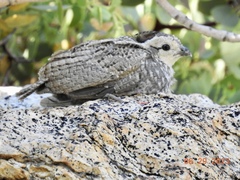
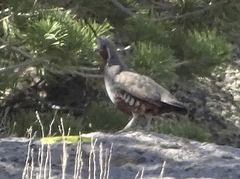
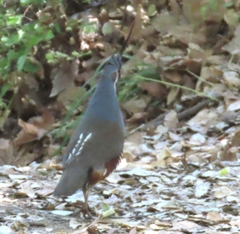
The bird's average length is 26–28 cm (10–11 in), with a wingspan of 35–40 cm (14–16 in). They have relatively short, rounded wings and long, featherless legs. These birds are easily recognized by their topknots, which are shorter in the female and change color with the seasons and geographic location of particular populations. They have a brown face, gray breast, brown back and primaries, and heavily white barred underside. Females display greater brown coloring on their dorsal side, a paler red on their undersides, and wider white barring on the flank than their male counterparts. Mountain quails lose the multi-color primary coverts on their wings as they age, and by 15 months old will only have solid-colored coverts.

There are five recognized subspecies: It inhabits mountainous... Wikipedia →

Sounds

Song1:28

United States · 2024

© Ed Pandolfino · XC906442 · CC BY-NC-SA 4.0

Alarm call0:32

United States · 2021

© Diana Doyle · XC663677 · CC BY-SA 4.0

Call0:41

United States · 2018

© Lance A. M. Benner · XC446526 · CC BY-NC-SA 4.0

Global Distribution

Parks Where Found

# Park Country Daily sighting probability
1 Yosemite National Park 🇺🇸 United States
~20%
2 Sequoia and Kings Canyon National Parks 🇺🇸 United States
~20%
3 Death Valley National Park 🇺🇸 United States
<5%
4 Joshua Tree National Park 🇺🇸 United States
<5%
5 Redwood National Park 🇺🇸 United States
<5%

Cities Where Found

# City Country Daily sighting probability
1 Los Angeles 🇺🇸 United States
<5%

Before you go

What are the chances of seeing a Mountain Quail in Sequoia and Kings Canyon National Parks?

Possible

About 20% of wildlife watchers report a Mountain Quail sighting in Sequoia and Kings Canyon National Parks on a given day, based on 383 verified sightings from GBIF citizen-science data from 2019 to 2026. It is the 44th most-seen of the 152 birds we can rate there. Over three days the chance rises to about 40%, and over a week to about 70%, if each day is a fresh chance.

When is the best time to see a Mountain Quail in Sequoia and Kings Canyon National Parks?

May and June

In those months about 30% of wildlife watchers report a Mountain Quail in Sequoia and Kings Canyon National Parks on a given day, against under 5% in January–March and November, the lowest months. Those are among Sequoia and Kings Canyon National Parks's driest months, with about 40 mm of rain a month against 190 mm in January.

What time of day is best to see a Mountain Quail?

Between 9 am and noon

Across all the parks we cover, that three-hour window holds the most Mountain Quail sightings with a recorded time, and about 8 in 10 of them come between 6 am and 6 pm: it is a daytime animal.

Is Sequoia and Kings Canyon National Parks the best place to see a Mountain Quail?

Among the best

Of the 5 parks where we can rate Mountain Quail sightings, Sequoia and Kings Canyon National Parks ranks 2nd at about 20%, level with the leaders once rounded. The best odds are in Yosemite National Park (United States, about 20%).

Where does the Mountain Quail sighting chance come from?

GBIF citizen-science records

It is estimated from how often the Mountain Quail is recorded against all the birds logged in Sequoia and Kings Canyon National Parks (383 verified sightings from 2019 to 2026), calibrated against known sighting rates. Figures are rounded to the nearest 10% because citizen-science data supports honest approximations, not decimals, and months with records from fewer than five people show "—". How it works.

← Back to Sequoia and Kings Canyon National Parks