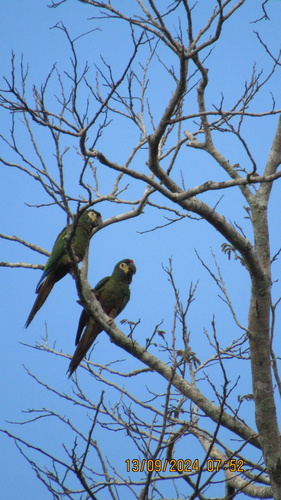
Plain Parakeet

Plain Parakeet

Brotogeris tirica

Silhouette: Myriam Ramirez · PhyloPic

LCLeast ConcernNTVUENCR Endemic
Daily sighting probability ~70% · Very likely
at Serra dos Órgãos National Park

In 3 days >90%

479 Verified sightings at Serra dos Órgãos National Park From 2019 to 2026
2,943 In all 3 parks
April Best month
☀️ Diurnal When it's spotted

About the Plain Parakeet

The plain parakeet (Brotogeris tirica) is a species of bird in subfamily Arinae of the family Psittacidae, the African and New World parrots. It is endemic to Brazil. The plain parakeet was formally described in 1788 by the German naturalist Johann Friedrich Gmelin in his revised and expanded edition of Carl Linnaeus's Systema Naturae. He placed it with all the other parrots in the genus Psittacus and coined the binomial name Psittacus tirica. The type locality was subsequently designated as Brazil. The plain parakeet is now placed with seven other parakeets in genus Brotogeris that was introduced in 1825 by Irish zoologist Nicholas Aylward Vigors. The genus name is from the Ancient Greek brotogērus meaning "with human voice". The specific epithet tirica is from the Tupi language tiriba meaning "tinkling". The word was used for a parakeet. The species is monotypic: no subspecies are recognized.

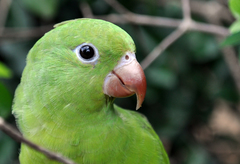
The plain parakeet is 23 to 25 cm (9.1 to 9.8 in) long and weighs about 63 g (2.2 oz). Adults have an essentially all green body, though their nape has a bluish tinge and their undersides have a yellowish one. Their shoulder is bronzy or brownish... Wikipedia →

Sounds

Call0:09

Brazil · 2026

© JAYRSON ARAUJO DE OLIVEIRA · XC1136275 · CC BY-NC-SA 4.0

Song0:16

Brazil · 2022

© Ricardo José Mitidieri · XC729638 · CC BY-NC-SA 4.0

Flight call0:16

Brazil · 2013

© Odirlei Vieira da Fonseca · XC668735 · CC BY-NC-SA 4.0

Global Distribution

Parks Where Found

# Park Country Daily sighting probability
1 Serra dos Órgãos National Park 🇧🇷 Brazil
~70%
2 Tijuca National Park 🇧🇷 Brazil
~60%
3 Itatiaia National Park 🇧🇷 Brazil
~30%

Cities Where Found

# City Country Daily sighting probability
1 São Paulo 🇧🇷 Brazil
~80%
2 Curitiba 🇧🇷 Brazil
~70%
3 Salvador 🇧🇷 Brazil
~70%
4 Santos 🇧🇷 Brazil
~50%
5 Rio de Janeiro 🇧🇷 Brazil
~50%
6 Campinas 🇧🇷 Brazil
~10%
7 Niterói 🇧🇷 Brazil
<5%
8 Belo Horizonte 🇧🇷 Brazil
<5%

Zoos & Centres Where Found

# Zoo / Centre Country
1 Parque das Aves 🇧🇷 Brazil In captivity
2 São Paulo Zoo 🇧🇷 Brazil In captivity
3 Loro Parque 🇪🇸 Spain In captivity
4 Acqua Mundo 🇧🇷 Brazil In captivity

Before you go

What are the chances of seeing a Plain Parakeet in Serra dos Órgãos National Park?

Very likely

About 70% of wildlife watchers report a Plain Parakeet sighting in Serra dos Órgãos National Park on a given day, based on 479 verified sightings from GBIF citizen-science data from 2019 to 2026. It is the 4th most-seen of the 336 birds we can rate there. Over three days the chance rises to over 90%, if each day is a fresh chance.

When is the best time to see a Plain Parakeet in Serra dos Órgãos National Park?

January, April–May and July

In those months about 80% of wildlife watchers report a Plain Parakeet in Serra dos Órgãos National Park on a given day, against about 50% in November, the lowest month.

What time of day is best to see a Plain Parakeet?

Between 8 and 11 am

Across all the parks we cover, that three-hour window holds the most Plain Parakeet sightings with a recorded time, and about 9 in 10 of them come between 6 am and 6 pm: it is a daytime animal.

Is Serra dos Órgãos National Park the best place to see a Plain Parakeet?

Yes

Of the 3 parks where we can rate Plain Parakeet sightings, Serra dos Órgãos National Park has the highest daily chance: about 70%. Next come Tijuca National Park (Brazil, about 60%) and Itatiaia National Park (Brazil, about 30%).

Where does the Plain Parakeet sighting chance come from?

GBIF citizen-science records

It is estimated from how often the Plain Parakeet is recorded against all the birds logged in Serra dos Órgãos National Park (479 verified sightings from 2019 to 2026), calibrated against known sighting rates. Figures are rounded to the nearest 10% because citizen-science data supports honest approximations, not decimals, and months with records from fewer than five people show "—". How it works.

← Back to Serra dos Órgãos National Park