Eastern Mole

Eastern Mole

Scalopus aquaticus

Silhouette: T. Michael Keesey · PhyloPic

LCLeast ConcernNTVUENCR
Daily sighting probability ~10% · With luck
at Shenandoah National Park

In 3 days ~20% in a week ~40%

5 Verified sightings at Shenandoah National Park From 2019 to 2026
17 In all 2 parks
December Best month
☀️ Diurnal When it's spotted

About the Eastern Mole

The eastern mole or common mole (Scalopus aquaticus) is a medium-sized North American mole. It is the only species in the genus Scalopus. It is found in forested and open areas with moist sandy soils in northern Mexico, the eastern United States and the southwestern corner of Ontario in Canada.

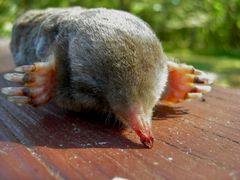
The eastern mole has grey-brown fur with silver-grey underparts, a pointed nose and a short tail. It is about 16 centimetres (6.3 in) in length including a 3 centimetres (1.2 in) long tail and weighs about 75 grams (2.6 oz). Its front paws are broad and spade-shaped, specialized for digging. It has 36 teeth. Its eyes are covered by fur and its ears are not visible.

The eastern mole spends most of its time underground, foraging in shallow burrows. It feeds on earthworms, grubs, beetles, insect larvae, and plant matter. The mole is mainly solitary except during mating in early spring. The female has a litter of two to five young in a deep burrow.

In Canada, the eastern mole is limited to about 2,600 acres in southern Ontario, primarily in Essex and Kent Counties. It prefers soft, sandy, or muddy soils and avoids clay or gravel, making its suitable habitat limited. Wikipedia →

Global Distribution

Parks Where Found

# Park Country Daily sighting probability
1 Point Pelee National Park 🇨🇦 Canada
~10%
2 Shenandoah National Park 🇺🇸 United States
~10%

Cities Where Found

# City Country Daily sighting probability
1 Orlando 🇺🇸 United States
<5%
2 Washington 🇺🇸 United States
<5%
3 Minneapolis [Saint Paul] 🇺🇸 United States
<5%
4 Miami 🇺🇸 United States
<5%
5 Chicago 🇺🇸 United States
<5%
6 Houston 🇺🇸 United States
<5%
7 New York City 🇺🇸 United States
<5%

Before you go

What are the chances of seeing an Eastern Mole in Shenandoah National Park?

With luck

About 10% of wildlife watchers report an Eastern Mole sighting in Shenandoah National Park on a given day, based on 5 verified sightings from GBIF citizen-science data from 2019 to 2026. It is the 17th most-seen of the 17 mammals we can rate there. Over three days the chance rises to about 20%, and over a week to about 40%, if each day is a fresh chance.

When is the best time to see an Eastern Mole in Shenandoah National Park?

December

In that month about 20% of wildlife watchers report an Eastern Mole in Shenandoah National Park on a given day, against under 5% in January–May, August and October–November, the lowest months.

What time of day is best to see an Eastern Mole?

Between 11 am and 2 pm

Across all the parks we cover, that three-hour window holds the most Eastern Mole sightings with a recorded time, and about 9 in 10 of them come between 6 am and 6 pm: it is a daytime animal.

Is Shenandoah National Park the best place to see an Eastern Mole?

Among the best

Of the 2 parks where we can rate Eastern Mole sightings, Shenandoah National Park ranks 2nd at about 10%, level with the leaders once rounded. The best odds are in Point Pelee National Park (Canada, about 10%).

Where does the Eastern Mole sighting chance come from?

GBIF citizen-science records

It is estimated from how often the Eastern Mole is recorded against all the mammals logged in Shenandoah National Park (5 verified sightings from 2019 to 2026), calibrated against known sighting rates. Figures are rounded to the nearest 10% because citizen-science data supports honest approximations, not decimals, and months with records from fewer than five people show "—". How it works.

← Back to Shenandoah National Park