

Roundneck Sexton Beetle

Roundneck Sexton Beetle

Nicrophorus orbicollis

Daily sighting probability ~10% · With luck
at Shenandoah National Park

In 3 days ~10% in a week ~30%

8 Verified sightings at Shenandoah National Park From 2019 to 2026
39 In all 3 parks
August Best month
🌙 Nocturnal When it's spotted

About the Roundneck Sexton Beetle

Nicrophorus orbicollis is a nearctic burying beetle first described by Thomas Say in 1825. It is a member of the genus Nicrophorus or sexton beetles, comprising the most common beetles in the family Silphidae. This species is a decomposer feeding on carcasses of small dead animals. N. orbicollis can be used for scientific research both medically and forensically (if the beetle is present in the area).

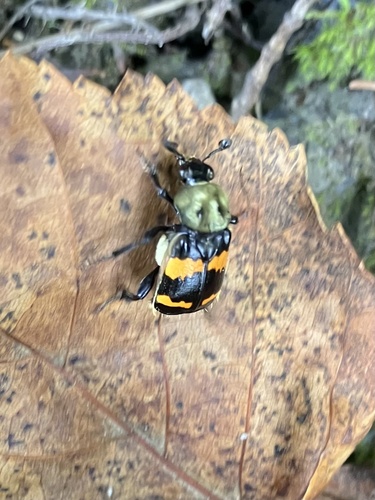
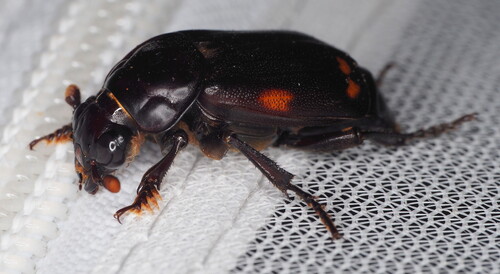
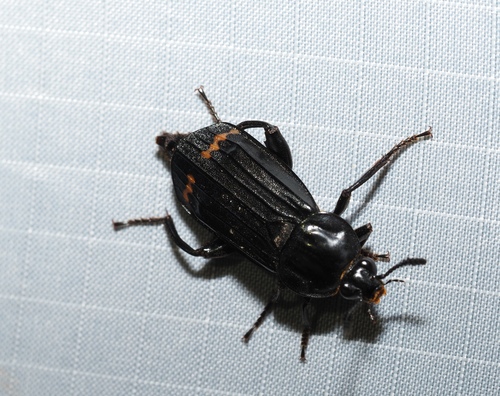
Nicrophorus orbicollis is immediately recognized by its colorful orange markings on its elytra. The dorsal surface of the elytra is covered in long, fine setae, especially laterally, giving it a hairy appearance. The pronotum is spherical with wide lateral and basal margins. Its most distinctive feature from other Silphidae is its clubbed antennae with three orange apical segments and a black base. The posterior lobe of the metepimeron has a few brown hairs and the hind tibia is straight. The adult form is moderately sized at about 15–22 mm (0.59–0.87 in) long. N. orbicollis is known to be a saprophagous feeder. The adults feed on protein from smaller decomposing carcasses as well as supply these nutrients to their larvae.

Larval N.orbicollis... Wikipedia →

Global Distribution

Parks Where Found

# Park Country Daily sighting probability
1 Great Smoky Mountains National Park 🇺🇸 United States
~10%
2 Acadia National Park 🇺🇸 United States
~10%
3 Shenandoah National Park 🇺🇸 United States
~10%

Cities Where Found

# City Country Daily sighting probability
1 Washington 🇺🇸 United States
<5%
2 Montreal 🇨🇦 Canada
<5%
3 Toronto 🇨🇦 Canada
<5%
4 New York City 🇺🇸 United States
<5%

Before you go

What are the chances of seeing a Roundneck Sexton Beetle in Shenandoah National Park?

With luck

About 10% of wildlife watchers report a Roundneck Sexton Beetle sighting in Shenandoah National Park on a given day, based on 8 verified sightings from GBIF citizen-science data from 2019 to 2026. It is the 447th most-seen of the 723 insects we can rate there. Over three days the chance rises to about 10%, and over a week to about 30%, if each day is a fresh chance.

When is the best time to see a Roundneck Sexton Beetle in Shenandoah National Park?

May–June and August

In those months about 10% of wildlife watchers report a Roundneck Sexton Beetle in Shenandoah National Park on a given day, against under 5% in July and September–April, the lowest months.

What time of day is best to see a Roundneck Sexton Beetle?

Between 9 pm and midnight

Across all the parks we cover, that three-hour window holds the most Roundneck Sexton Beetle sightings with a recorded time, and about 7 in 10 of them come between 6 pm and 6 am: it is mostly seen at night.

Is Shenandoah National Park the best place to see a Roundneck Sexton Beetle?

Among the best

Of the 3 parks where we can rate Roundneck Sexton Beetle sightings, Shenandoah National Park ranks 3rd at about 10%, level with the leaders once rounded. The best odds are in Great Smoky Mountains National Park (United States, about 10%) and Acadia National Park (United States, about 10%).

Where does the Roundneck Sexton Beetle sighting chance come from?

GBIF citizen-science records

It is estimated from how often the Roundneck Sexton Beetle is recorded against all the insects logged in Shenandoah National Park (8 verified sightings from 2019 to 2026), calibrated against known sighting rates. Figures are rounded to the nearest 10% because citizen-science data supports honest approximations, not decimals, and months with records from fewer than five people show "—". How it works.

← Back to Shenandoah National Park