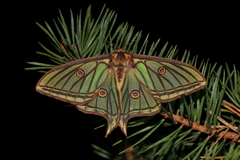
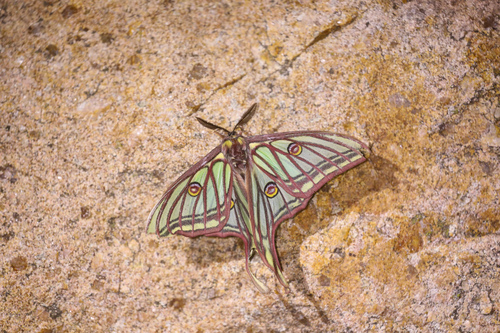
Spanish Moon Moth

Spanish Moon Moth

Graellsia isabellae

Daily sighting probability ~10% · With luck
at Sierra de Guadarrama National Park

In 3 days ~30% in a week ~50%

77 Verified sightings at Sierra de Guadarrama National Park From 2019 to 2026
173 In all 2 parks
May Best month
☀️🌙 Day & Night When it's spotted

About the Spanish Moon Moth

Graellsia isabellae, the Spanish moon moth, is in the silkmoth family Saturniidae. It is the only species in the monotypic genus Graellsia. The species was first described by Mariano de la Paz Graells y de la Agüera in 1849 and the genus was erected by Augustus Radcliffe Grote in 1896.

This moth is native to Peninsular Spain and France. They live high up in the Pyrenees and other mountain ranges where the climate is cold. Early papers (1920s-1970s) suggested the French Graellsia isabellae colonies might stem from collectors’ releases, because the species had long been thought Iberian-only. Subsequent field work uncovered relict populations in the Alps and eastern Pyrenees, and a 2016 phylogeographic study showed their DNA matches ancient Iberian lineages. Today the consensus is that French populations are natural post-glacial relics, not results of human introductions. On the contrary, in Switzerland this species is not native but has been illegally introduced in the end of the 1980s.

They are relics originating from the Ice age or beyond as it is thought that their habitat is a refuge location. This means that for the past few millions of years, while the climate of Europe... Wikipedia →

Global Distribution

Parks Where Found

# Park Country Daily sighting probability
1 Sierra de Guadarrama National Park 🇪🇸 Spain
~10%
2 Pyrénées National Park 🇫🇷 France
~10%

Before you go

What are the chances of seeing a Spanish Moon Moth in Sierra de Guadarrama National Park?

With luck

About 10% of wildlife watchers report a Spanish Moon Moth sighting in Sierra de Guadarrama National Park on a given day, based on 77 verified sightings from GBIF citizen-science data from 2019 to 2026. It is the 88th most-seen of the 597 insects we can rate there. Over three days the chance rises to about 30%, and over a week to about 50%, if each day is a fresh chance.

When is the best time to see a Spanish Moon Moth in Sierra de Guadarrama National Park?

May and June

In those months about 20% of wildlife watchers report a Spanish Moon Moth in Sierra de Guadarrama National Park on a given day, against under 5% in August to February, the lowest months.

What time of day is best to see a Spanish Moon Moth?

Between 10 pm and 1 am

Across all the parks we cover, that three-hour window holds the most Spanish Moon Moth sightings with a recorded time, and about 6 in 10 of them come between 6 pm and 6 am: it is seen both by day and at night.

Is Sierra de Guadarrama National Park the best place to see a Spanish Moon Moth?

Yes

Of the 2 parks where we can rate Spanish Moon Moth sightings, Sierra de Guadarrama National Park has the highest daily chance: about 10%. Next come Pyrénées National Park (France, about 10%).

Where does the Spanish Moon Moth sighting chance come from?

GBIF citizen-science records

It is estimated from how often the Spanish Moon Moth is recorded against all the insects logged in Sierra de Guadarrama National Park (77 verified sightings from 2019 to 2026), calibrated against known sighting rates. Figures are rounded to the nearest 10% because citizen-science data supports honest approximations, not decimals, and months with records from fewer than five people show "—". How it works.

← Back to Sierra de Guadarrama National Park