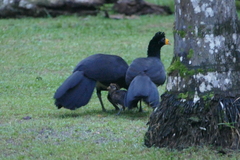
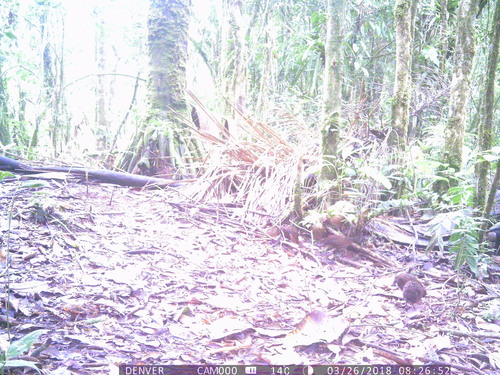
Black Curassow

Black Curassow

Crax alector

Silhouette: J. N. Wiegers · PhyloPic

LCLeast ConcernNTVUENCR
Daily sighting probability <5% · Rare
at Sierra de la Macarena National Park

In 3 days <5% in a week ~10%

9 Verified sightings at Sierra de la Macarena National Park From 2019 to 2026
56 In all 2 parks
March Best month
☀️ Diurnal When it's spotted

About the Black Curassow

The black curassow (Crax alector), also known as the smooth-billed curassow and the crested curassow, is a species of bird in the family Cracidae, the chachalacas, guans, and curassows. It is found in humid forests in northern South America in Colombia, Venezuela, the Guianas including Suriname, and far northern Brazil, and is introduced to Bahamas, Cuba, Jamaica, Haiti, Dominican Republic, Puerto Rico and Lesser Antilles. It is the only Crax curassow where the male and female cannot be separated by plumage, as both are essentially black with a white crissum (the area around the cloaca), and have a yellow (eastern part of its range) or orange-red (western part of its range) cere.

The black curassow is a large bird reaching about 900 millimetres (35 in) in length. The male has black upper parts glossed with a purplish sheen and an inconspicuous black crest. The skin at the base of the grey beak is yellow... Wikipedia →

Sounds

Call0:50

Brazil · 2024

© JAYRSON ARAUJO DE OLIVEIRA · XC939570 · CC BY-NC-SA 4.0

Alarm call0:42

Brazil · 2020

© Felipe Arantes · XC599587 · CC BY-NC-SA 4.0

?0:47

Guyana · 2010

© Alexandre Renaudier · XC66195 · CC BY-NC-ND 2.5

Global Distribution

Parks Where Found

# Park Country Daily sighting probability
1 Brownsberg Nature Park 🇸🇷 Suriname
~20%
2 Sierra de la Macarena National Park 🇨🇴 Colombia
<5%

Zoos & Centres Where Found

# Zoo / Centre Country
1 Curitiba Zoo 🇧🇷 Brazil In captivity
2 Shanghai Zoo 🇨🇳 China In captivity
3 江苏淹城野生动物世界 🇨🇳 China In captivity
4 Wilhelma 🇩🇪 Germany In captivity
5 Green World Ecological Farm 🇹🇼 Taiwan In captivity
6 Rio de Janeiro Zoological Garden 🇧🇷 Brazil In captivity
7 Buin Zoo 🇨🇱 Chile In captivity
8 Guyana Zoo 🇬🇾 Guyana In captivity

Before you go

What are the chances of seeing a Black Curassow in Sierra de la Macarena National Park?

Rare

Under 5% of wildlife watchers report a Black Curassow sighting in Sierra de la Macarena National Park on a given day, based on 9 verified sightings from GBIF citizen-science data from 2019 to 2026. It is the 362nd most-seen of the 418 birds we can rate there. Over three days the chance rises to under 5%, and over a week to about 10%, if each day is a fresh chance.

When is the best time to see a Black Curassow in Sierra de la Macarena National Park?

March

In that month about 10% of wildlife watchers report a Black Curassow in Sierra de la Macarena National Park on a given day, against under 5% in April to February, the lowest months.

What time of day is best to see a Black Curassow?

Between 3 and 6 pm

Across all the parks we cover, that three-hour window holds the most Black Curassow sightings with a recorded time, and about 8 in 10 of them come between 6 am and 6 pm: it is a daytime animal.

Is Sierra de la Macarena National Park the best place to see a Black Curassow?

2nd of 2

Of the 2 parks where we can rate Black Curassow sightings, Sierra de la Macarena National Park ranks 2nd at under 5%. The best odds are in Brownsberg Nature Park (Suriname, about 20%).

Which relatives of the Black Curassow live in Sierra de la Macarena National Park?

Same family: Cracidae

The closest relatives of the Black Curassow that you can see in Sierra de la Macarena National Park (family Cracidae, Guans, Chachalacas, and Curassows) are Speckled Chachalaca (about 30%) and Spix's Guan (about 20%), with each one's daily chance of a sighting.

Where does the Black Curassow sighting chance come from?

GBIF citizen-science records

It is estimated from how often the Black Curassow is recorded against all the birds logged in Sierra de la Macarena National Park (9 verified sightings from 2019 to 2026), calibrated against known sighting rates. Figures are rounded to the nearest 10% because citizen-science data supports honest approximations, not decimals, and months with records from fewer than five people show "—". How it works.

← Back to Sierra de la Macarena National Park