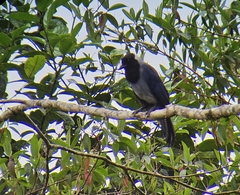
Violaceous Jay

Violaceous Jay

Cyanocorax violaceus

Silhouette: Sheatherius · PhyloPic

LCLeast ConcernNTVUENCR
Daily sighting probability ~70% · Very likely
at Sierra de la Macarena National Park

In 3 days >90%

1,144 Verified sightings at Sierra de la Macarena National Park From 2019 to 2026
5,766 In all 8 parks
May Best month
☀️ Diurnal When it's spotted

About the Violaceous Jay

The violaceous jay (Cyanocorax violaceus) is a species of bird in the family Corvidae, the crows and jays. It is found in Bolivia, Brazil, Colombia, Ecuador, Peru, Venezuela, and possibly Guyana. The violaceous jay was originally described in 1847 as Cyanocorax violaceus, its current binomial.

The violaceus jay is 33 to 37 cm (13 to 15 in) long and weighs about 260 g (9.2 oz). The sexes have similar plumage. Adult males of the nominate subspecies have a blackish forecrown and a blackish or dark sepia crown and sides of the head and neck. Their nape is pale bluish white that becomes pale blue at the base of the nape. Their upper back is pale violaceous blue and the rest of their upperparts a darker violaceous blue. Their primaries are blackish with violaceous blue on their outer edges. Their tail is indigo-blue. Their throat and upper breast are the same blackish or dark sepia as the sides of the head, and the rest of their underparts are violaceous blue. The undersides of their wings and tail have a blackish... Wikipedia →

Sounds

Call0:18

Brazil · 2026

© JAYRSON ARAUJO DE OLIVEIRA · XC1186227 · CC BY-NC-SA 4.0

Song1:04

Ecuador · 2025

© Marc Anderson · XC995776 · CC BY-NC-ND 4.0

Alarm call0:22

Brazil · 2022

© Ricardo Gagliardi · XC837028 · CC BY-NC-SA 4.0

Global Distribution

Parks Where Found

# Park Country Daily sighting probability
1 Sierra de la Macarena National Park 🇨🇴 Colombia
~70%
2 Yasuní National Park 🇪🇨 Ecuador
~50%
3 Manu National Park 🇵🇪 Peru
~40%
4 Cuyabeno Wildlife Reserve 🇪🇨 Ecuador
~30%
5 Tambopata National Reserve 🇵🇪 Peru
~30%
6 Podocarpus National Park 🇪🇨 Ecuador
<5%
7 Chingaza National Natural Park 🇨🇴 Colombia
<5%
8 Amacayacu National Natural Park 🇨🇴 Colombia
<5%

Zoos & Centres Where Found

# Zoo / Centre Country
1 Aviario Nacional de Colombia 🇨🇴 Colombia In captivity

Before you go

What are the chances of seeing a Violaceous Jay in Sierra de la Macarena National Park?

Very likely

About 70% of wildlife watchers report a Violaceous Jay sighting in Sierra de la Macarena National Park on a given day, based on 1,144 verified sightings from GBIF citizen-science data from 2019 to 2026. It is the most-seen of the 418 birds we can rate there. Over three days the chance rises to over 90%, if each day is a fresh chance.

When is the best time to see a Violaceous Jay in Sierra de la Macarena National Park?

May, August and December

In those months about 80% of wildlife watchers report a Violaceous Jay in Sierra de la Macarena National Park on a given day, against about 50% in April, the lowest month.

What time of day is best to see a Violaceous Jay?

Between 6 and 9 am

Across all the parks we cover, that three-hour window holds the most Violaceous Jay sightings with a recorded time, and about 9 in 10 of them come between 6 am and 6 pm: it is a daytime animal.

Is Sierra de la Macarena National Park the best place to see a Violaceous Jay?

Yes

Of the 8 parks where we can rate Violaceous Jay sightings, Sierra de la Macarena National Park has the highest daily chance: about 70%. Next come Yasuní National Park (Ecuador, about 50%) and Manu National Park (Peru, about 40%). All parks ranked.

Which relatives of the Violaceous Jay live in Sierra de la Macarena National Park?

Same order: Passeriformes

The closest relatives of the Violaceous Jay that you can see in Sierra de la Macarena National Park (order Passeriformes, Perching Birds) are Tropical Kingbird (about 60%), Palm Tanager (about 50%) and Crested Oropendola (about 40%), with each one's daily chance of a sighting.

Where does the Violaceous Jay sighting chance come from?

GBIF citizen-science records

It is estimated from how often the Violaceous Jay is recorded against all the birds logged in Sierra de la Macarena National Park (1,144 verified sightings from 2019 to 2026), calibrated against known sighting rates. Figures are rounded to the nearest 10% because citizen-science data supports honest approximations, not decimals, and months with records from fewer than five people show "—". How it works.

← Back to Sierra de la Macarena National Park