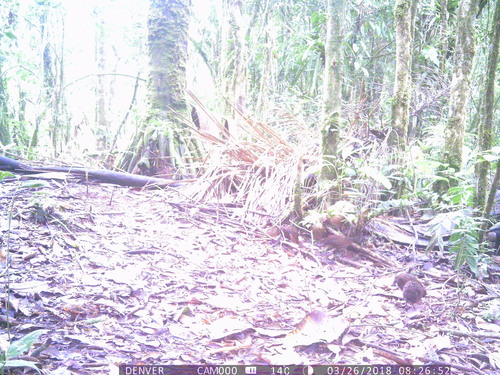
Spix's Guan

Spix's Guan

Penelope jacquacu

Silhouette: Sheatherius · PhyloPic

LCLeast ConcernNTVUENCR
Daily sighting probability ~20% · Possible
at Sierra de la Macarena National Park

In 3 days ~40% in a week ~70%

140 Verified sightings at Sierra de la Macarena National Park From 2019 to 2026
3,250 In all 7 parks
January Best month
☀️ Diurnal When it's spotted

About the Spix's Guan

Spix's guan (Penelope jacquacu) is a species of bird in the family Cracidae. It is "the prototypical cracid of the Amazonian lowlands." The common name commemorates the German naturalist Johann Baptist von Spix (1782-1826).

It was at times considered conspecific with dusky-legged guan (P. obscura) or crested guan (P. purpurascens). P. j. speciosa was once considered a race of dusky-legged guan, and "Grant's guan" was formerly considered a separate species.

The four subspecies of Spix's guan differ in weight and plumage, and there are intergrades between them. Their length is 66–76 cm (26–30 in). The male and female nominate P. j. jacquacu weigh 1.24–1.36 kg (2.7–3.0 lb) and 1.14 kg (2.5 lb) respectively. The male P. j. orienticola weighs 1.40–1.78 kg (3.1–3.9 lb) and the female 1.27–1.72 kg (2.8–3.8 lb). The nominate subspecies is bronzy olive green above and bright reddish below. "Grant's" is much darker; the upper parts have a blue-green gloss and the red underside is dark... Wikipedia →

Sounds

Dusk song0:41

Ecuador · 2026

© Manuel Sánchez-Nivicela · XC1182842 · CC BY-NC-ND 4.0

Call0:14

Ecuador · 2026

© Daan van der Hoeven · XC1155241 · CC BY-NC-SA 4.0

Wing rattle0:08

Ecuador · 2025

© Marc Anderson · XC986580 · CC BY-NC-ND 4.0

Global Distribution

Parks Where Found

# Park Country Daily sighting probability
1 Manu National Park 🇵🇪 Peru
~30%
2 Yasuní National Park 🇪🇨 Ecuador
~20%
3 Tambopata National Reserve 🇵🇪 Peru
~20%
4 Cuyabeno Wildlife Reserve 🇪🇨 Ecuador
~20%
5 Sierra de la Macarena National Park 🇨🇴 Colombia
~20%
6 Amacayacu National Natural Park 🇨🇴 Colombia
~10%
7 Amboró National Park 🇧🇴 Bolivia
<5%

Zoos & Centres Where Found

# Zoo / Centre Country
1 Zoo Pilsen 🇨🇿 Czechia In captivity
2 Bioparque Municipal Vesty Pakos 🇧🇴 Bolivia In captivity
3 Zoológico de Fauna Sudamericana 🇧🇴 Bolivia In captivity
4 Agroflori Parque de las Aves 🇧🇴 Bolivia In captivity
5 Zoológico do Acre 🇧🇷 Brazil In captivity
6 Amazon Rescue Center 🇵🇪 Peru In captivity
7 Wiwa Quito 🇪🇨 Ecuador In captivity

Before you go

What are the chances of seeing a Spix's Guan in Sierra de la Macarena National Park?

Possible

About 20% of wildlife watchers report a Spix's Guan sighting in Sierra de la Macarena National Park on a given day, based on 140 verified sightings from GBIF citizen-science data from 2019 to 2026. It is the 73rd most-seen of the 418 birds we can rate there. Over three days the chance rises to about 40%, and over a week to about 70%, if each day is a fresh chance.

When is the best time to see a Spix's Guan in Sierra de la Macarena National Park?

January

In that month about 40% of wildlife watchers report a Spix's Guan in Sierra de la Macarena National Park on a given day, against about 10% in May, July–August and October–December, the lowest months. That is one of Sierra de la Macarena National Park's driest months, with about 95 mm of rain against 430 mm in May.

What time of day is best to see a Spix's Guan?

Between 6 and 9 am

Across all the parks we cover, that three-hour window holds the most Spix's Guan sightings with a recorded time, and about 8 in 10 of them come between 6 am and 6 pm: it is a daytime animal.

Is Sierra de la Macarena National Park the best place to see a Spix's Guan?

5th of 7

Of the 7 parks where we can rate Spix's Guan sightings, Sierra de la Macarena National Park ranks 5th at about 20%. The best odds are in Manu National Park (Peru, about 30%), Yasuní National Park (Ecuador, about 20%) and Tambopata National Reserve (Peru, about 20%).

Where does the Spix's Guan sighting chance come from?

GBIF citizen-science records

It is estimated from how often the Spix's Guan is recorded against all the birds logged in Sierra de la Macarena National Park (140 verified sightings from 2019 to 2026), calibrated against known sighting rates. Figures are rounded to the nearest 10% because citizen-science data supports honest approximations, not decimals, and months with records from fewer than five people show "—". How it works.

← Back to Sierra de la Macarena National Park