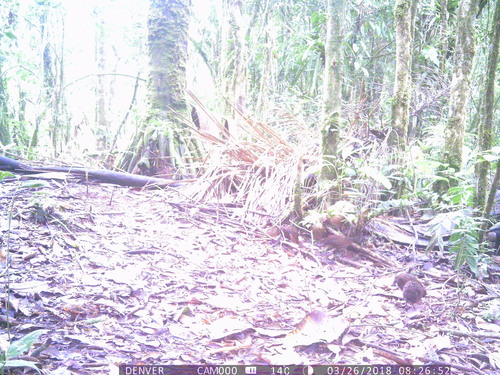
Crestless Curassow

Crestless Curassow

Mitu tomentosum

Silhouette: Sheatherius · PhyloPic

LCLeast ConcernNTVUENCR
Daily sighting probability <5% · Rare
at Sierra de la Macarena National Park

In 3 days ~10%

17 Verified sightings at Sierra de la Macarena National Park From 2019 to 2026
46 In all 2 parks
March Best month
☀️ Diurnal When it's spotted

About the Crestless Curassow

The crestless curassow (Mitu tomentosum) is a species of bird in the family Cracidae, the chachalacas, guans, and curassows. It is found in Brazil, Colombia, Guyana, and Venezuela. The crestless curassow was originally described in genus Crax but genetic data confirm that Mitu is a valid genus. The crestless curassow is monotypic.

Phylogenetic analyses based on mitochondrial gene sequences indicate that the crestless curassow is sister to the Alagoas curassow, the other Mitu species with brown eumelanin in the tail tip; together, these two species are the sister group to the rest of the Mitu genus.

The crestless curassow is 75 to 85 cm (2.5 to 2.8 ft) long. Males weigh 2,300 to 3,050 g (5.1 to 6.7 lb) and females 1,300 to 2,425 g (2.9 to 5.3 lb). It is mostly black with a dark blue to purplish gloss. Its belly and the tip of its tail are rich chestnut. Unlike most other curassows, it has no crest and no swelling on its red bill.

The crestless curassow is found in eastern Colombia, southern Venezuela, northwestern Brazil, and southwestern Guyana. It mostly inhabits rainforest along rivers, though it is also... Wikipedia →


Sounds

Song1:18

Colombia · 2013

© David Bradley y Sandra Valderrama · XC124929 · CC BY-NC-ND 3.0

Uncertain0:20

Colombia · 2025

© LiamDB99 · XC990604 · CC BY-NC-SA 4.0

Call0:25

Brazil · 2018

© GABRIEL LEITE · XC442188 · CC BY-NC-SA 4.0

Global Distribution

Parks Where Found

# Park Country Daily sighting probability
1 Anavilhanas National Park 🇧🇷 Brazil
~10%
2 Sierra de la Macarena National Park 🇨🇴 Colombia
<5%

Zoos & Centres Where Found

# Zoo / Centre Country
1 Planckendael Zoo 🇧🇪 Belgium In captivity
2 Curitiba Zoo 🇧🇷 Brazil In captivity
3 Bioparque Los Ocarros 🇨🇴 Colombia In captivity

Before you go

What are the chances of seeing a Crestless Curassow in Sierra de la Macarena National Park?

Rare

Under 5% of wildlife watchers report a Crestless Curassow sighting in Sierra de la Macarena National Park on a given day, based on 17 verified sightings from GBIF citizen-science data from 2019 to 2026. It is the 290th most-seen of the 418 birds we can rate there. Over three days the chance rises to about 10%, if each day is a fresh chance.

When is the best time to see a Crestless Curassow in Sierra de la Macarena National Park?

March

In that month about 10% of wildlife watchers report a Crestless Curassow in Sierra de la Macarena National Park on a given day, against under 5% in April to February, the lowest months.

What time of day is best to see a Crestless Curassow?

Between 6 and 9 am

Across all the parks we cover, that three-hour window holds the most Crestless Curassow sightings with a recorded time, and about 9 in 10 of them come between 6 am and 6 pm: it is a daytime animal.

Is Sierra de la Macarena National Park the best place to see a Crestless Curassow?

2nd of 2

Of the 2 parks where we can rate Crestless Curassow sightings, Sierra de la Macarena National Park ranks 2nd at under 5%. The best odds are in Anavilhanas National Park (Brazil, about 10%).

Which relatives of the Crestless Curassow live in Sierra de la Macarena National Park?

Same family: Cracidae

The closest relatives of the Crestless Curassow that you can see in Sierra de la Macarena National Park (family Cracidae, Guans, Chachalacas, and Curassows) are Speckled Chachalaca (about 30%) and Spix's Guan (about 20%), with each one's daily chance of a sighting.

Where does the Crestless Curassow sighting chance come from?

GBIF citizen-science records

It is estimated from how often the Crestless Curassow is recorded against all the birds logged in Sierra de la Macarena National Park (17 verified sightings from 2019 to 2026), calibrated against known sighting rates. Figures are rounded to the nearest 10% because citizen-science data supports honest approximations, not decimals, and months with records from fewer than five people show "—". How it works.

← Back to Sierra de la Macarena National Park