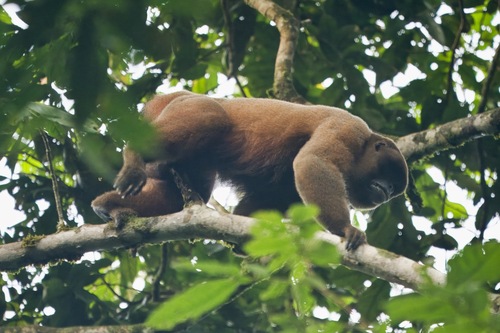
Humboldt’s Squirrel Monkey

Humboldt’s Squirrel Monkey

Saimiri cassiquiarensis

Silhouette: PhyloPic

LCLeast ConcernNTVUENCR
Daily sighting probability ~40% · Likely
at Sierra de la Macarena National Park

In 3 days ~80% in a week >90%

8 Verified sightings at Sierra de la Macarena National Park From 2019 to 2026
8 In 1 park
July Best month
☀️ Diurnal When it's spotted

About the Humboldt’s Squirrel Monkey

Humboldt's squirrel monkey (Saimiri cassiquiarensis) is a species of squirrel monkey from Brazil, Colombia, Ecuador, Peru and Venezuela. It had previously been considered a subspecies of the common squirrel monkey, S. sciureus, but was elevated to full species status based on a genetic study by Carretero-Pinzón in 2009. A genetic study by Jessica Lynch Alfaro, et al indicated that the Ecuadorian squirrel monkey may be synonymous with Saimiri cassiquiarensis. As of 2018, the Ecuadorian squirrel monkey is generally regarded as a subspecies of Humboldt's squirrel monkey, S. cassiquiarensis macrodon.

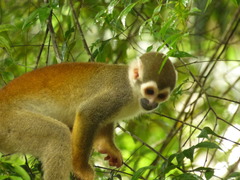
Humboldt's squirrel monkey have a head and body length of between 25 and 37 cm (9.8 and 14.6 in) with a tail between 36 and 45 cm (14 and 18 in). Its coloration is similar to that of the Guianan squirrel monkey but the fur on the base of the crown is golden yellow as compared with gray for the Guianan squirrel monkey. It eats fruits when available, primarily between January and June, and also eats insects. It is named after the Prussian naturalist and explorer Alexander von Humboldt (1769-1859). Wikipedia →

Global Distribution

Parks Where Found

# Park Country Daily sighting probability
1 Sierra de la Macarena National Park 🇨🇴 Colombia
~40%

More parks will be added in future updates.

Zoos & Centres Where Found

# Zoo / Centre Country
1 Parque Temático Hacienda Nápoles 🇨🇴 Colombia In captivity
2 Guadalajara Zoo 🇲🇽 Mexico In captivity
3 Ukumarí Biopark 🇨🇴 Colombia In captivity
4 Chapultepec Zoo 🇲🇽 Mexico In captivity
5 Bioparque Los Ocarros 🇨🇴 Colombia In captivity
6 Safari Masai Mara 🇲🇽 Mexico In captivity
7 Parque de la Conservación 🇨🇴 Colombia In captivity
8 Zoo El Pantanal 🇪🇨 Ecuador In captivity

Before you go

What are the chances of seeing a Humboldt’s Squirrel Monkey in Sierra de la Macarena National Park?

Likely

About 40% of wildlife watchers report a Humboldt’s Squirrel Monkey sighting in Sierra de la Macarena National Park on a given day, based on 8 verified sightings from GBIF citizen-science data from 2019 to 2026. It is the 2nd most-seen of the 6 mammals we can rate there. Over three days the chance rises to about 80%, and over a week to over 90%, if each day is a fresh chance.

When is the best time to see a Humboldt’s Squirrel Monkey in Sierra de la Macarena National Park?

February–April and July

In those months about 60% of wildlife watchers report a Humboldt’s Squirrel Monkey in Sierra de la Macarena National Park on a given day, against about 10% in January and September–November, the lowest months.

What time of day is best to see a Humboldt’s Squirrel Monkey?

Between 7 and 10 am

Across all the parks we cover, that three-hour window holds the most Humboldt’s Squirrel Monkey sightings with a recorded time, and about 9 in 10 of them come between 6 am and 6 pm: it is a daytime animal.

Where else can you see a Humboldt’s Squirrel Monkey?

Only Sierra de la Macarena National Park, in our data

Sierra de la Macarena National Park is the only park on Wallace's Line with enough records to rate Humboldt’s Squirrel Monkey sightings: about 40% of wildlife watchers there report one on a given day.

Where does the Humboldt’s Squirrel Monkey sighting chance come from?

GBIF citizen-science records

It is estimated from how often the Humboldt’s Squirrel Monkey is recorded against all the mammals logged in Sierra de la Macarena National Park (8 verified sightings from 2019 to 2026), calibrated against known sighting rates. Figures are rounded to the nearest 10% because citizen-science data supports honest approximations, not decimals, and months with records from fewer than five people show "—". How it works.

← Back to Sierra de la Macarena National Park