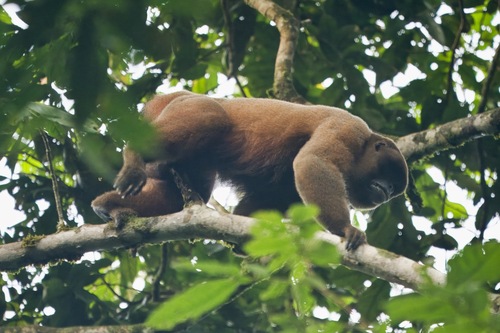
Ecuadorian Squirrel Monkey

Ecuadorian Squirrel Monkey

Saimiri macrodon

Silhouette: PhyloPic

Daily sighting probability ~40% · Likely
at Sierra de la Macarena National Park

In 3 days ~80% in a week >90%

7 Verified sightings at Sierra de la Macarena National Park From 2019 to 2026
315 In all 4 parks
August Best month
☀️ Diurnal When it's spotted

About the Ecuadorian Squirrel Monkey

The Ecuadorian squirrel monkey (Saimiri cassiquiarensis macrodon) is a type of squirrel monkey. It had been considered a subspecies of the Guianan squirrel monkey, Saimiri sciureus, but was elevated to a full species, S. macrodon, based on a 2009 study by Carretero-Pinzón, et al. Based on subsequent genetic research by Jessica Lynch Alfaro, et al it was again reclassified as a subspecies of Humboldt's squirrel monkey.

The Ecuadorian squirrel monkey lives in the western Brazilian Amazon, as well as southern Colombia, eastern Ecuador and northern and eastern Peru. It lives in humid tropical and subtropical forest, preferring dense forest but able to live in secondary forest and disturbed forest as well. It can live at elevations up to 1,200 m (3,900 ft), but where it has been studied in Ecuador it prefers elevations under 500 m (1,600 ft).

The Ecuadorian squirrel monkey has a head and body length of between 25 and 32 cm (9.8 and 12.6 in) with a tail length between 34 and 44 cm (13 and 17 in). Males weigh between 885 and 1,380 g (31.2 and 48.7 oz) and females weigh between 590 and 1,150 g (21 and 41 oz). Its coloration is similar to that of the Guianan squirrel monkey but its fur is darker. Wikipedia →

Sounds

Alarm call0:09

Ecuador · 2021

© Manuel Sánchez-Nivicela · XC1027021 · CC BY-NC-ND 4.0

Call0:48

Ecuador · 2025

© Marc Anderson · XC979834 · CC BY-NC-ND 4.0

Recording1:08

Brazil · 2022

© Thiago Bicudo · iNaturalist · CC BY 4.0

Global Distribution

Parks Where Found

# Park Country Daily sighting probability
1 Cuyabeno Wildlife Reserve 🇪🇨 Ecuador
~70%
2 Yasuní National Park 🇪🇨 Ecuador
~50%
3 Amacayacu National Natural Park 🇨🇴 Colombia
~40%
4 Sierra de la Macarena National Park 🇨🇴 Colombia
~40%

Zoos & Centres Where Found

# Zoo / Centre Country
1 Seoul Zoo 🇰🇷 South Korea In captivity
2 Gembira Loka Zoo 🇮🇩 Indonesia In captivity
3 Amaru 🇪🇨 Ecuador In captivity
4 Parque de las Leyendas 🇵🇪 Peru In captivity
5 Ecozoológico San Martín 🇪🇨 Ecuador In captivity
6 Zoo Criadero Tarqui 🇪🇨 Ecuador In captivity
7 Zoo El Pantanal 🇪🇨 Ecuador In captivity
8 Monkey Park 🇪🇸 Spain In captivity
9 Amazon Rescue Center 🇵🇪 Peru In captivity
10 Wiwa Quito 🇪🇨 Ecuador In captivity

Before you go

What are the chances of seeing an Ecuadorian Squirrel Monkey in Sierra de la Macarena National Park?

Likely

About 40% of wildlife watchers report an Ecuadorian Squirrel Monkey sighting in Sierra de la Macarena National Park on a given day, based on 7 verified sightings from GBIF citizen-science data from 2019 to 2026. It is the 3rd most-seen of the 6 mammals we can rate there. Over three days the chance rises to about 80%, and over a week to over 90%, if each day is a fresh chance.

When is the best time to see an Ecuadorian Squirrel Monkey in Sierra de la Macarena National Park?

August

In that month about 70% of wildlife watchers report an Ecuadorian Squirrel Monkey in Sierra de la Macarena National Park on a given day, against about 10% in January–March, June and October–November, the lowest months.

What time of day is best to see an Ecuadorian Squirrel Monkey?

Between 3 and 6 pm

Across all the parks we cover, that three-hour window holds the most Ecuadorian Squirrel Monkey sightings with a recorded time, and about 8 in 10 of them come between 6 am and 6 pm: it is a daytime animal.

Where does the Ecuadorian Squirrel Monkey sighting chance come from?

GBIF citizen-science records

It is estimated from how often the Ecuadorian Squirrel Monkey is recorded against all the mammals logged in Sierra de la Macarena National Park (7 verified sightings from 2019 to 2026), calibrated against known sighting rates. Figures are rounded to the nearest 10% because citizen-science data supports honest approximations, not decimals, and months with records from fewer than five people show "—". How it works.

← Back to Sierra de la Macarena National Park