About the New Forest Fly
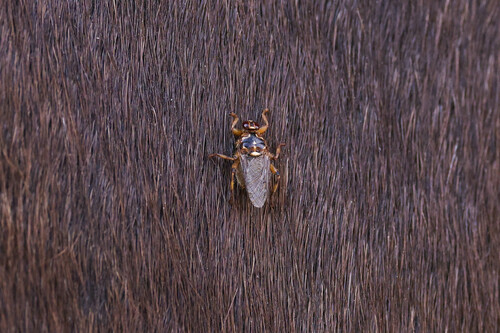
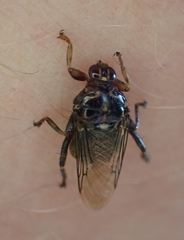
Hippobosca equina, also known as the forest fly or New Forest fly, is a biting fly from the family Hippoboscidae. They are blood-feeding ectoparasites of primarily horses and other large mammals including cattle. It is a permanently fully winged fly, not shedding its wings on finding its host, as in some other Hippoboscidae. With its wings retained, it may thus fly away from its host to deposit its larvae. They are good fliers.
Wing length 6.0–8.5 millimetres (0.24–0.33 in). Generally pale reddish brown with yellow spots on the indistinctly segmented abdomen. They have one pair of sub-triangular wings and the wing veins are crowded together towards the anterior border.
The characteristic feature of these flies is that they move sidewards and they feed preferably between the hind legs and on the perineum region. The New Forest fly lays larvae singly in late instar (stage III). They rapidly pupate over one hour and exhibit varying duration as pupae, depending on temperature.
The primary distribution is in Europe and parts of Asia and Africa. It has been introduced to other locations, though in some cases latter eradicated by modern... Wikipedia →