Hill Swallow

Hill Swallow

Hirundo domicola

Silhouette: Matt Wilkins · PhyloPic

Daily sighting probability <5% · Rare
at Sinharaja Forest Reserve

In 3 days <5%

5 Verified sightings at Sinharaja Forest Reserve From 2019 to 2026
968 In all 6 parks
July Best month
🌅 Crepuscular When it's spotted

About the Hill Swallow

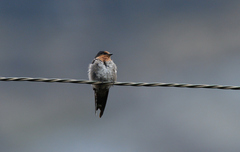
The hill swallow (Hirundo domicola) is a small passerine bird in the swallow family. It breeds in southern India and Sri Lanka. It is resident apart from some local seasonal movements. This bird is associated with coasts, but is increasingly spreading to forested uplands. It was formerly considered to be a subspecies of the Pacific swallow.

This species is a small swallow at 13 cm (5.1 in). It has a blue back with browner wings and tail, a red face and throat, and dusky underparts. It differs from the barn swallow and the closely related welcome swallow in its shorter and less forked tail.

The hill swallow builds a neat cup-shaped nest, constructed with mud pellets collected in the beak, under a cliff ledge or on man-made structures such as a building, bridge or tunnel. The nest is lined with softer material, and the clutch is up to four eggs. Detailed studies on the breeding ecology of the species were conducted in Silent Valley National Park and Muthikkulam reserve forests of Kerala.

It is similar in behaviour to other aerial insectivores, such as other swallows and the unrelated swifts. It is a fast flyer and feeds... Wikipedia →

Sounds

Call0:29

India · 2022

© Sathyan Meppayur · XC744703 · CC BY-NC-SA 4.0

Uncertain0:31

India · 2021

© Vijay Ramesh · XC620441 · CC BY-NC-SA 4.0

Flight call0:04

India · 2020

© Sreekumar Chirukandoth · XC604261 · CC BY-NC-SA 4.0

Global Distribution

Parks Where Found

# Park Country Daily sighting probability
1 Horton Plains National Park 🇱🇰 Sri Lanka
~80%
2 Eravikulam National Park 🇮🇳 India
~70%
3 Mudumalai National Park 🇮🇳 India
~10%
4 Periyar National Park 🇮🇳 India
<5%
5 Bandipur National Park 🇮🇳 India
<5%
6 Sinharaja Forest Reserve 🇱🇰 Sri Lanka
<5%

Before you go

What are the chances of seeing a Hill Swallow in Sinharaja Forest Reserve?

Rare

Under 5% of wildlife watchers report a Hill Swallow sighting in Sinharaja Forest Reserve on a given day, based on 5 verified sightings from GBIF citizen-science data from 2019 to 2026. It is the 153rd most-seen of the 156 birds we can rate there. Over three days the chance rises to under 5%, if each day is a fresh chance.

When is the best time to see a Hill Swallow in Sinharaja Forest Reserve?

Any time of year

In every month with enough records, under 5% of wildlife watchers report a Hill Swallow in Sinharaja Forest Reserve on a given day, so our monthly data shows no clear season.

What time of day is best to see a Hill Swallow?

Between 3 and 6 am

Across all the parks we cover, that three-hour window holds the most Hill Swallow sightings with a recorded time, and about half of them come between 6 am and 6 pm: it is most active around dawn and dusk.

Where does the Hill Swallow sighting chance come from?

GBIF citizen-science records

It is estimated from how often the Hill Swallow is recorded against all the birds logged in Sinharaja Forest Reserve (5 verified sightings from 2019 to 2026), calibrated against known sighting rates. Figures are rounded to the nearest 10% because citizen-science data supports honest approximations, not decimals, and months with records from fewer than five people show "—". How it works.

← Back to Sinharaja Forest Reserve