
Kelaart's Dwarf Toad

Kelaart's Dwarf Toad

Adenomus kelaartii

Silhouette: Michael Scroggie, from original photograph by Gary M. Stolz, USFWS (original photograph in public domain). · PhyloPic

LCNTVUVulnerableENCR Endemic
Daily sighting probability ~20% · Possible
at Sinharaja Forest Reserve

In 3 days ~40% in a week ~70%

18 Verified sightings at Sinharaja Forest Reserve From 2019 to 2026
18 In 1 park
June Best month
☀️🌙 Day & Night When it's spotted

About the Kelaart's Dwarf Toad

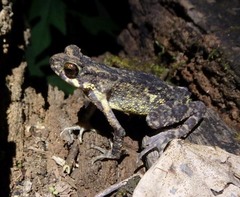
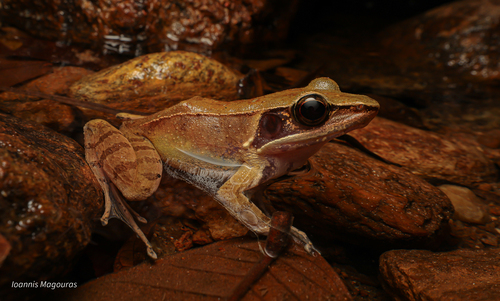
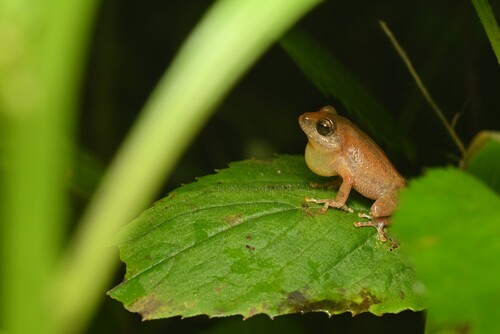
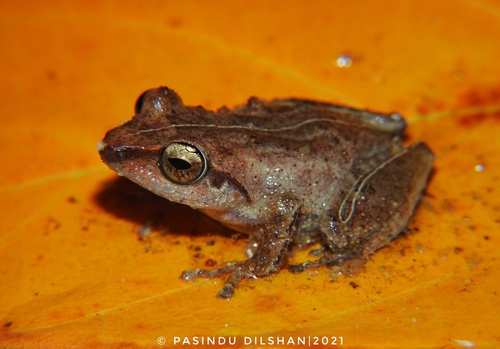
Adenomus kelaartii (Kelaart's toad or Kelaart's dwarf toad) is a species of toad in the family Bufonidae. It is endemic to Sri Lanka, where it is found in the south-west of the island at elevations between 30 and 1,230 m. The specific name kelaartii honours Edward Frederick Kelaart, a Ceylonese-born physician and zoologist.

Kelaart's toad is a fairly small species with females having a snout-to vent length of 36 to 50 mm (1.4 to 2.0 in) and males 25 to 33 mm (1.0 to 1.3 in). The skin in some individuals is smooth but in others it bears spiny warts. The upper parts are brown more or less blotched with darker colour and the underparts are cream or white, blotched with brown and sometimes speckled with red flecks. In some individuals, there are both red and blue flecks on the underside.

Kelaart's toad is endemic to southwestern Sri Lanka where it is found at altitudes of up to 1,230 m (4,035 ft) above sea level. It does not have a continuous distribution as its range is fragmented into a number of separate locations. Its typical habitat is tropical humid forests where it occurs in the leaf litter on the ground near upland streams. It sometimes... Wikipedia →

Global Distribution

Parks Where Found

# Park Country Daily sighting probability
1 Sinharaja Forest Reserve 🇱🇰 Sri Lanka
~20%

More parks will be added in future updates.

Closest Relatives at Sinharaja Forest Reserve

Before you go

What are the chances of seeing a Kelaart's Dwarf Toad in Sinharaja Forest Reserve?

Possible

About 20% of wildlife watchers report a Kelaart's Dwarf Toad sighting in Sinharaja Forest Reserve on a given day, based on 18 verified sightings from GBIF citizen-science data from 2019 to 2026. It is the 17th most-seen of the 25 amphibians we can rate there. Over three days the chance rises to about 40%, and over a week to about 70%, if each day is a fresh chance.

When is the best time to see a Kelaart's Dwarf Toad in Sinharaja Forest Reserve?

February, June and August

In those months about 30% of wildlife watchers report a Kelaart's Dwarf Toad in Sinharaja Forest Reserve on a given day, against under 5% in April, September–October and December, the lowest months.

What time of day is best to see a Kelaart's Dwarf Toad?

Between 7 and 10 pm

Across all the parks we cover, that three-hour window holds the most Kelaart's Dwarf Toad sightings with a recorded time, and about 6 in 10 of them come between 6 pm and 6 am: it is seen both by day and at night.

Where else can you see a Kelaart's Dwarf Toad?

Only Sinharaja Forest Reserve, in our data

Sinharaja Forest Reserve is the only park on Wallace's Line with enough records to rate Kelaart's Dwarf Toad sightings: about 20% of wildlife watchers there report one on a given day.

Where does the Kelaart's Dwarf Toad sighting chance come from?

GBIF citizen-science records

It is estimated from how often the Kelaart's Dwarf Toad is recorded against all the amphibians logged in Sinharaja Forest Reserve (18 verified sightings from 2019 to 2026), calibrated against known sighting rates. Figures are rounded to the nearest 10% because citizen-science data supports honest approximations, not decimals, and months with records from fewer than five people show "—". How it works.

← Back to Sinharaja Forest Reserve