Sri Lanka rock frog

Sri Lanka rock frog

Nannophrys ceylonensis

Silhouette: Jose Carlos Arenas-Monroy · PhyloPic

LCNTVUVulnerableENCR Endemic
Daily sighting probability ~20% · Possible
at Sinharaja Forest Reserve

In 3 days ~60% in a week ~90%

31 Verified sightings at Sinharaja Forest Reserve From 2019 to 2026
31 In 1 park
August Best month
🌅 Crepuscular When it's spotted

About the Sri Lanka rock frog

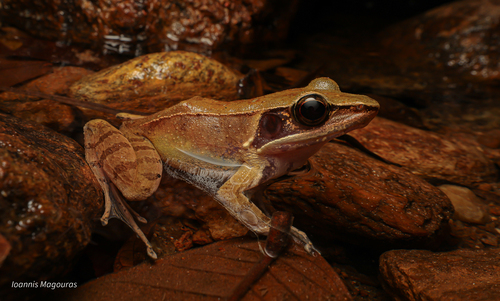
Nannophrys ceylonensis, commonly known as the Sri Lanka rock frog or the Ceylon streamlined frog, is a species of frog. It used to be placed in the large frog family Ranidae but a phylogenetic study was undertaken using DNA sequences and it is now included in the family Dicroglossidae. It is endemic to Sri Lanka where its natural habitats are subtropical or tropical moist lowland forests, subtropical or tropical moist montane forests, rivers and streams.

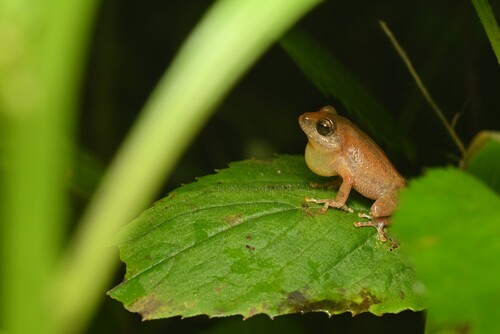
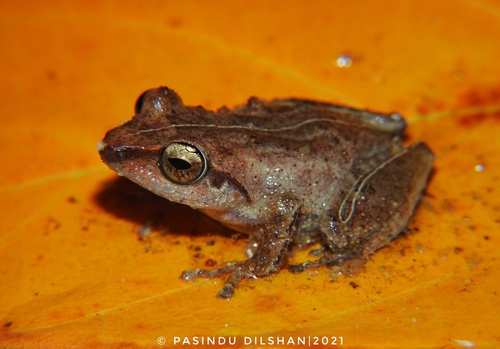
Female Sri Lanka rock frogs grow to a length of about 5 centimetres (2.0 in) while males grow to 4 centimetres (1.6 in). The colour is olive green or yellowish-brown, mottled with brown patches. The legs have transverse bars of brown. When sitting on alga covered rocks it is well camouflaged.

The Sri Lanka rock frog is endemic to south, central and western Sri Lanka where it is found in wet tropical forests at altitudes of up to 1,200 metres (3,900 ft) above sea level. It is a largely aquatic species and occurs in fast flowing mountain streams, under boulders and on wet rocks beside waterfalls. It is also found on land in disturbed areas where there are suitable breeding locations such... Wikipedia →

Global Distribution

Parks Where Found

# Park Country Daily sighting probability
1 Sinharaja Forest Reserve 🇱🇰 Sri Lanka
~20%

More parks will be added in future updates.

Closest Relatives at Sinharaja Forest Reserve

Before you go

What are the chances of seeing a Sri Lanka rock frog in Sinharaja Forest Reserve?

Possible

About 20% of wildlife watchers report a Sri Lanka rock frog sighting in Sinharaja Forest Reserve on a given day, based on 31 verified sightings from GBIF citizen-science data from 2019 to 2026. It is the 13th most-seen of the 25 amphibians we can rate there. Over three days the chance rises to about 60%, and over a week to about 90%, if each day is a fresh chance.

When is the best time to see a Sri Lanka rock frog in Sinharaja Forest Reserve?

August and November

In those months about 40% of wildlife watchers report a Sri Lanka rock frog in Sinharaja Forest Reserve on a given day, against under 5% in September, the lowest month.

What time of day is best to see a Sri Lanka rock frog?

Between 5 and 8 am

Across all the parks we cover, that three-hour window holds the most Sri Lanka rock frog sightings with a recorded time, and about 7 in 10 of them come between 6 am and 6 pm: it is most active around dawn and dusk.

Where else can you see a Sri Lanka rock frog?

Only Sinharaja Forest Reserve, in our data

Sinharaja Forest Reserve is the only park on Wallace's Line with enough records to rate Sri Lanka rock frog sightings: about 20% of wildlife watchers there report one on a given day.

Where does the Sri Lanka rock frog sighting chance come from?

GBIF citizen-science records

It is estimated from how often the Sri Lanka rock frog is recorded against all the amphibians logged in Sinharaja Forest Reserve (31 verified sightings from 2019 to 2026), calibrated against known sighting rates. Figures are rounded to the nearest 10% because citizen-science data supports honest approximations, not decimals, and months with records from fewer than five people show "—". How it works.

← Back to Sinharaja Forest Reserve