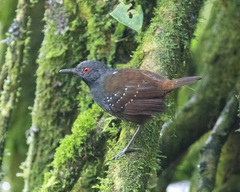
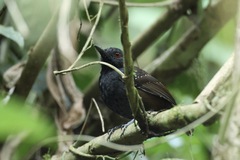
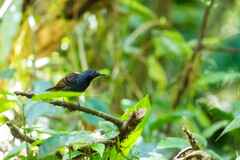
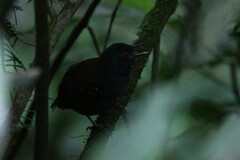

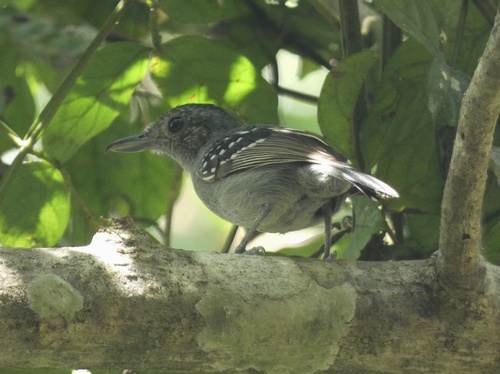
Dull-mantled Antbird

Dull-mantled Antbird

Sipia laemosticta

Silhouette: Sheatherius · PhyloPic

LCLeast ConcernNTVUENCR
Daily sighting probability <5% · Rare
at Soberanía National Park

In 3 days <5%

12 Verified sightings at Soberanía National Park From 2019 to 2026
2,949 In all 7 parks
April Best month
☀️ Diurnal When it's spotted

About the Dull-mantled Antbird

The dull-mantled antbird (Sipia laemosticta) is a perching bird species in subfamily Thamnophilinae of family Thamnophilidae, the "typical antbirds". It is found in Colombia, Costa Rica, and Panama. The dull-mantled antbird was described by the English naturalist Osbert Salvin in 1865 and given the binomial name Myrmeciza laemosticta. A molecular phylogenetic study published in 2013 found that the genus Myrmeciza, as then defined, was polyphyletic. In the resulting rearrangement to create monophyletic genera, four species including the dull-mantled antbird were moved to the resurrected genus Sipia that had been introduced by the Austrian ornithologist Carl Eduard Hellmayr in 1924.

What is now the Magdalena antbird (S. palliata) was previously considered conspecific with the dull-mantled antbird but was elevated to species status based on an analysis of vocalization and mitochondrial DNA sequences published in 2010.

The dull-mantled antbird's closest relative appears to be the Esmeraldas antbird (S. nigricauda). The other two members of genus Sipia, the Magdalena antbird and stub-tailed antbird (S. berlepschi) are the next most closely related. The chestnut... Wikipedia →

Sounds

Call0:09

Costa Rica · 2013

© Albert Lastukhin · XC1087892 · CC BY-NC-ND 4.0

Song0:59

Panama · 2025

© Sue Riffe · XC1071763 · CC BY-NC-SA 4.0

Alarm call0:41

Panama · 2022

© Cameron Rutt · XC721473 · CC BY-NC-SA 4.0

Global Distribution

Parks Where Found

# Park Country Daily sighting probability
1 Darién National Park 🇵🇦 Panama
~20%
2 Arenal Volcano National Park 🇨🇷 Costa Rica
~10%
3 Tapantí-Macizo de la Muerte National Park 🇨🇷 Costa Rica
<5%
4 Braulio Carrillo National Park 🇨🇷 Costa Rica
<5%
5 Tenorio Volcano National Park 🇨🇷 Costa Rica
<5%
6 La Amistad International Park (Panama) 🇵🇦 Panama
<5%
7 Soberanía National Park 🇵🇦 Panama
<5%

Before you go

What are the chances of seeing a Dull-mantled Antbird in Soberanía National Park?

Rare

Under 5% of wildlife watchers report a Dull-mantled Antbird sighting in Soberanía National Park on a given day, based on 12 verified sightings from GBIF citizen-science data from 2019 to 2026. It is the 411th most-seen of the 449 birds we can rate there. Over three days the chance rises to under 5%, if each day is a fresh chance.

When is the best time to see a Dull-mantled Antbird in Soberanía National Park?

Any time of year

In every month with enough records, under 5% of wildlife watchers report a Dull-mantled Antbird in Soberanía National Park on a given day, so our monthly data shows no clear season.

What time of day is best to see a Dull-mantled Antbird?

Between 6 and 9 am

Across all the parks we cover, that three-hour window holds the most Dull-mantled Antbird sightings with a recorded time, and about 8 in 10 of them come between 6 am and 6 pm: it is a daytime animal.

Which relatives of the Dull-mantled Antbird live in Soberanía National Park?

Same family: Thamnophilidae

The closest relatives of the Dull-mantled Antbird that you can see in Soberanía National Park (family Thamnophilidae, Typical Antbirds) are Western Slaty-Antshrike (about 50%), Dot-winged Antwren (about 50%) and Fasciated Antshrike (about 40%), with each one's daily chance of a sighting.

Where does the Dull-mantled Antbird sighting chance come from?

GBIF citizen-science records

It is estimated from how often the Dull-mantled Antbird is recorded against all the birds logged in Soberanía National Park (12 verified sightings from 2019 to 2026), calibrated against known sighting rates. Figures are rounded to the nearest 10% because citizen-science data supports honest approximations, not decimals, and months with records from fewer than five people show "—". How it works.

← Back to Soberanía National Park