Bandy Bandy

Bandy Bandy

Vermicella annulata

Silhouette: SeismicShrimp · PhyloPic

LCLeast ConcernNTVUENCR Endemic
Daily sighting probability ~10% · With luck
at Springbrook National Park

In 3 days ~30% in a week ~50%

10 Verified sightings at Springbrook National Park From 2019 to 2026
41 In all 3 parks
February Best month
🌙 Nocturnal When it's spotted

About the Bandy Bandy

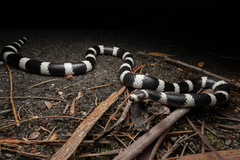
The bandy-bandy (Vermicella annulata), also commonly known as the hoop snake, is a species of venomous snake in the family Elapidae. The word bandy-bandy (bandi-bandi) traces back to the indigenous dialect of Kattang, from the Taree region, New South Wales. There are 5 known species of bandy-bandy, all of which are endemic to Australia.

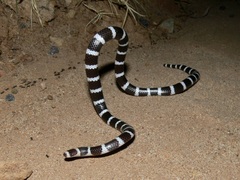
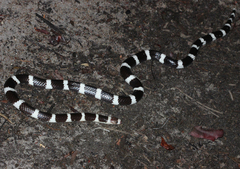
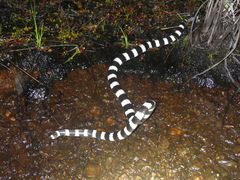
The bandy-bandy is a smooth-scaled, glossy snake with a distinctive pattern of sharply contrasting black and white rings that continue right around the body. Bandy-bandys are strikingly distinguishable from other Australian land snakes by their unique banding pattern, which gives the species both its common names and its scientific name (from the diminutive form, annul-, of the Latin anus, meaning "ring"). Their tail is relatively short, having fewer than 35 subcaudals and the tip is blunt, unlike other elapids. The dorsal scales are in 15 rows at mid body. The average total length (including tail) is 50 to 60 cm (20 to 24 in), but size is highly variable between sexes.

The family Elapidae is distinguished from other snake families by their proteroglyphous dentition. They have at least one pair of fangs that are hollow... Wikipedia →

Global Distribution

Parks Where Found

# Park Country Daily sighting probability
1 Lamington National Park 🇦🇺 Australia
~20%
2 Springbrook National Park 🇦🇺 Australia
~10%
3 Blue Mountains National Park 🇦🇺 Australia
~10%

Closest Relatives at Springbrook National Park

Before you go

What are the chances of seeing a Bandy Bandy in Springbrook National Park?

With luck

About 10% of wildlife watchers report a Bandy Bandy sighting in Springbrook National Park on a given day, based on 10 verified sightings from GBIF citizen-science data from 2019 to 2026. It is the 21st most-seen of the 27 reptiles we can rate there. Over three days the chance rises to about 30%, and over a week to about 50%, if each day is a fresh chance.

When is the best time to see a Bandy Bandy in Springbrook National Park?

February and October

In those months about 20% of wildlife watchers report a Bandy Bandy in Springbrook National Park on a given day, against under 5% in April to September, the lowest months. Those are among Springbrook National Park's wettest months, with about 160 mm of rain a month against 45 mm in August.

What time of day is best to see a Bandy Bandy?

Between 8 and 11 pm

Across all the parks we cover, that three-hour window holds the most Bandy Bandy sightings with a recorded time, and about 7 in 10 of them come between 6 pm and 6 am: it is mostly seen at night.

Is Springbrook National Park the best place to see a Bandy Bandy?

2nd of 3

Of the 3 parks where we can rate Bandy Bandy sightings, Springbrook National Park ranks 2nd at about 10%. The best odds are in Lamington National Park (Australia, about 20%).

Which relatives of the Bandy Bandy live in Springbrook National Park?

Same family: Elapidae

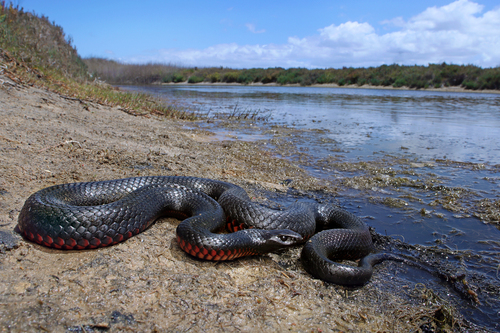
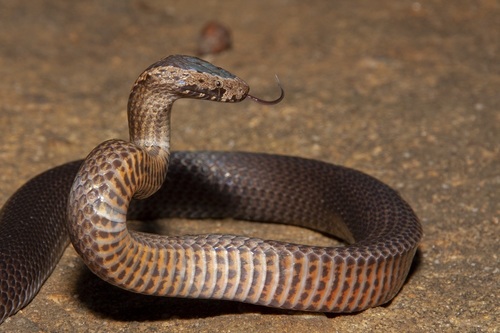
The closest relatives of the Bandy Bandy that you can see in Springbrook National Park (family Elapidae, Elapid Snakes) are Small-eyed Snake (about 30%), Red-bellied Black Snake (about 20%) and Dwarf Crowned Snake (about 20%), with each one's daily chance of a sighting.

Where does the Bandy Bandy sighting chance come from?

GBIF citizen-science records

It is estimated from how often the Bandy Bandy is recorded against all the reptiles logged in Springbrook National Park (10 verified sightings from 2019 to 2026), calibrated against known sighting rates. Figures are rounded to the nearest 10% because citizen-science data supports honest approximations, not decimals, and months with records from fewer than five people show "—". How it works.

← Back to Springbrook National Park