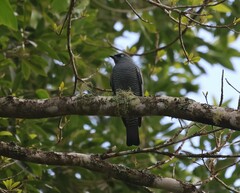
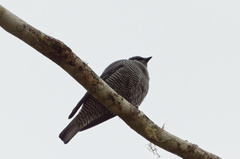
Barred Cuckoo-shrike

Barred Cuckoo-shrike

Coracina lineata

Silhouette: PhyloPic

LCLeast ConcernNTVUENCR
Daily sighting probability <5% · Rare
at Springbrook National Park

In 3 days ~10% in a week ~30%

16 Verified sightings at Springbrook National Park From 2019 to 2026
182 In all 4 parks
November Best month
☀️ Diurnal When it's spotted

About the Barred Cuckoo-shrike

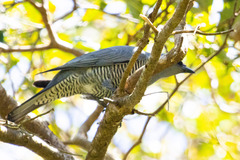
The barred cuckooshrike (Coracina lineata), also called the yellow-eyed cuckooshrike, is a species of bird in the family Campephagidae. It is found in eastern Australia, Indonesia, Papua New Guinea, and Solomon Islands. Coracina lineata lineata: Northeast Australia (east Cape York Peninsula to northeast New South Wales)

Coracina lineata axillaris: Mountains of central New Guinea and Waigeo Island. Coracina lineata maforensis: Numfor Island (New Guinea) Coracina lineata sublineata: Bismarck Archipelago (New Ireland and New Britain) Coracina lineata nigrifrons: Solomon Islands (Bougainville, Choiseul and Santa Isabel)

Coracina lineata ombriosa: Solomon Is. (Kolombangara, New Georgia Group and Rendova) Coracina lineata pusilla: Guadalcanal (Solomon Islands) Coracina lineata malaitae: Malaita (Solomon Islands) Coracina lineata makirae: Makira (Solomon Islands)

Coracina lineata gracilis: Rennell (Solomon Islands) The holotype of Graucalus nigrifrons Tristram (Ibis, 1892, p. 294), an adult male, is held in the vertebrate zoology collection of National Museums Liverpool at World Museum, with accession number NML-VZ T16744. The specimen was collected in Bugotu... Wikipedia →

Sounds

Call0:18

Australia · 2022

© Marc Anderson · XC1032277 · CC BY-NC-ND 4.0

Duet0:47

Papua New Guinea · 2010

© Phil Gregory · XC604901 · CC BY-NC-SA 4.0

Song0:15

Papua New Guinea · 1993

© Scott Connop · XC597322 · CC BY-NC-SA 4.0

Global Distribution

Parks Where Found

# Park Country Daily sighting probability
1 Raja Ampat 🇮🇩 Indonesia
~10%
2 Springbrook National Park 🇦🇺 Australia
<5%
3 Daintree National Park 🇦🇺 Australia
<5%
4 Lamington National Park 🇦🇺 Australia
<5%

Before you go

What are the chances of seeing a Barred Cuckoo-shrike in Springbrook National Park?

Rare

Under 5% of wildlife watchers report a Barred Cuckoo-shrike sighting in Springbrook National Park on a given day, based on 16 verified sightings from GBIF citizen-science data from 2019 to 2026. It is the 106th most-seen of the 136 birds we can rate there. Over three days the chance rises to about 10%, and over a week to about 30%, if each day is a fresh chance.

When is the best time to see a Barred Cuckoo-shrike in Springbrook National Park?

November

In that month about 20% of wildlife watchers report a Barred Cuckoo-shrike in Springbrook National Park on a given day, against under 5% in April–October and December–February, the lowest months.

What time of day is best to see a Barred Cuckoo-shrike?

Between 7 and 10 am

Across all the parks we cover, that three-hour window holds the most Barred Cuckoo-shrike sightings with a recorded time, and about 9 in 10 of them come between 6 am and 6 pm: it is a daytime animal.

Is Springbrook National Park the best place to see a Barred Cuckoo-shrike?

2nd of 4

Of the 4 parks where we can rate Barred Cuckoo-shrike sightings, Springbrook National Park ranks 2nd at under 5%. The best odds are in Raja Ampat (Indonesia, about 10%).

Which relatives of the Barred Cuckoo-shrike live in Springbrook National Park?

Same genus: Coracina

The closest relatives of the Barred Cuckoo-shrike that you can see in Springbrook National Park (genus Coracina, Typical Cuckooshrikes) are Black-faced Cuckoo-shrike (about 20%) and White-bellied Cuckooshrike (about 10%), with each one's daily chance of a sighting.

Where does the Barred Cuckoo-shrike sighting chance come from?

GBIF citizen-science records

It is estimated from how often the Barred Cuckoo-shrike is recorded against all the birds logged in Springbrook National Park (16 verified sightings from 2019 to 2026), calibrated against known sighting rates. Figures are rounded to the nearest 10% because citizen-science data supports honest approximations, not decimals, and months with records from fewer than five people show "—". How it works.

← Back to Springbrook National Park