Blue-speckled Forest Skink

Blue-speckled Forest Skink

Silvascincus murrayi

Silhouette: David Orr · PhyloPic

LCLeast ConcernNTVUENCR Endemic
Daily sighting probability ~20% · Possible
at Springbrook National Park

In 3 days ~50% in a week ~80%

35 Verified sightings at Springbrook National Park From 2019 to 2026
278 In all 2 parks
January Best month
☀️ Diurnal When it's spotted

About the Blue-speckled Forest Skink

Silvascincus murrayi, also known commonly as the blue-speckled forest-skink and Murray's skink, is a species of lizard in the subfamily Sphenomorphinae of the family Scincidae. The species is native to New South Wales and Queensland in Australia.

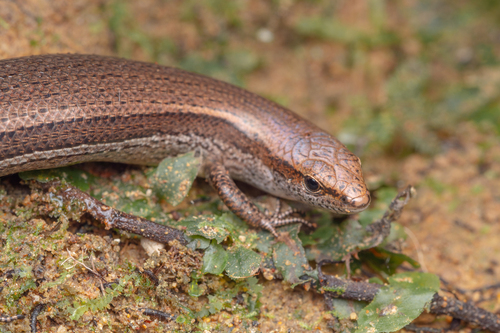
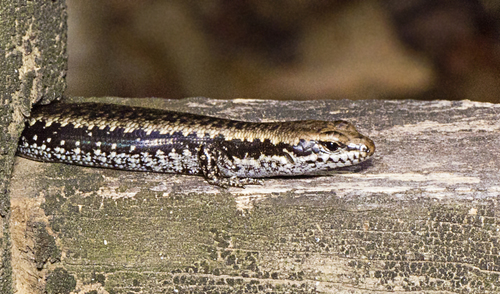
The specific name, murrayi, is in honor of Canadian oceanographer, John Murray. Adults of Silvascincus murrayi have an average snout-to-vent length (SVL) of about 11 cm (4.3 in). The body is robust. Dorsally, it is golden brown to coppery brown, with black scale edges and black flecks. The flanks are black with yellow dots and fine bluish white speckles. Ventrally, it is pale yellow.

Silvascincus murrayi is found in extreme eastern Australia, in northeastern New South Wales and southeastern Queensland. The preferred natural habitat of Silvascincus murrayi is forest. The mode of reproduction of Silvacincus murrayi has been described as viviparous and as ovoviviparous. Litter size is three to five neonates.

Boulenger, G.A. (1887). Catalogue of the Lizards in the British Museum (Natural History). Second Edition... Wikipedia →

Global Distribution

Parks Where Found

# Park Country Daily sighting probability
1 Lamington National Park 🇦🇺 Australia
~50%
2 Springbrook National Park 🇦🇺 Australia
~20%

Before you go

What are the chances of seeing a Blue-speckled Forest Skink in Springbrook National Park?

Possible

About 20% of wildlife watchers report a Blue-speckled Forest Skink sighting in Springbrook National Park on a given day, based on 35 verified sightings from GBIF citizen-science data from 2019 to 2026. It is the 7th most-seen of the 27 reptiles we can rate there. Over three days the chance rises to about 50%, and over a week to about 80%, if each day is a fresh chance.

When is the best time to see a Blue-speckled Forest Skink in Springbrook National Park?

January

In that month about 40% of wildlife watchers report a Blue-speckled Forest Skink in Springbrook National Park on a given day, against under 5% in May to August, the lowest months.

What time of day is best to see a Blue-speckled Forest Skink?

Between 10 am and 1 pm

Across all the parks we cover, that three-hour window holds the most Blue-speckled Forest Skink sightings with a recorded time, and nearly all of them come between 6 am and 6 pm: it is a daytime animal.

Is Springbrook National Park the best place to see a Blue-speckled Forest Skink?

2nd of 2

Of the 2 parks where we can rate Blue-speckled Forest Skink sightings, Springbrook National Park ranks 2nd at about 20%. The best odds are in Lamington National Park (Australia, about 50%).

Which relatives of the Blue-speckled Forest Skink live in Springbrook National Park?

Same family: Scincidae

The closest relatives of the Blue-speckled Forest Skink that you can see in Springbrook National Park (family Scincidae, Skinks) are Land Mullet (about 50%), Eastern Water Skink (about 20%) and Major Skink (about 20%), with each one's daily chance of a sighting.

Where does the Blue-speckled Forest Skink sighting chance come from?

GBIF citizen-science records

It is estimated from how often the Blue-speckled Forest Skink is recorded against all the reptiles logged in Springbrook National Park (35 verified sightings from 2019 to 2026), calibrated against known sighting rates. Figures are rounded to the nearest 10% because citizen-science data supports honest approximations, not decimals, and months with records from fewer than five people show "—". How it works.

← Back to Springbrook National Park