Major Skink

Major Skink

Bellatorias frerei

Silhouette: David Orr · PhyloPic

LCLeast ConcernNTVUENCR
Daily sighting probability ~20% · Possible
at Springbrook National Park

In 3 days ~40% in a week ~70%

22 Verified sightings at Springbrook National Park From 2019 to 2026
163 In all 4 parks
December Best month
☀️ Diurnal When it's spotted

About the Major Skink

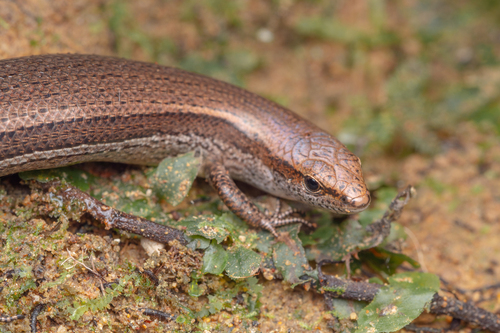
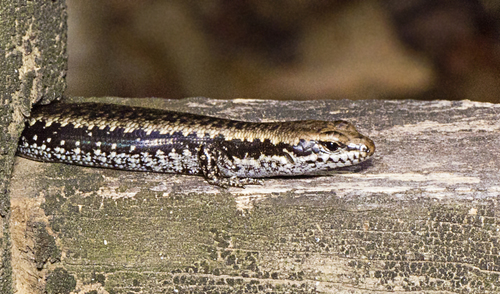
The major skink (Bellatorias frerei) is a species of lizard in the family Scincidae. The species is native to part of Australia and part of Australasia. The specific name, frerei, refers to Mount Bartle Frere where the holotype was collected.

B. frerei is found in Australia in the states of Queensland and New South Wales, and in Papua New Guinea. B. frerei is found in a variety of habitats including forest, savanna, grassland, rocky areas, and suburban areas.

The holotype of B. frerei has a snout-to-vent length (SVL) of 9.3 cm (3.7 in), plus a tail length of 14 cm (5.5 in). B. frerei is terrestrial and diurnal, basking to thermoregulate, and living socially in small colonies.

B. frerei is omnivorous. B. frerei is ovoviviparous. Cogger HG (2014). Reptiles and Amphibians of Australia, Seventh Edition. Clayton, Victoria, Australia: CSIRO Publishing. xxx + 1,033 pp. ISBN 978-0643100350. Gardner MG, Hugall AF, Donnellan SC, Hutchinson MN, Foster R (2008). "Molecular systematics of social skinks: phylogeny and taxonomy of the Egernia group... Wikipedia →

Global Distribution

Parks Where Found

# Park Country Daily sighting probability
1 Noosa National Park 🇦🇺 Australia
~40%
2 Daintree National Park 🇦🇺 Australia
~30%
3 Lamington National Park 🇦🇺 Australia
~20%
4 Springbrook National Park 🇦🇺 Australia
~20%

Cities Where Found

# City Country Daily sighting probability
1 Brisbane 🇦🇺 Australia
~10%

Zoos & Centres Where Found

# Zoo / Centre Country
1 Healesville Sanctuary 🇦🇺 Australia In captivity
2 Frankfurt Zoological Garden 🇩🇪 Germany In captivity
3 Reptile Gardens 🇺🇸 United States In captivity
4 VigoNature 🇪🇸 Spain In captivity
5 Cairns Aquarium 🇦🇺 Australia In captivity

Before you go

What are the chances of seeing a Major Skink in Springbrook National Park?

Possible

About 20% of wildlife watchers report a Major Skink sighting in Springbrook National Park on a given day, based on 22 verified sightings from GBIF citizen-science data from 2019 to 2026. It is the 13th most-seen of the 27 reptiles we can rate there. Over three days the chance rises to about 40%, and over a week to about 70%, if each day is a fresh chance.

When is the best time to see a Major Skink in Springbrook National Park?

February and December

In those months about 30% of wildlife watchers report a Major Skink in Springbrook National Park on a given day, against under 5% in April to August, the lowest months. Those are among Springbrook National Park's wettest months, with about 170 mm of rain a month against 45 mm in August.

What time of day is best to see a Major Skink?

Between 1 and 4 pm

Across all the parks we cover, that three-hour window holds the most Major Skink sightings with a recorded time, and about 9 in 10 of them come between 6 am and 6 pm: it is a daytime animal.

Is Springbrook National Park the best place to see a Major Skink?

4th of 4

Of the 4 parks where we can rate Major Skink sightings, Springbrook National Park ranks 4th at about 20%. The best odds are in Noosa National Park (Australia, about 40%), Daintree National Park (Australia, about 30%) and Lamington National Park (Australia, about 20%).

Where does the Major Skink sighting chance come from?

GBIF citizen-science records

It is estimated from how often the Major Skink is recorded against all the reptiles logged in Springbrook National Park (22 verified sightings from 2019 to 2026), calibrated against known sighting rates. Figures are rounded to the nearest 10% because citizen-science data supports honest approximations, not decimals, and months with records from fewer than five people show "—". How it works.

← Back to Springbrook National Park