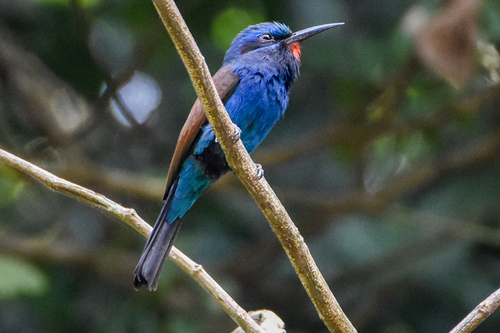
Blue-headed Bee-eater

Blue-headed Bee-eater

Merops mentalis

Silhouette: Sheatherius · PhyloPic

LCNTNear ThreatenedVUENCR
Daily sighting probability ~10% · With luck
at Taï National Park

In 3 days ~30% in a week ~50%

5 Verified sightings at Taï National Park From 2019 to 2026
5 In 1 park
September Best month
☀️ Diurnal When it's spotted

About the Blue-headed Bee-eater

The blue-moustached bee-eater (Merops mentalis) is a species of bird in the family Meropidae, a group of brightly colored Palearctic and Afrotropical birds noted for feeding primarily on venomous Hymenoptera such as bees and wasps. The blue-moustached bee-eater is one of 31 species within this family. It is a small, dark bee-eater measuring about 19 cm in length. Both sexes are generally similar in appearance, with predominantly purplish-blue plumage, a rich chestnut mantle, back, and wings.

The species is native to the Upper Guinean forests, the Western High Plateau and Bioko, and occurs in Cameroon, Ivory Coast, Equatorial Guinea, Ghana, Guinea, Liberia, Nigeria, and Sierra Leone, where it inhabits submontane and upland rainforest habitats.

The blue-moustached bee-eater is typically found singly and is most often seen perched high in the forest canopy beside tracks or clearings. From these perches, it swoops down to capture small insects, such as butterflies, honeybees and other flying arthropods before returning to its original perch.

The genus Merops was introduced by the Swedish naturalist Carl Linnaeus in 1758 in the tenth edition of his Systema Naturae. The name... Wikipedia →
Sounds

Call0:15

Ghana · 2022

© Peter Boesman · XC719290 · CC BY-NC-ND 4.0

Begging call0:28

Nigeria · 2015

© Brian Cox · XC241435 · CC BY-NC-SA 4.0

Recording0:23

Ghana · 2024

© dbeadle · iNaturalist · CC BY-NC 4.0

Global Distribution

Parks Where Found

# Park Country Daily sighting probability
1 Taï National Park 🇨🇮 Ivory Coast
~10%

More parks will be added in future updates.

Before you go

What are the chances of seeing a Blue-headed Bee-eater in Taï National Park?

With luck

About 10% of wildlife watchers report a Blue-headed Bee-eater sighting in Taï National Park on a given day, based on 5 verified sightings from GBIF citizen-science data from 2019 to 2026. It is the 56th most-seen of the 74 birds we can rate there. Over three days the chance rises to about 30%, and over a week to about 50%, if each day is a fresh chance.

What time of day is best to see a Blue-headed Bee-eater?

Between 8 and 11 am

Across all the parks we cover, that three-hour window holds the most Blue-headed Bee-eater sightings with a recorded time, and about 7 in 10 of them come between 6 am and 6 pm: it is a daytime animal.

Where else can you see a Blue-headed Bee-eater?

Only Taï National Park, in our data

Taï National Park is the only park on Wallace's Line with enough records to rate Blue-headed Bee-eater sightings: about 10% of wildlife watchers there report one on a given day.

Which relatives of the Blue-headed Bee-eater live in Taï National Park?

Same order: Coraciiformes

The closest relatives of the Blue-headed Bee-eater that you can see in Taï National Park (order Coraciiformes, Rollers, Kingfishers, and Allies) are Woodland Kingfisher (about 30%), Blue-breasted Kingfisher (about 10%) and Malachite Kingfisher (about 10%), with each one's daily chance of a sighting.

Where does the Blue-headed Bee-eater sighting chance come from?

GBIF citizen-science records

It is estimated from how often the Blue-headed Bee-eater is recorded against all the birds logged in Taï National Park (5 verified sightings from 2019 to 2026), calibrated against known sighting rates. Figures are rounded to the nearest 10% because citizen-science data supports honest approximations, not decimals, and months with records from fewer than five people show "—". How it works.

← Back to Taï National Park