Yellow-casqued Hornbill

Yellow-casqued Hornbill

Ceratogymna elata

Silhouette: Charles J. Sharp and T. Michael Keesey · PhyloPic

LCNTVUVulnerableENCR
Daily sighting probability ~40% · Likely
at Taï National Park

In 3 days ~70% in a week >90%

28 Verified sightings at Taï National Park From 2019 to 2026
28 In 1 park
May Best month
☀️ Diurnal When it's spotted

About the Yellow-casqued Hornbill

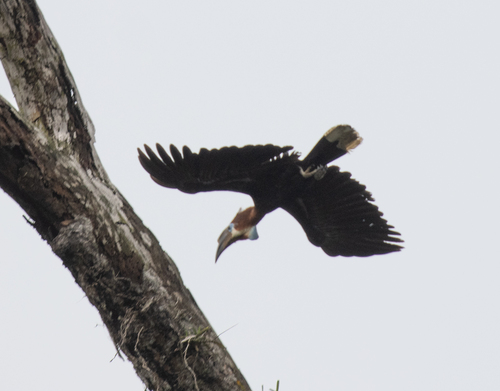
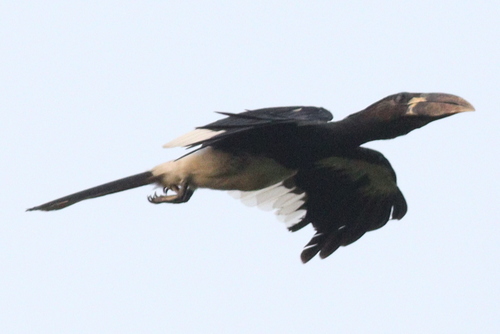
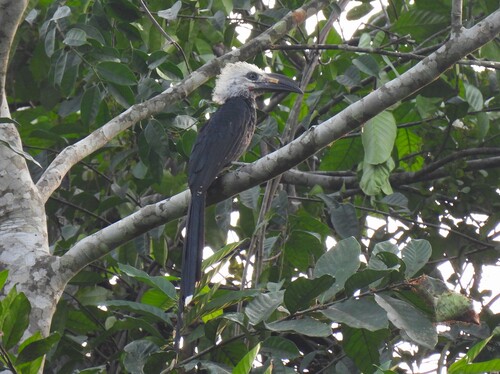
The yellow-casqued hornbill (Ceratogymna elata), also known as the yellow-casqued wattled hornbill, is found in the rainforest of coastal regions of West Africa, for example in Côte d'Ivoire. It is threatened by habitat loss.

The yellow-casqued hornbill is one of the largest birds of the West African forest, with adults weighing up to two kilograms (4+1⁄2 pounds). They live mainly in the forest canopy, rarely feeding on the ground. They live in small family groups containing at least one adult male and female, with one or two immature birds, though they sometimes gather in larger flocks to exploit a major food supply such as an ant or termite nest.

The birds are occasionally preyed upon by crowned hawk-eagles, and they respond to the presence of an eagle (sometimes indicated by its characteristic shriek) by mobbing – approaching it and emitting calls. Since the eagles depend on surprise to make a catch, this frequently causes them to leave the area. Recent research (Rainey et al., 2004) has shown that the birds respond in the same way to the alarm calls that Diana monkeys, which live in the same areas, emit if they notice an eagle, and that they can distinguish the calls made by the monkeys in the presence of eagles from those they make in the presence of leopards, which prey on the monkeys but not on the hornbills. Wikipedia →

Sounds

Call0:53

Sierra Leone · 2022

© Brendan Sloan · XC905397 · CC BY-NC-ND 4.0

Song0:14

Cameroon · 2012

© Mike Nelson · XC99864 · CC BY-NC-ND 2.5

Call0:39

Ivory Coast · 2018

© Étienne Leroy · XC411791 · CC BY-NC-SA 4.0

Global Distribution

Parks Where Found

# Park Country Daily sighting probability
1 Taï National Park 🇨🇮 Ivory Coast
~40%

More parks will be added in future updates.

Zoos & Centres Where Found

# Zoo / Centre Country
1 Memphis Zoo 🇺🇸 United States In captivity
2 Hong Kong Zoological and Botanical Gardens 🇨🇳 China In captivity
3 Aviary 🇭🇰 Hong Kong SAR China In captivity
4 Ocean Park Hong Kong 🇨🇳 China In captivity

Before you go

What are the chances of seeing a Yellow-casqued Hornbill in Taï National Park?

Likely

About 40% of wildlife watchers report a Yellow-casqued Hornbill sighting in Taï National Park on a given day, based on 28 verified sightings from GBIF citizen-science data from 2019 to 2026. It is the 4th most-seen of the 74 birds we can rate there. Over three days the chance rises to about 70%, and over a week to over 90%, if each day is a fresh chance.

What time of day is best to see a Yellow-casqued Hornbill?

Between 7 and 10 am

Across all the parks we cover, that three-hour window holds the most Yellow-casqued Hornbill sightings with a recorded time, and about 8 in 10 of them come between 6 am and 6 pm: it is a daytime animal.

Where else can you see a Yellow-casqued Hornbill?

Only Taï National Park, in our data

Taï National Park is the only park on Wallace's Line with enough records to rate Yellow-casqued Hornbill sightings: about 40% of wildlife watchers there report one on a given day.

Where does the Yellow-casqued Hornbill sighting chance come from?

GBIF citizen-science records

It is estimated from how often the Yellow-casqued Hornbill is recorded against all the birds logged in Taï National Park (28 verified sightings from 2019 to 2026), calibrated against known sighting rates. Figures are rounded to the nearest 10% because citizen-science data supports honest approximations, not decimals, and months with records from fewer than five people show "—". How it works.

← Back to Taï National Park