

Dusky Broadbill

Dusky Broadbill

Corydon sumatranus

Silhouette: Sheatherius · PhyloPic

LCLeast ConcernNTVUENCR
Daily sighting probability <5% · Rare
at Taman Negara National Park

In 3 days ~10% in a week ~20%

49 Verified sightings at Taman Negara National Park From 2019 to 2026
897 In all 9 parks
September Best month
☀️ Diurnal When it's spotted

About the Dusky Broadbill

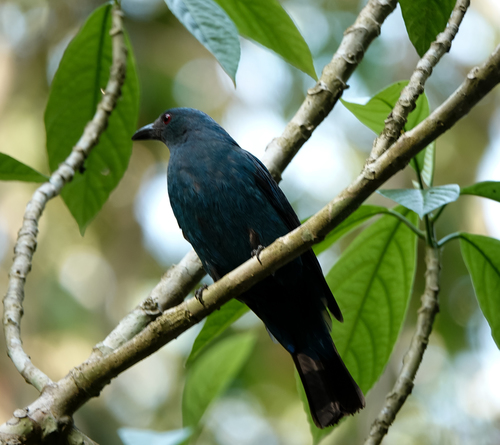
The dusky broadbill (Corydon sumatranus) is a species of bird in the family Eurylaimidae, the broadbills. It is native to Southeast Asia. It may be slowly declining due to habitat loss, especially from logging, but it has a large enough range that it is still considered to be a least-concern species.

This species, like most in its family, is an insectivore. It is mostly a charcoal gray color with a pale-yellow throat and red bill. It has a brown eye ring. There is a single white band on the wings and some white bands on the underside of the tail. The dusky broadbill is found in moist and dry tropical and subtropical broadleaf forests, tropical swamps, and cloud forests with an upper elevation limit of 2000 metres in Thailand, Myanmar, Laos, Vietnam, Cambodia, and Singapore, as well as the islands of Sumatra and Borneo. Wikipedia →

Sounds

Subsong0:57

Malaysia · 2026

© Ding Li Yong · XC1166905 · CC BY-NC-ND 4.0

Song0:29

Thailand · 2022

© Peter Ericsson · XC700259 · CC BY-NC-SA 4.0

Song0:48

Malaysia · 2014

© Peter Boesman · XC290612 · CC BY-NC-ND 4.0

Global Distribution

Parks Where Found

# Park Country Daily sighting probability
1 Way Kambas National Park 🇮🇩 Indonesia
~20%
2 Khao Luang National Park 🇹🇭 Thailand
~20%
3 Kaeng Krachan National Park 🇹🇭 Thailand
~10%
4 Danum Valley Conservation Area 🇲🇾 Malaysia
~10%
5 Kerinci Seblat National Park 🇮🇩 Indonesia
~10%
6 Taman Negara National Park 🇲🇾 Malaysia
<5%
7 Kinabatangan Wildlife Sanctuary 🇲🇾 Malaysia
<5%
8 Cat Tien National Park 🇻🇳 Vietnam
<5%
9 Khao Yai National Park 🇹🇭 Thailand
<5%

Before you go

What are the chances of seeing a Dusky Broadbill in Taman Negara National Park?

Rare

Under 5% of wildlife watchers report a Dusky Broadbill sighting in Taman Negara National Park on a given day, based on 49 verified sightings from GBIF citizen-science data from 2019 to 2026. It is the 186th most-seen of the 293 birds we can rate there. Over three days the chance rises to about 10%, and over a week to about 20%, if each day is a fresh chance.

When is the best time to see a Dusky Broadbill in Taman Negara National Park?

June to September

In those months about 10% of wildlife watchers report a Dusky Broadbill in Taman Negara National Park on a given day, against under 5% in October to May, the lowest months.

What time of day is best to see a Dusky Broadbill?

Between 8 and 11 am

Across all the parks we cover, that three-hour window holds the most Dusky Broadbill sightings with a recorded time, and about 9 in 10 of them come between 6 am and 6 pm: it is a daytime animal.

Which relatives of the Dusky Broadbill live in Taman Negara National Park?

Same family: Eurylaimidae

The closest relatives of the Dusky Broadbill that you can see in Taman Negara National Park (family Eurylaimidae, Asian and Grauer's Broadbills) are Black-and-yellow Broadbill (about 40%), Black-and-red Broadbill (about 40%) and Green Broadbill (about 40%), with each one's daily chance of a sighting.

Where does the Dusky Broadbill sighting chance come from?

GBIF citizen-science records

It is estimated from how often the Dusky Broadbill is recorded against all the birds logged in Taman Negara National Park (49 verified sightings from 2019 to 2026), calibrated against known sighting rates. Figures are rounded to the nearest 10% because citizen-science data supports honest approximations, not decimals, and months with records from fewer than five people show "—". How it works.

← Back to Taman Negara National Park