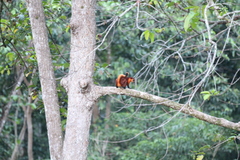
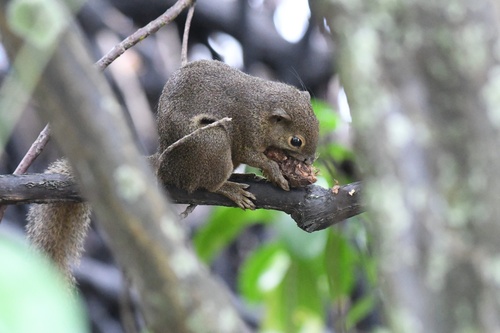
Red Giant Flying Squirrel

Red Giant Flying Squirrel

Petaurista petaurista

Silhouette: CBG Photography Group, Centre for Biodiversity Genomics (photograph) · PhyloPic

LCLeast ConcernNTVUENCR
Daily sighting probability ~20% · Possible
at Taman Negara National Park

In 3 days ~50% in a week ~80%

6 Verified sightings at Taman Negara National Park From 2019 to 2026
228 In all 4 parks
July Best month
☀️ Diurnal When it's spotted

About the Red Giant Flying Squirrel

The red giant flying squirrel or common giant flying squirrel (Petaurista petaurista) is a species of rodent in the family Sciuridae (squirrels). It is found in a wide variety of forest–types, plantations and more open habitats with scattered trees in Southeast Asia, ranging north to the Himalayas and southern and central China. One of the largest arboreal squirrels, all populations have at least some reddish-brown above and pale underparts, but otherwise there are significant geographic variations in the colours. The taxonomic position of those in the Sundaic region is generally agreed upon, but there is considerable uncertainty about the others, which variously have been included in this or other species, or recognized as their own species.

Like other flying squirrels, the red giant flying squirrel is mostly nocturnal and able to glide (not actually fly like a bat) long distances between trees by spreading out its patagium, skin between its limbs. It is a herbivore and the female has one, infrequently two, young per litter. Although declining locally due to habitat loss and to a lesser degree hunting, it remains overall common and it is not a threatened species. Wikipedia →

Global Distribution

Parks Where Found

# Park Country Daily sighting probability
1 Sepilok 🇲🇾 Malaysia
~60%
2 Namdapha National Park 🇮🇳 India
~40%
3 Danum Valley Conservation Area 🇲🇾 Malaysia
~30%
4 Taman Negara National Park 🇲🇾 Malaysia
~20%

Zoos & Centres Where Found

# Zoo / Centre Country
1 Night Safari 🇸🇬 Singapore In captivity

Before you go

What are the chances of seeing a Red Giant Flying Squirrel in Taman Negara National Park?

Possible

About 20% of wildlife watchers report a Red Giant Flying Squirrel sighting in Taman Negara National Park on a given day, based on 6 verified sightings from GBIF citizen-science data from 2019 to 2026. It is the 18th most-seen of the 22 mammals we can rate there. Over three days the chance rises to about 50%, and over a week to about 80%, if each day is a fresh chance.

When is the best time to see a Red Giant Flying Squirrel in Taman Negara National Park?

July

In that month about 40% of wildlife watchers report a Red Giant Flying Squirrel in Taman Negara National Park on a given day, against under 5% in February, April, June, August and October–December, the lowest months.

What time of day is best to see a Red Giant Flying Squirrel?

Between 1 and 4 pm

Across all the parks we cover, that three-hour window holds the most Red Giant Flying Squirrel sightings with a recorded time, and about 9 in 10 of them come between 6 am and 6 pm: it is a daytime animal.

Is Taman Negara National Park the best place to see a Red Giant Flying Squirrel?

4th of 4

Of the 4 parks where we can rate Red Giant Flying Squirrel sightings, Taman Negara National Park ranks 4th at about 20%. The best odds are in Sepilok (Malaysia, about 60%), Namdapha National Park (India, about 40%) and Danum Valley Conservation Area (Malaysia, about 30%). All parks ranked.

Which relatives of the Red Giant Flying Squirrel live in Taman Negara National Park?

Same family: Sciuridae

The closest relatives of the Red Giant Flying Squirrel that you can see in Taman Negara National Park (family Sciuridae, Squirrels) are Prevost's Squirrel (about 40%), Black Giant Squirrel (about 40%) and Plantain Squirrel (about 30%), with each one's daily chance of a sighting.

Where does the Red Giant Flying Squirrel sighting chance come from?

GBIF citizen-science records

It is estimated from how often the Red Giant Flying Squirrel is recorded against all the mammals logged in Taman Negara National Park (6 verified sightings from 2019 to 2026), calibrated against known sighting rates. Figures are rounded to the nearest 10% because citizen-science data supports honest approximations, not decimals, and months with records from fewer than five people show "—". How it works.

← Back to Taman Negara National Park