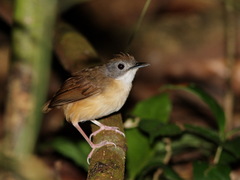
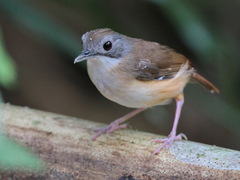
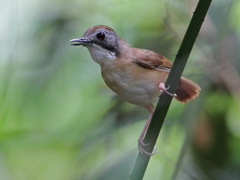
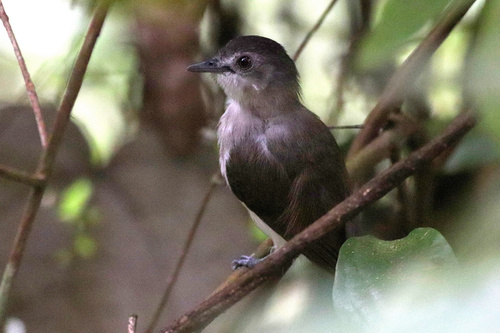
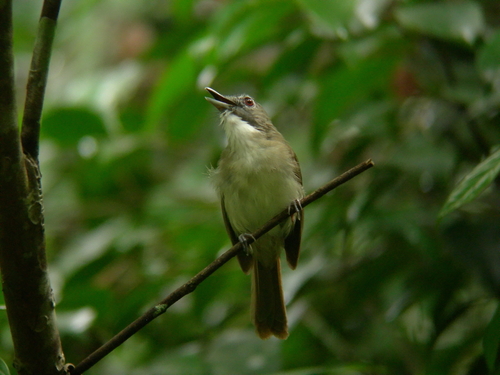
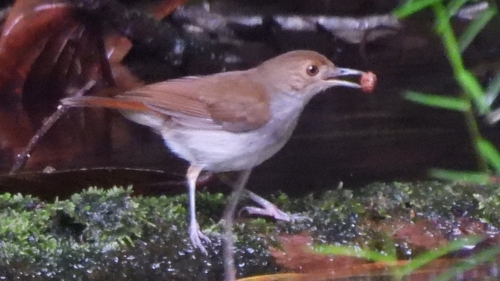
Short-tailed Babbler

Short-tailed Babbler

Pellorneum malaccense

Silhouette: Rachael Joakim · PhyloPic

LCNTNear ThreatenedVUENCR
Daily sighting probability ~20% · Possible
at Taman Negara National Park

In 3 days ~40% in a week ~70%

250 Verified sightings at Taman Negara National Park From 2019 to 2026
872 In all 8 parks
August Best month
☀️ Diurnal When it's spotted

About the Short-tailed Babbler

The mourning babbler (Pellorneum malaccense), previously the short-tailed babbler, is a species of bird in the ground babbler family Pellorneidae. It is found in the Malay Peninsula, Anambas Islands, Sumatra, Banyak Islands, Batu Islands, Riau Islands, Lingga Islands and the Natuna Islands. It was formerly considered to be conspecific with the glissando babbler (Pellorneum saturatum) and the leaflitter babbler (Pellorneum poliogene).

Its natural habitat is tropical moist lowland forests. The species is generally solitary, not joining larger mixed-species flocks, instead foraging as singles or pairs. They forage in the understory on the ground on a variety of insects including beetles, grasshoppers, and ants. Like other babblers they will use their foot to grasp food items, an unusual behaviour for passerine birds.

The mourning babbler is locally common at a number of places within its range but is considered near-threatened due to the loss of lowland forest in its range. The mourning babbler was formally described in 1844 by the German ornithologist Gustav Hartlaub. He placed it with the shortwings in the genus Brachypteryx and coined the binomial name Brachypteryx... Wikipedia →

Sounds

Song0:22

Singapore · 2026

© Joan Theng · XC1104640 · CC BY-NC-SA 4.0

Call0:12

Malaysia · 2025

© Lim Ying Hien 林勇贤 · XC1078123 · CC BY-NC-ND 4.0

Duet0:51

Indonesia · 2023

© Okamoto Keita Sin · XC838635 · CC BY-NC-SA 4.0

Global Distribution

Parks Where Found

# Park Country Daily sighting probability
1 Khao Luang National Park 🇹🇭 Thailand
~30%
2 Danum Valley Conservation Area 🇲🇾 Malaysia
~20%
3 Taman Negara National Park 🇲🇾 Malaysia
~20%
4 Way Kambas National Park 🇮🇩 Indonesia
~10%
5 Sepilok 🇲🇾 Malaysia
<5%
6 Gunung Leuser National Park 🇮🇩 Indonesia
<5%
7 Kinabatangan Wildlife Sanctuary 🇲🇾 Malaysia
<5%
8 Kinabalu Park 🇲🇾 Malaysia
<5%

Cities Where Found

# City Country Daily sighting probability
1 Kuala Lumpur 🇲🇾 Malaysia
~10%
2 Singapore 🇸🇬 Singapore
<5%

Before you go

What are the chances of seeing a Short-tailed Babbler in Taman Negara National Park?

Possible

About 20% of wildlife watchers report a Short-tailed Babbler sighting in Taman Negara National Park on a given day, based on 250 verified sightings from GBIF citizen-science data from 2019 to 2026. It is the 68th most-seen of the 293 birds we can rate there. Over three days the chance rises to about 40%, and over a week to about 70%, if each day is a fresh chance.

When is the best time to see a Short-tailed Babbler in Taman Negara National Park?

August

In that month about 30% of wildlife watchers report a Short-tailed Babbler in Taman Negara National Park on a given day, against about 10% in April–May, July and November–February, the lowest months.

What time of day is best to see a Short-tailed Babbler?

Between 8 and 11 am

Across all the parks we cover, that three-hour window holds the most Short-tailed Babbler sightings with a recorded time, and about 9 in 10 of them come between 6 am and 6 pm: it is a daytime animal.

Is Taman Negara National Park the best place to see a Short-tailed Babbler?

3rd of 8

Of the 8 parks where we can rate Short-tailed Babbler sightings, Taman Negara National Park ranks 3rd at about 20%. The best odds are in Khao Luang National Park (Thailand, about 30%) and Danum Valley Conservation Area (Malaysia, about 20%).

Where does the Short-tailed Babbler sighting chance come from?

GBIF citizen-science records

It is estimated from how often the Short-tailed Babbler is recorded against all the birds logged in Taman Negara National Park (250 verified sightings from 2019 to 2026), calibrated against known sighting rates. Figures are rounded to the nearest 10% because citizen-science data supports honest approximations, not decimals, and months with records from fewer than five people show "—". How it works.

← Back to Taman Negara National Park