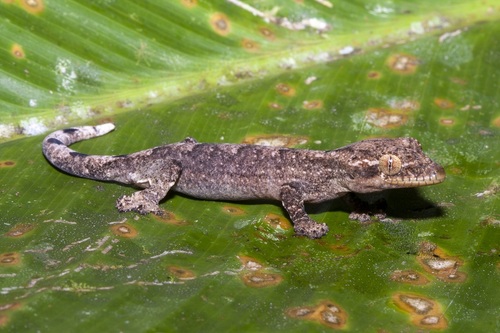
Bates's Tree Boa

Bates's Tree Boa

Corallus batesii

Silhouette: T. Michael Keesey (from a photo by Maximilian Paradiz) · PhyloPic

LCLeast ConcernNTVUENCR
Daily sighting probability ~20% · Possible
at Tambopata National Reserve

In 3 days ~40% in a week ~70%

16 Verified sightings at Tambopata National Reserve From 2019 to 2026
77 In all 2 parks
January Best month
☀️🌙 Day & Night When it's spotted

About the Bates's Tree Boa

Corallus batesii, also known commonly as the Amazon Basin emerald tree boa, is a species of snake in the subfamily Boinae of the family Boidae. The species is native to the tropical rainforests of South America. This species was revalidated from the synonymy of Corallus caninus by Henderson and colleagues in 2009.

English naturalist John Edward Gray originally described this species as Chrysenis batesii in 1860. The specific name, batesii, is in honor of Henry Walter Bates, an English naturalist and explorer, for whom Batesian mimicry is also named.

The Amazon Basin emerald tree boa has a yellow belly. The dorsum is dark green with an enamel-white vertebral stripe, which has confluent partial crossbars, often bordered by some black spots. C. batesii differs from C. caninus by the shape and the number of scales across the snout. C. batesii is bigger than C. caninus, growing to a total length (including tail) approaching 9 feet (2.7 m).

Corallus batesii is arboreal, and it is both diurnal and nocturnal. Corallus batesii is capable of hunting small airborne prey, such as bats and birds, as well as rodents, opossums... Wikipedia →

Global Distribution

Parks Where Found

# Park Country Daily sighting probability
1 Manu National Park 🇵🇪 Peru
~30%
2 Tambopata National Reserve 🇵🇪 Peru
~20%

Zoos & Centres Where Found

# Zoo / Centre Country
1 Prague Zoo 🇨🇿 Czechia In captivity
2 Shedd Aquarium 🇺🇸 United States In captivity
3 ZooParc de Beauval 🇫🇷 France In captivity
4 Zoo Miami 🇺🇸 United States In captivity
5 Zoological Garden of Belo Horizonte 🇧🇷 Brazil In captivity
6 Oklahoma City Zoo and Botanical Garden 🇺🇸 United States In captivity
7 Memphis Zoo 🇺🇸 United States In captivity
8 Zoo Atlanta 🇺🇸 United States In captivity
9 London Zoo 🇬🇧 United Kingdom In captivity
10 Riverbanks Zoo 🇺🇸 United States In captivity
11 Amaru 🇪🇨 Ecuador In captivity
12 Le Cornelle 🇮🇹 Italy In captivity
13 Parque Zoobotânico do Museu Paraense Emílio Goeldi 🇧🇷 Brazil In captivity
14 Museu Paraense Emílio Goeldi 🇧🇷 Brazil In captivity
15 Tennessee Aquarium 🇺🇸 United States In captivity
16 Jacques Huber Aquarium 🇧🇷 Brazil In captivity
17 Rákosův pavilon 🇨🇿 Czechia In captivity
18 Velemlokárium 🇨🇿 Czechia In captivity
19 Belo Horizonte Aquarium 🇧🇷 Brazil In captivity

Before you go

What are the chances of seeing a Bates's Tree Boa in Tambopata National Reserve?

Possible

About 20% of wildlife watchers report a Bates's Tree Boa sighting in Tambopata National Reserve on a given day, based on 16 verified sightings from GBIF citizen-science data from 2019 to 2026. It is the 19th most-seen of the 47 reptiles we can rate there. Over three days the chance rises to about 40%, and over a week to about 70%, if each day is a fresh chance.

When is the best time to see a Bates's Tree Boa in Tambopata National Reserve?

January, March, May–July and September–November

In those months about 20% of wildlife watchers report a Bates's Tree Boa in Tambopata National Reserve on a given day, against under 5% in February, April and December, the lowest months.

What time of day is best to see a Bates's Tree Boa?

Between 8 and 11 am

Across all the parks we cover, that three-hour window holds the most Bates's Tree Boa sightings with a recorded time, and about 6 in 10 of them come between 6 am and 6 pm: it is seen both by day and at night.

Is Tambopata National Reserve the best place to see a Bates's Tree Boa?

2nd of 2

Of the 2 parks where we can rate Bates's Tree Boa sightings, Tambopata National Reserve ranks 2nd at about 20%. The best odds are in Manu National Park (Peru, about 30%).

Where does the Bates's Tree Boa sighting chance come from?

GBIF citizen-science records

It is estimated from how often the Bates's Tree Boa is recorded against all the reptiles logged in Tambopata National Reserve (16 verified sightings from 2019 to 2026), calibrated against known sighting rates. Figures are rounded to the nearest 10% because citizen-science data supports honest approximations, not decimals, and months with records from fewer than five people show "—". How it works.

← Back to Tambopata National Reserve