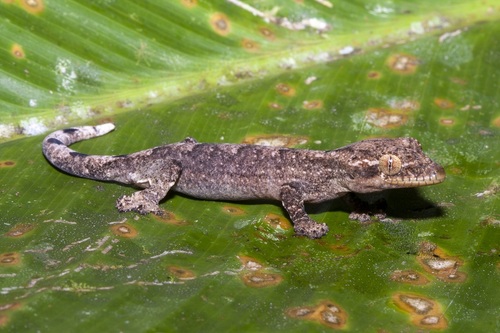
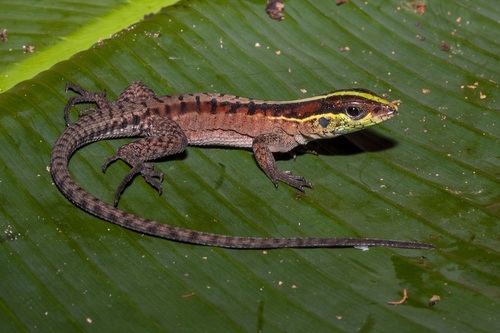
Brown-eared Anole

Brown-eared Anole

Anolis fuscoauratus

Silhouette: Sarah Werning · PhyloPic

LCLeast ConcernNTVUENCR
Daily sighting probability ~40% · Likely
at Tambopata National Reserve

In 3 days ~70% in a week >90%

66 Verified sightings at Tambopata National Reserve From 2019 to 2026
308 In all 5 parks
December Best month
☀️🌙 Day & Night When it's spotted

About the Brown-eared Anole

Anolis fuscoauratus, commonly known as the slender anole, slender Amazon anole, or brown-eared anole, is a species of lizard in the family Dactyloidae. The species is native to northern South America and Panama. It was described as a new species in 1837. In 2009 the geographic range of this widespread species was found to extend farther south to Rio de Janeiro State in Brazil.

The specific name, fuscoauratus, is derived from the Latin roots fuscus (combining form, fusco-) meaning "dark" and auratus meaning "golden". The name describes the lizard's morphological characteristic of having a dark gold skin colour.

It is called tai tsjõ in the Kwaza language of Rondônia, Brazil. The preferred natural habitat of A. fuscoauratus is forest, at altitudes from sea level to 1,800 m (5,910 ft). A. fuscoauratus is arboreal. A. fuscoauratus preys upon spiders, insects, and insect larvae. A. fuscoauratus is oviparous.

List of Anolis lizards Boulenger GA (1885). Catalogue of the Lizards in the British Museum (Natural History). Vol. II. Iguanidæ.... (Second ed.). London: Trustees... Wikipedia →

Global Distribution

Parks Where Found

# Park Country Daily sighting probability
1 Cuyabeno Wildlife Reserve 🇪🇨 Ecuador
~40%
2 Yasuní National Park 🇪🇨 Ecuador
~40%
3 Manu National Park 🇵🇪 Peru
~40%
4 Tambopata National Reserve 🇵🇪 Peru
~40%
5 Amacayacu National Natural Park 🇨🇴 Colombia
~20%

Cities Where Found

# City Country Daily sighting probability
1 Manaus 🇧🇷 Brazil
~20%

Before you go

What are the chances of seeing a Brown-eared Anole in Tambopata National Reserve?

Likely

About 40% of wildlife watchers report a Brown-eared Anole sighting in Tambopata National Reserve on a given day, based on 66 verified sightings from GBIF citizen-science data from 2019 to 2026. It is the 6th most-seen of the 47 reptiles we can rate there. Over three days the chance rises to about 70%, and over a week to over 90%, if each day is a fresh chance.

When is the best time to see a Brown-eared Anole in Tambopata National Reserve?

December

In that month about 50% of wildlife watchers report a Brown-eared Anole in Tambopata National Reserve on a given day, against about 30% in January, March–April and June–August, the lowest months. That is one of Tambopata National Reserve's wettest months, with about 400 mm of rain against 45 mm in July.

What time of day is best to see a Brown-eared Anole?

Between 7 and 10 pm

Across all the parks we cover, that three-hour window holds the most Brown-eared Anole sightings with a recorded time, and about 6 in 10 of them come between 6 pm and 6 am: it is seen both by day and at night.

Is Tambopata National Reserve the best place to see a Brown-eared Anole?

Among the best

Of the 5 parks where we can rate Brown-eared Anole sightings, Tambopata National Reserve ranks 4th at about 40%, level with the leaders once rounded. The best odds are in Cuyabeno Wildlife Reserve (Ecuador, about 40%), Yasuní National Park (Ecuador, about 40%) and Manu National Park (Peru, about 40%). All parks ranked.

Where does the Brown-eared Anole sighting chance come from?

GBIF citizen-science records

It is estimated from how often the Brown-eared Anole is recorded against all the reptiles logged in Tambopata National Reserve (66 verified sightings from 2019 to 2026), calibrated against known sighting rates. Figures are rounded to the nearest 10% because citizen-science data supports honest approximations, not decimals, and months with records from fewer than five people show "—". How it works.

← Back to Tambopata National Reserve