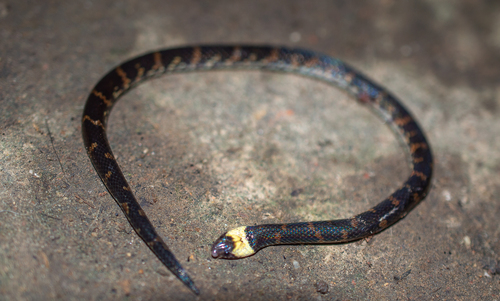
Black-headed Snake

Black-headed Snake

Tantilla melanocephala

Silhouette: Jessica Tingle · PhyloPic

LCLeast ConcernNTVUENCR
Daily sighting probability ~10% · With luck
at Tambopata National Reserve

In 3 days ~30% in a week ~50%

6 Verified sightings at Tambopata National Reserve From 2019 to 2026
6 In 1 park
March Best month
☀️ Diurnal When it's spotted

About the Black-headed Snake

Tantilla melanocephala, commonly known as the black-headed snake, the neotropical black-headed snake, and la culebra de cabeza negra in Spanish, is a small species of snake in the subfamily Colubrinae of the family Colubridae. The species is native to Central America and South America.

In Central America Tantilla melanocephala is found from Guatemala south to Panama. In South America it is found from Trinidad and Tobago south to northern Argentina. The preferred natural habitats of Tantilla melanocephala are grassland, savanna, and forest, at altitudes from sea level to 2,750 m (9,020 ft), and it has also been found in artificial habitats such as pastures, gardens, and plantations.

Tantilla melanocephala may attain a total length of 50 cm (20 in), which includes a tail 10 cm (3.9 in) long. Dorsally, it is pale brown or red, and some specimens also have 3 or 5 narrow brown stripes. The top of the head and neck are black or dark brown. Ventrally, it is yellowish white.

The dorsal scales are smooth, without apical pits, and arranged in 15 rows at midbody. Tantilla melanocephala is terrestrial and diurnal. Wikipedia →

Global Distribution

Parks Where Found

# Park Country Daily sighting probability
1 Tambopata National Reserve 🇵🇪 Peru
~10%

More parks will be added in future updates.

Cities Where Found

# City Country Daily sighting probability
1 Medellín 🇨🇴 Colombia
~10%

Before you go

What are the chances of seeing a Black-headed Snake in Tambopata National Reserve?

With luck

About 10% of wildlife watchers report a Black-headed Snake sighting in Tambopata National Reserve on a given day, based on 6 verified sightings from GBIF citizen-science data from 2019 to 2026. It is the 38th most-seen of the 47 reptiles we can rate there. Over three days the chance rises to about 30%, and over a week to about 50%, if each day is a fresh chance.

When is the best time to see a Black-headed Snake in Tambopata National Reserve?

March

In that month about 30% of wildlife watchers report a Black-headed Snake in Tambopata National Reserve on a given day, against under 5% in April–May, July and September–January, the lowest months.

What time of day is best to see a Black-headed Snake?

Between 8 and 11 am

Across all the parks we cover, that three-hour window holds the most Black-headed Snake sightings with a recorded time, and about 7 in 10 of them come between 6 am and 6 pm: it is a daytime animal.

Where else can you see a Black-headed Snake?

Only Tambopata National Reserve, in our data

Tambopata National Reserve is the only park on Wallace's Line with enough records to rate Black-headed Snake sightings: about 10% of wildlife watchers there report one on a given day.

Where does the Black-headed Snake sighting chance come from?

GBIF citizen-science records

It is estimated from how often the Black-headed Snake is recorded against all the reptiles logged in Tambopata National Reserve (6 verified sightings from 2019 to 2026), calibrated against known sighting rates. Figures are rounded to the nearest 10% because citizen-science data supports honest approximations, not decimals, and months with records from fewer than five people show "—". How it works.

← Back to Tambopata National Reserve