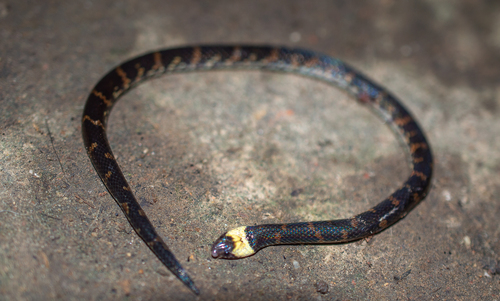
Catesby's Snail-eater

Catesby's Snail-eater

Dipsas catesbyi

Silhouette: Alex Slavenko · PhyloPic

LCLeast ConcernNTVUENCR
Daily sighting probability ~20% · Possible
at Tambopata National Reserve

In 3 days ~40% in a week ~70%

17 Verified sightings at Tambopata National Reserve From 2019 to 2026
55 In all 3 parks
September Best month
🌙 Nocturnal When it's spotted

About the Catesby's Snail-eater

Catesby's snail-eater (Dipsas catesbyi), also commonly known as Catesby's snail sucker, is a nocturnal species of non-venomous snake in the family Colubridae. The species is native to northern South America. In June 2021 upon manipulation, a snake of this species presented vocalization, a duration of 0.06 seconds, reaching 3036 Hz in its peak frequency with a modulated note, emitted through exhalation of air through the larynx, being the first record of a snake call in South America.

The specific name, catesbyi, is in honor of English naturalist Mark Catesby. D. catesbyi is found in Bolivia, Brazil, Guyana, Colombia, Ecuador, French Guiana, Peru, Suriname, and Venezuela. D.catesbyi has a thin body, with the maximum recorded length sitting at 598 mm (23.5 in) for males and 585 mm (23.0 in) for females. The number of ventral scales have been recorded to vary from 164 to 220 for males and from 167 to 200 for females, while the number of subcaudal scales have been recorded to vary from 70 to 120 for males and 60 to 102 for females. A D.catesbyi has between 10 to 40 dark brown to black blotches, usually with white outlines, along the length... Wikipedia →

Global Distribution

Parks Where Found

# Park Country Daily sighting probability
1 Manu National Park 🇵🇪 Peru
~20%
2 Yasuní National Park 🇪🇨 Ecuador
~20%
3 Tambopata National Reserve 🇵🇪 Peru
~20%

Before you go

What are the chances of seeing a Catesby's Snail-eater in Tambopata National Reserve?

Possible

About 20% of wildlife watchers report a Catesby's Snail-eater sighting in Tambopata National Reserve on a given day, based on 17 verified sightings from GBIF citizen-science data from 2019 to 2026. It is the 19th most-seen of the 47 reptiles we can rate there. Over three days the chance rises to about 40%, and over a week to about 70%, if each day is a fresh chance.

When is the best time to see a Catesby's Snail-eater in Tambopata National Reserve?

September

In that month about 30% of wildlife watchers report a Catesby's Snail-eater in Tambopata National Reserve on a given day, against under 5% in April–May and December–January, the lowest months. That is one of Tambopata National Reserve's driest months, with about 90 mm of rain against 420 mm in February.

What time of day is best to see a Catesby's Snail-eater?

Between 7 and 10 pm

Across all the parks we cover, that three-hour window holds the most Catesby's Snail-eater sightings with a recorded time, and about 8 in 10 of them come between 6 pm and 6 am: it is mostly seen at night.

Is Tambopata National Reserve the best place to see a Catesby's Snail-eater?

Among the best

Of the 3 parks where we can rate Catesby's Snail-eater sightings, Tambopata National Reserve ranks 3rd at about 20%, level with the leaders once rounded. The best odds are in Manu National Park (Peru, about 20%) and Yasuní National Park (Ecuador, about 20%).

Which relatives of the Catesby's Snail-eater live in Tambopata National Reserve?

Same family: Colubridae

The closest relatives of the Catesby's Snail-eater that you can see in Tambopata National Reserve (family Colubridae, Colubrid Snakes) are Blunthead Tree Snake (about 30%), Tschudi's False Coral Snake (about 20%) and Wucherer's Ground Snake (about 20%), with each one's daily chance of a sighting.

Where does the Catesby's Snail-eater sighting chance come from?

GBIF citizen-science records

It is estimated from how often the Catesby's Snail-eater is recorded against all the reptiles logged in Tambopata National Reserve (17 verified sightings from 2019 to 2026), calibrated against known sighting rates. Figures are rounded to the nearest 10% because citizen-science data supports honest approximations, not decimals, and months with records from fewer than five people show "—". How it works.

← Back to Tambopata National Reserve