
Black-necked Amazonian Coralsnake

Black-necked Amazonian Coralsnake

Micrurus obscurus

Silhouette: Edwin Price · PhyloPic

LCLeast ConcernNTVUENCR
Daily sighting probability ~10% · With luck
at Tambopata National Reserve

In 3 days ~30% in a week ~60%

12 Verified sightings at Tambopata National Reserve From 2019 to 2026
32 In all 2 parks
February Best month
🌅 Crepuscular When it's spotted

About the Black-necked Amazonian Coralsnake

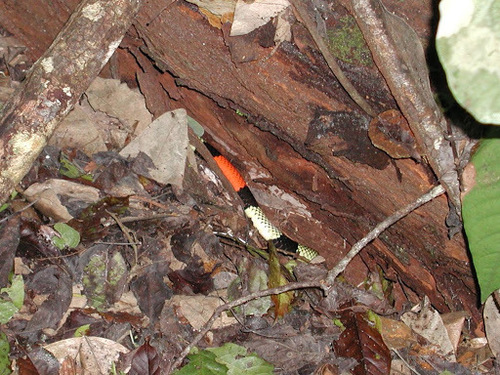
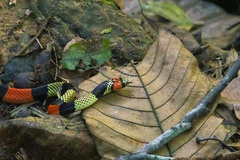
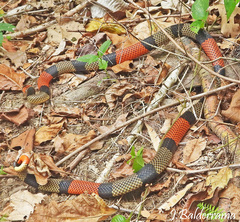
Micrurus obscurus, also known commonly as the black-neck Amazonian coral snake and the Bolivian coral snake, is a species of venomous snake in the family Elapidae. The species is native to northwestern South America. The color pattern of Micrurus obscurus consists of black, red, and yellow (or white) rings. The black rings are arranged in triads of three black rings separated by two yellow rings. The triads are separated by red rings. The yellow rings are as wide or wider than the black rings. The dorsal scales within the yellow rings are heavily marked with black on the tips and edges, making the rings appear grayish or greenish. The red rings are the widest and also contain black marks. Most specimens have 4–6 triads on the body.

Males have 200–228 ventrals and 17–22 subcaudals. Females have 207–225 ventrals and 16–22 subcaudals. M. obscurus is a large species. The holotype of the synonym Elaps princeps has a total length (tail included) of 1.22 m (4.0 ft).

Micrurus obscurus is found in northern Bolivia, northwestern Brazil, southeastern Colombia, eastern Ecuador, and eastern Peru. The preferred natural habitat of Micrurus... Wikipedia →

Sounds

Recording0:49

Peru · 2025

© luckyben · iNaturalist · CC BY-NC 4.0

Global Distribution

Parks Where Found

# Park Country Daily sighting probability
1 Manu National Park 🇵🇪 Peru
~20%
2 Tambopata National Reserve 🇵🇪 Peru
~10%

Before you go

What are the chances of seeing a Black-necked Amazonian Coralsnake in Tambopata National Reserve?

With luck

About 10% of wildlife watchers report a Black-necked Amazonian Coralsnake sighting in Tambopata National Reserve on a given day, based on 12 verified sightings from GBIF citizen-science data from 2019 to 2026. It is the 30th most-seen of the 47 reptiles we can rate there. Over three days the chance rises to about 30%, and over a week to about 60%, if each day is a fresh chance.

When is the best time to see a Black-necked Amazonian Coralsnake in Tambopata National Reserve?

February, May–June and September–October

In those months about 20% of wildlife watchers report a Black-necked Amazonian Coralsnake in Tambopata National Reserve on a given day, against under 5% in March–April and December–January, the lowest months.

What time of day is best to see a Black-necked Amazonian Coralsnake?

Between 4 and 7 pm

Across all the parks we cover, that three-hour window holds the most Black-necked Amazonian Coralsnake sightings with a recorded time, and about half of them come between 6 pm and 6 am: it is most active around dawn and dusk.

Is Tambopata National Reserve the best place to see a Black-necked Amazonian Coralsnake?

2nd of 2

Of the 2 parks where we can rate Black-necked Amazonian Coralsnake sightings, Tambopata National Reserve ranks 2nd at about 10%. The best odds are in Manu National Park (Peru, about 20%).

Where does the Black-necked Amazonian Coralsnake sighting chance come from?

GBIF citizen-science records

It is estimated from how often the Black-necked Amazonian Coralsnake is recorded against all the reptiles logged in Tambopata National Reserve (12 verified sightings from 2019 to 2026), calibrated against known sighting rates. Figures are rounded to the nearest 10% because citizen-science data supports honest approximations, not decimals, and months with records from fewer than five people show "—". How it works.

← Back to Tambopata National Reserve