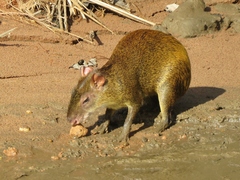
Brown Agouti

Brown Agouti

Dasyprocta variegata

Silhouette: Margot Michaud · PhyloPic

Daily sighting probability ~30% · Possible
at Tambopata National Reserve

In 3 days ~60% in a week ~90%

42 Verified sightings at Tambopata National Reserve From 2019 to 2026
62 In all 2 parks
May Best month
☀️ Diurnal When it's spotted

About the Brown Agouti

The brown agouti (Dasyprocta variegata) is a species of agouti in the family Dasyproctidae that is native to portions of central or southeastern Peru, east to western Brazil (specifically within the administrative divisions of Acre, Amazonas, and Rondônia), south to a strip of Bolivia. It was originally regarded as conspecific with the Central American agouti (Dasyprocta punctata), but revised as distinct.

The brown agouti has an orange-brown body, with an average length of 61 cm (24.01 in), and a weight of 1.8 kg (3.96 lbs). Dark head, rump, and midline of the back. Peruvian individuals have a fairly different and distinctive coloration (see text below). The species is commonly preyed upon by the South American jaguar.

The brown agouti is known to reside near Brazil nut trees (Bertholletia excelsa) in forested cover, and around gardens, or plantations. The brown agouti was previously regarded as a subspecies of the Central American agouti (Dasyprocta punctata), but has now been elevated to species status, for multivariate statistical analysis and morphological differences have revealed such. Although there is evidence for a species elevation, most authorities still... Wikipedia →

Global Distribution

Parks Where Found

# Park Country Daily sighting probability
1 Tambopata National Reserve 🇵🇪 Peru
~30%
2 Manu National Park 🇵🇪 Peru
~20%

Zoos & Centres Where Found

# Zoo / Centre Country
1 Leipzig Zoological Garden 🇩🇪 Germany In captivity
2 Zoologischer Garten Leipzig 🇩🇪 Germany In captivity
3 Senda Verde (Wildlife Sanctuary) 🇧🇴 Bolivia In captivity
4 Zoológico de Fauna Sudamericana 🇧🇴 Bolivia In captivity
5 Odsherred Zoo 🇩🇰 Denmark In captivity
6 Zoologico Mundo Andino - Tipon 🇵🇪 Peru In captivity

Before you go

What are the chances of seeing a Brown Agouti in Tambopata National Reserve?

Possible

About 30% of wildlife watchers report a Brown Agouti sighting in Tambopata National Reserve on a given day, based on 42 verified sightings from GBIF citizen-science data from 2019 to 2026. It is the 7th most-seen of the 28 mammals we can rate there. Over three days the chance rises to about 60%, and over a week to about 90%, if each day is a fresh chance.

When is the best time to see a Brown Agouti in Tambopata National Reserve?

April–May and November

In those months about 40% of wildlife watchers report a Brown Agouti in Tambopata National Reserve on a given day, against about 20% in June–July, September and December–February, the lowest months.

What time of day is best to see a Brown Agouti?

Between 2 and 5 pm

Across all the parks we cover, that three-hour window holds the most Brown Agouti sightings with a recorded time, and about 8 in 10 of them come between 6 am and 6 pm: it is a daytime animal.

Is Tambopata National Reserve the best place to see a Brown Agouti?

Yes

Of the 2 parks where we can rate Brown Agouti sightings, Tambopata National Reserve has the highest daily chance: about 30%. Next come Manu National Park (Peru, about 20%).

Which relatives of the Brown Agouti live in Tambopata National Reserve?

Same order: Rodentia

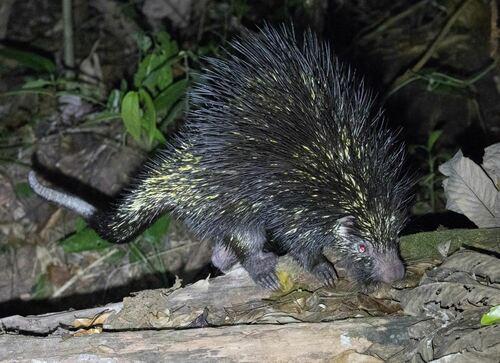
The closest relatives of the Brown Agouti that you can see in Tambopata National Reserve (order Rodentia, Rodents) are Capybara (about 50%), Southern Amazon Red Squirrel (about 30%) and Bicolor-spined Porcupine (about 10%), with each one's daily chance of a sighting.

Where does the Brown Agouti sighting chance come from?

GBIF citizen-science records

It is estimated from how often the Brown Agouti is recorded against all the mammals logged in Tambopata National Reserve (42 verified sightings from 2019 to 2026), calibrated against known sighting rates. Figures are rounded to the nearest 10% because citizen-science data supports honest approximations, not decimals, and months with records from fewer than five people show "—". How it works.

← Back to Tambopata National Reserve