
Southern Amazon Red Squirrel

Southern Amazon Red Squirrel

Sciurus spadiceus

Silhouette: Ferran Sayol · PhyloPic

LCLeast ConcernNTVUENCR
Daily sighting probability ~30% · Possible
at Tambopata National Reserve

In 3 days ~70% in a week ~90%

45 Verified sightings at Tambopata National Reserve From 2019 to 2026
57 In all 2 parks
May Best month
☀️ Diurnal When it's spotted

About the Southern Amazon Red Squirrel

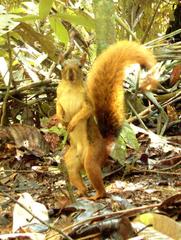
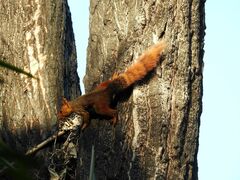
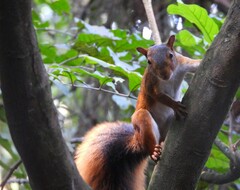
The southern Amazon red squirrel (Sciurus spadiceus), is a squirrel species from South America where it inhabits forests in much of north-western South America east of the Andes. Three subspecies are currently recognised. It is a dark red colour, or a dark brown grizzled with ochre, has whitish underparts and grows to a total length of 48 to 63 cm (19 to 25 in), including a very long tail. It spends much of its time on the ground in the undergrowth and feeds largely on nuts. Little is known of its breeding habits, but it is a sociable species, several individuals often feeding together in one tree. This squirrel faces no particular threats, has a wide range and is relatively common, and the International Union for Conservation of Nature lists it as a "least-concern species".

One of the largest species of squirrel in its range, S. spadiceus ranges from 48 to 63 cm (19 to 25 in) in total length, including a very long, 24 to 34 cm (9.4 to 13.4 in), tail. Males and females are similarly sized, and weigh between 570 and 660 g (20 and 23 oz). The fur is typically reddish-brown over most of the body, grizzled with paler yellow, but can be dark brown to near-black, especially... Wikipedia →

Sounds

Recording0:11

Bolivia · 2025

© Carlos Justiniano Parada · iNaturalist · CC BY-NC 4.0

Global Distribution

Parks Where Found

# Park Country Daily sighting probability
1 Tambopata National Reserve 🇵🇪 Peru
~30%
2 Manu National Park 🇵🇪 Peru
~10%

Cities Where Found

# City Country Daily sighting probability
1 Santa Cruz de la Sierra 🇧🇴 Bolivia
~40%

Before you go

What are the chances of seeing a Southern Amazon Red Squirrel in Tambopata National Reserve?

Possible

About 30% of wildlife watchers report a Southern Amazon Red Squirrel sighting in Tambopata National Reserve on a given day, based on 45 verified sightings from GBIF citizen-science data from 2019 to 2026. It is the 6th most-seen of the 28 mammals we can rate there. Over three days the chance rises to about 70%, and over a week to about 90%, if each day is a fresh chance.

When is the best time to see a Southern Amazon Red Squirrel in Tambopata National Reserve?

May

In that month about 50% of wildlife watchers report a Southern Amazon Red Squirrel in Tambopata National Reserve on a given day, against about 20% in February, June, September and December, the lowest months.

What time of day is best to see a Southern Amazon Red Squirrel?

Between 7 and 10 am

Across all the parks we cover, that three-hour window holds the most Southern Amazon Red Squirrel sightings with a recorded time, and about 9 in 10 of them come between 6 am and 6 pm: it is a daytime animal.

Is Tambopata National Reserve the best place to see a Southern Amazon Red Squirrel?

Yes

Of the 2 parks where we can rate Southern Amazon Red Squirrel sightings, Tambopata National Reserve has the highest daily chance: about 30%. Next come Manu National Park (Peru, about 10%).

Which relatives of the Southern Amazon Red Squirrel live in Tambopata National Reserve?

Same order: Rodentia

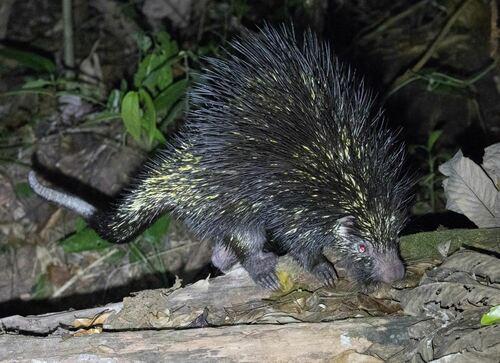
The closest relatives of the Southern Amazon Red Squirrel that you can see in Tambopata National Reserve (order Rodentia, Rodents) are Capybara (about 50%), Brown Agouti (about 30%) and Bicolor-spined Porcupine (about 10%), with each one's daily chance of a sighting.

Where does the Southern Amazon Red Squirrel sighting chance come from?

GBIF citizen-science records

It is estimated from how often the Southern Amazon Red Squirrel is recorded against all the mammals logged in Tambopata National Reserve (45 verified sightings from 2019 to 2026), calibrated against known sighting rates. Figures are rounded to the nearest 10% because citizen-science data supports honest approximations, not decimals, and months with records from fewer than five people show "—". How it works.

← Back to Tambopata National Reserve