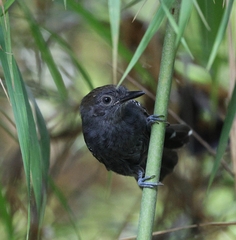
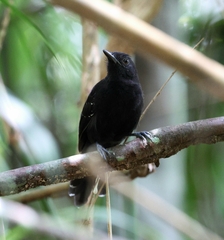
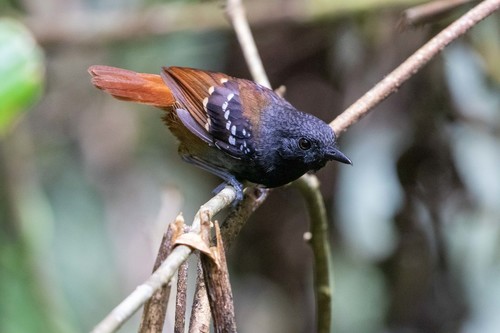
Manú Antbird

Manú Antbird

Cercomacra manu

Silhouette: Sheatherius · PhyloPic

LCLeast ConcernNTVUENCR
Daily sighting probability <5% · Rare
at Tambopata National Reserve

In 3 days <5% in a week ~10%

38 Verified sightings at Tambopata National Reserve From 2019 to 2026
371 In all 2 parks
May Best month
☀️ Diurnal When it's spotted

About the Manú Antbird

The Manu antbird (Cercomacra manu) is a species of bird in subfamily Thamnophilinae of family Thamnophilidae, the "typical antbirds". It is found in Brazil, Bolivia, and Peru. The type specimen of the Manu antbird was collected in 1980 and was identified as this new species. A specimen collected in the same general region in 1964 was retroactively determined to also be a Manu antbird; it had been thought to be a jet antbird (C. nigricans). Its closest relatives within genus Cercomacra have not been determined.

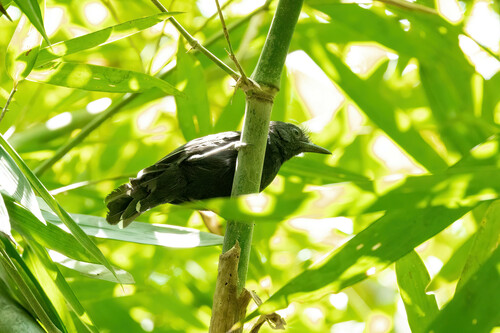
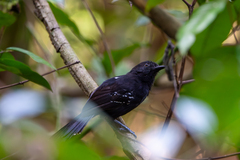
The Manu antbird is monotypic. The Manu antbird is 14 to 15.5 cm (5.5 to 6.1 in) long and weighs 16 to 20 g (0.56 to 0.71 oz). Adult males are mostly very dark gray, with paler gray on their face, flanks, and undertail coverts. They have a mostly hidden white patch between their scapulars, white tips on their wing coverts, and white tips on their tail feathers. Females have an olive-brown crown and back with a hidden white interscapular patch. Their wing coverts are dusky brown to black with white tips. Their tail is dark gray-brown with white crescents near the feather tips. Their face and underparts are neutral gray with faint... Wikipedia →
Sounds

Song0:18

Brazil · 2011

© Tulio Dornas · XC794746 · CC BY-NC-SA 4.0

Call0:26

Bolivia · 2021

© Jacob Wijpkema · XC673251 · CC BY-NC-SA 4.0

Recording0:22

Brazil · 2021

© FilhoManfredini · XC664465 · CC BY-NC-SA 4.0

Global Distribution

Parks Where Found

# Park Country Daily sighting probability
1 Manu National Park 🇵🇪 Peru
~10%
2 Tambopata National Reserve 🇵🇪 Peru
<5%

Before you go

What are the chances of seeing a Manú Antbird in Tambopata National Reserve?

Rare

Under 5% of wildlife watchers report a Manú Antbird sighting in Tambopata National Reserve on a given day, based on 38 verified sightings from GBIF citizen-science data from 2019 to 2026. It is the 412th most-seen of the 550 birds we can rate there. Over three days the chance rises to under 5%, and over a week to about 10%, if each day is a fresh chance.

When is the best time to see a Manú Antbird in Tambopata National Reserve?

Any time of year

In every month with enough records, under 5% of wildlife watchers report a Manú Antbird in Tambopata National Reserve on a given day, so our monthly data shows no clear season.

What time of day is best to see a Manú Antbird?

Between 7 and 10 am

Across all the parks we cover, that three-hour window holds the most Manú Antbird sightings with a recorded time, and about 7 in 10 of them come between 6 am and 6 pm: it is a daytime animal.

Is Tambopata National Reserve the best place to see a Manú Antbird?

2nd of 2

Of the 2 parks where we can rate Manú Antbird sightings, Tambopata National Reserve ranks 2nd at under 5%. The best odds are in Manu National Park (Peru, about 10%).

Where does the Manú Antbird sighting chance come from?

GBIF citizen-science records

It is estimated from how often the Manú Antbird is recorded against all the birds logged in Tambopata National Reserve (38 verified sightings from 2019 to 2026), calibrated against known sighting rates. Figures are rounded to the nearest 10% because citizen-science data supports honest approximations, not decimals, and months with records from fewer than five people show "—". How it works.

← Back to Tambopata National Reserve