Black Antbird

Black Antbird

Cercomacra serva

Silhouette: Sheatherius · PhyloPic

LCLeast ConcernNTVUENCR
Daily sighting probability <5% · Rare
at Tambopata National Reserve

In 3 days ~10% in a week ~20%

80 Verified sightings at Tambopata National Reserve From 2019 to 2026
298 In all 4 parks
May Best month
☀️ Diurnal When it's spotted

About the Black Antbird

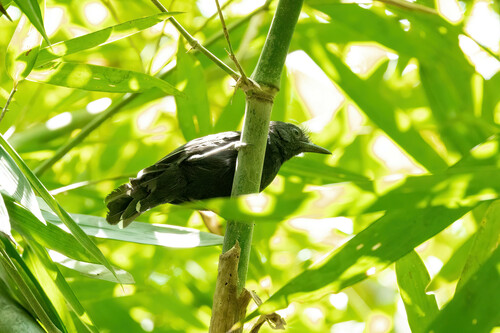
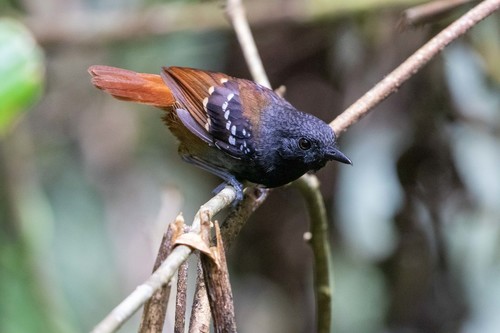
The black antbird (Cercomacroides serva) is a species of passerine bird in subfamily Thamnophilinae of family Thamnophilidae, the "typical antbirds". It is found in Bolivia, Brazil, Colombia, Ecuador, and Peru. The black antbird was described by the English zoologist Philip Sclater in 1858 and given the binomial name Pyriglena serva. It was later included in genus Cercomacra but when a molecular phylogenetic study published in 2014 found that Cercomacra was polyphyletic, the genus was split to create two monophyletic genera, and six species including the black antbird were moved to the newly erected genus Cercomacroides.

The black antbird is monotypic. The black antbird is 13.5 to 15 cm (5.3 to 5.9 in) long and weighs 15 to 17 g (0.53 to 0.60 oz). Males are almost entirely blackish to dark gray. They have a white patch between their scapulars, a small hidden white patch under the scapulars, gray edges on their flight feathers, and white tips on their wing coverts. Females have an olive-tinged dark gray crown, upperparts, wings, and tail with a small white interscapular patch. Their wing coverts and the edges of their flight feathers... Wikipedia →

Sounds

Song1:17

Ecuador · 2025

© Manuel Sánchez-Nivicela · XC1161501 · CC BY-NC-ND 4.0

Duet1:02

Bolivia · 2021

© Jacob Wijpkema · XC692575 · CC BY-NC-SA 4.0

Call0:23

Ecuador · 1992

© Paul Coopmans · XC264613 · CC BY-NC-SA 4.0

Global Distribution

Parks Where Found

# Park Country Daily sighting probability
1 Manu National Park 🇵🇪 Peru
<5%
2 Tambopata National Reserve 🇵🇪 Peru
<5%
3 Amacayacu National Natural Park 🇨🇴 Colombia
<5%
4 Yasuní National Park 🇪🇨 Ecuador
<5%

Before you go

What are the chances of seeing a Black Antbird in Tambopata National Reserve?

Rare

Under 5% of wildlife watchers report a Black Antbird sighting in Tambopata National Reserve on a given day, based on 80 verified sightings from GBIF citizen-science data from 2019 to 2026. It is the 348th most-seen of the 550 birds we can rate there. Over three days the chance rises to about 10%, and over a week to about 20%, if each day is a fresh chance.

When is the best time to see a Black Antbird in Tambopata National Reserve?

May

In that month about 10% of wildlife watchers report a Black Antbird in Tambopata National Reserve on a given day, against under 5% in June to April, the lowest months.

What time of day is best to see a Black Antbird?

Between 7 and 10 am

Across all the parks we cover, that three-hour window holds the most Black Antbird sightings with a recorded time, and about 8 in 10 of them come between 6 am and 6 pm: it is a daytime animal.

Is Tambopata National Reserve the best place to see a Black Antbird?

Among the best

Of the 4 parks where we can rate Black Antbird sightings, Tambopata National Reserve ranks 2nd at under 5%, level with the leaders once rounded. The best odds are in Manu National Park (Peru, under 5%).

Where does the Black Antbird sighting chance come from?

GBIF citizen-science records

It is estimated from how often the Black Antbird is recorded against all the birds logged in Tambopata National Reserve (80 verified sightings from 2019 to 2026), calibrated against known sighting rates. Figures are rounded to the nearest 10% because citizen-science data supports honest approximations, not decimals, and months with records from fewer than five people show "—". How it works.

← Back to Tambopata National Reserve