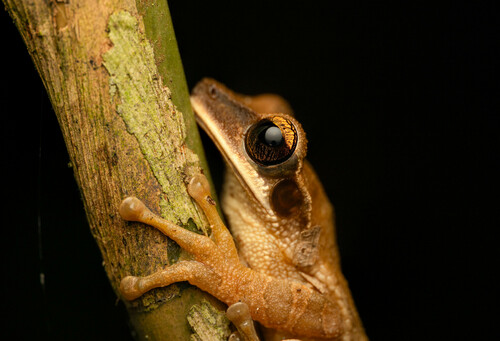
Map Tree Frog

Map Tree Frog

Boana geographica

Silhouette: Andy Wilson · PhyloPic

LCLeast ConcernNTVUENCR
Daily sighting probability ~20% · Possible
at Tambopata National Reserve

In 3 days ~50% in a week ~80%

35 Verified sightings at Tambopata National Reserve From 2019 to 2026
122 In all 2 parks
July Best month
🌙 Nocturnal When it's spotted

About the Map Tree Frog

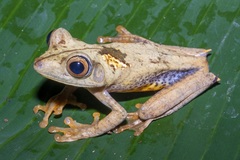
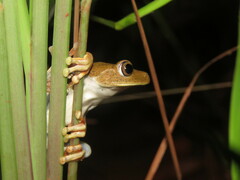
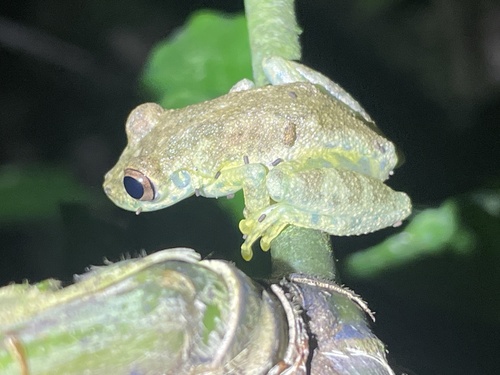
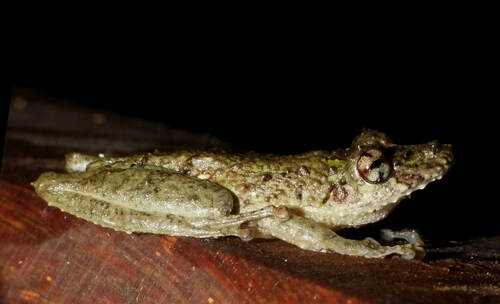
The map tree frog (Boana geographica) is a species of frog in the family Hylidae found in Bolivia, Brazil, Colombia, Ecuador, French Guiana, Guyana, Peru, Suriname, Trinidad and Tobago, and Venezuela. Its natural habitats are subtropical or tropical dry forests, subtropical or tropical moist lowland forests, moist savanna, subtropical or tropical seasonally wet or flooded lowland grassland, rivers, freshwater lakes, intermittent freshwater lakes, freshwater marshes, plantations, rural gardens, heavily degraded former forests, ponds, and aquaculture ponds. It was previously known as Hyla geographica. The name comes from the reticulated map-like patterns on its eyelids (palpebrum).

The black tadpoles congregate in dense clusters in ponds or other calm waters. Wikipedia →

Sounds

Recording1:25

Suriname · 1968

© M.S. Hoogmoed · XC882709 · CC BY 4.0

Global Distribution

Parks Where Found

# Park Country Daily sighting probability
1 Manu National Park 🇵🇪 Peru
~30%
2 Tambopata National Reserve 🇵🇪 Peru
~20%

Before you go

What are the chances of seeing a Map Tree Frog in Tambopata National Reserve?

Possible

About 20% of wildlife watchers report a Map Tree Frog sighting in Tambopata National Reserve on a given day, based on 35 verified sightings from GBIF citizen-science data from 2019 to 2026. It is the 11th most-seen of the 44 amphibians we can rate there. Over three days the chance rises to about 50%, and over a week to about 80%, if each day is a fresh chance.

When is the best time to see a Map Tree Frog in Tambopata National Reserve?

July

In that month about 40% of wildlife watchers report a Map Tree Frog in Tambopata National Reserve on a given day, against under 5% in November to January, the lowest months. That is one of Tambopata National Reserve's driest months, with about 45 mm of rain against 420 mm in February.

What time of day is best to see a Map Tree Frog?

Between 7 and 10 pm

Across all the parks we cover, that three-hour window holds the most Map Tree Frog sightings with a recorded time, and about 9 in 10 of them come between 6 pm and 6 am: it is mostly seen at night.

Is Tambopata National Reserve the best place to see a Map Tree Frog?

2nd of 2

Of the 2 parks where we can rate Map Tree Frog sightings, Tambopata National Reserve ranks 2nd at about 20%. The best odds are in Manu National Park (Peru, about 30%).

Which relatives of the Map Tree Frog live in Tambopata National Reserve?

Same genus: Boana

The closest relatives of the Map Tree Frog that you can see in Tambopata National Reserve (genus Boana, Gladiator Tree Frogs) are Rusty Tree Frog (about 20%), Rocket Tree Frog (about 10%) and Sara Tree Frog (about 10%), with each one's daily chance of a sighting.

Where does the Map Tree Frog sighting chance come from?

GBIF citizen-science records

It is estimated from how often the Map Tree Frog is recorded against all the amphibians logged in Tambopata National Reserve (35 verified sightings from 2019 to 2026), calibrated against known sighting rates. Figures are rounded to the nearest 10% because citizen-science data supports honest approximations, not decimals, and months with records from fewer than five people show "—". How it works.

← Back to Tambopata National Reserve