Razor-billed Curassow

Razor-billed Curassow

Mitu tuberosum

Silhouette: Sheatherius · PhyloPic

LCNTNear ThreatenedVUENCR
Daily sighting probability ~10% · With luck
at Tambopata National Reserve

In 3 days ~20% in a week ~50%

283 Verified sightings at Tambopata National Reserve From 2019 to 2026
695 In all 3 parks
September Best month
☀️ Diurnal When it's spotted

About the Razor-billed Curassow

The razor-billed curassow (Mitu tuberosum) is a species of bird in the family Cracidae, the chachalacas, guans, and curassows. It is found in Bolivia, Brazil, Colombia, and Peru. The razor-billed curassow was originally placed in genus Crax but genetic data confirm that Mitu is a valid genus. It was for a time treated as a subspecies of Alagoas curassow (Mitu mitu) and they are now treated as sister species. The razor-billed curassow is monotypic.

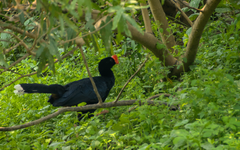
The razor-billed curassow is 83 to 89 cm (2.7 to 2.9 ft) long and males weigh about 3,860 g (8.5 lb). Their plumage is mostly black with a strong purplish blue gloss. The lower belly and undertail coverts are chestnut and the tips of the tail feathers white. It has a tall ragged crest. Its large bright red bill is laterally compressed, which gives the species its common name.

The razor-billed curassow is found in much of Amazonia, mostly south of the Amazon River in eastern Peru, northern Bolivia, and northern Brazil all the way to the Atlantic coast. It is found north of the Amazon in southeastern Colombia, extreme northeastern Peru, and Brazil as far east as... Wikipedia →

Sounds

Song0:21

Brazil · 2022

© JAYRSON ARAUJO DE OLIVEIRA · XC768944 · CC BY-NC-SA 4.0

Call0:59

Peru · 2011

© Eric DeFonso · XC123101 · CC BY-NC-SA 3.0

Alarm call0:12

Brazil · 2022

© Nunes D´Acosta · XC723321 · CC BY-NC-SA 4.0

Global Distribution

Parks Where Found

# Park Country Daily sighting probability
1 Manu National Park 🇵🇪 Peru
~10%
2 Tambopata National Reserve 🇵🇪 Peru
~10%
3 Amboró National Park 🇧🇴 Bolivia
<5%

Zoos & Centres Where Found

# Zoo / Centre Country
1 Parque das Aves 🇧🇷 Brazil In captivity
2 Walsrode World Bird Park 🇩🇪 Germany In captivity
3 Parque Zoobotânico de Teresina 🇧🇷 Brazil In captivity
4 Parque Zoológico de León - Zooleón 🇲🇽 Mexico In captivity
5 Temaikén 🇦🇷 Argentina In captivity
6 Night Safari 🇸🇬 Singapore In captivity
7 Singapore Zoo 🇸🇬 Singapore In captivity
8 Zoológico Municipal de Cascavel 🇧🇷 Brazil In captivity
9 Bird Paradise 🇸🇬 Singapore In captivity
10 Rainforest Wild Asia 🇸🇬 Singapore In captivity
11 Rio de Janeiro Zoological Garden 🇧🇷 Brazil In captivity
12 Zoo das Aves 🇧🇷 Brazil In captivity
13 Zoo Americana / Parque Ecológico Municipal 🇧🇷 Brazil In captivity
14 River Wonders 🇸🇬 Singapore In captivity
15 Zoológico do CIGS 🇧🇷 Brazil In captivity
16 Ecozoológico San Martín 🇪🇨 Ecuador In captivity
17 Zoo Koki (Parque zoológico y botánico) 🇪🇸 Spain In captivity
18 Tropical Manaus Zoo 🇧🇷 Brazil In captivity
19 Fundação Zoobotânica de Marabá 🇧🇷 Brazil In captivity

Before you go

What are the chances of seeing a Razor-billed Curassow in Tambopata National Reserve?

With luck

About 10% of wildlife watchers report a Razor-billed Curassow sighting in Tambopata National Reserve on a given day, based on 283 verified sightings from GBIF citizen-science data from 2019 to 2026. It is the 165th most-seen of the 550 birds we can rate there. Over three days the chance rises to about 20%, and over a week to about 50%, if each day is a fresh chance.

When is the best time to see a Razor-billed Curassow in Tambopata National Reserve?

September

In that month about 20% of wildlife watchers report a Razor-billed Curassow in Tambopata National Reserve on a given day, against under 5% in February and March, the lowest months. That is one of Tambopata National Reserve's driest months, with about 90 mm of rain against 420 mm in February.

What time of day is best to see a Razor-billed Curassow?

Between 7 and 10 am

Across all the parks we cover, that three-hour window holds the most Razor-billed Curassow sightings with a recorded time, and about 8 in 10 of them come between 6 am and 6 pm: it is a daytime animal.

Is Tambopata National Reserve the best place to see a Razor-billed Curassow?

Among the best

Of the 3 parks where we can rate Razor-billed Curassow sightings, Tambopata National Reserve ranks 2nd at about 10%, level with the leaders once rounded. The best odds are in Manu National Park (Peru, about 10%).

Which relatives of the Razor-billed Curassow live in Tambopata National Reserve?

Same family: Cracidae

The closest relatives of the Razor-billed Curassow that you can see in Tambopata National Reserve (family Cracidae, Guans, Chachalacas, and Curassows) are Spix's Guan (about 20%), Speckled Chachalaca (about 20%) and Blue-throated Piping-Guan (about 20%), with each one's daily chance of a sighting.

Where does the Razor-billed Curassow sighting chance come from?

GBIF citizen-science records

It is estimated from how often the Razor-billed Curassow is recorded against all the birds logged in Tambopata National Reserve (283 verified sightings from 2019 to 2026), calibrated against known sighting rates. Figures are rounded to the nearest 10% because citizen-science data supports honest approximations, not decimals, and months with records from fewer than five people show "—". How it works.

← Back to Tambopata National Reserve