Rufous-capped Nunlet

Rufous-capped Nunlet

Nonnula ruficapilla

Silhouette: Matt Wilkins (Photo by Len Blumin) · PhyloPic

LCLeast ConcernNTVUENCR
Daily sighting probability <5% · Rare
at Tambopata National Reserve

In 3 days ~10% in a week ~20%

92 Verified sightings at Tambopata National Reserve From 2019 to 2026
243 In all 2 parks
September Best month
☀️ Diurnal When it's spotted

About the Rufous-capped Nunlet

The rufous-capped nunlet (Nonnula ruficapilla) is a species of near-passerine bird in the family Bucconidae, the puffbirds, nunlets, and nunbirds. It is found in Bolivia, Brazil, and Peru. These four subspecies of rufous-capped nunlet are generally recognized:

The grey-cheeked nunlet (N. frontalis) and brown nunlet (N. brunnea) have sometimes been suggested to be conspecific with the rufous-capped nunlet. Alternatively, one subspecies grey-capped nunlet, N. f. pallescens, has been suggested to instead be a subspecies of rufous-capped nunlet. The rufous-capped, grey-cheeked, and chestnut-headed (N. amaurocephala) nunlets form a superspecies.

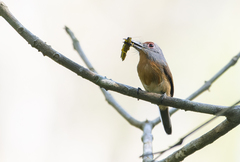
The rufous-capped nunlet is about 14 cm (5.5 in) long and weighs 14 to 22 g (0.49 to 0.78 oz). The nominate subspecies has a large rich chestnut crown. The rest of the face, its nape, and the sides of the breast are cold gray. The rest of the upperparts are plain dull brown with some reddish highlights. The chin and breast are reddish orange, the flanks a paler rufous, and... Wikipedia →

Sounds

Song0:18

Brazil · 2025

© Joost van Bruggen · XC1050571 · CC BY-NC-ND 4.0

Call0:21

Brazil · 2011

© Tayler Brooks · XC108520 · CC BY-NC-ND 2.5

Canto0:54

Brazil · 2014

© Caio Brito · XC427708 · CC BY-NC-SA 4.0

Global Distribution

Parks Where Found

# Park Country Daily sighting probability
1 Manu National Park 🇵🇪 Peru
<5%
2 Tambopata National Reserve 🇵🇪 Peru
<5%

Before you go

What are the chances of seeing a Rufous-capped Nunlet in Tambopata National Reserve?

Rare

Under 5% of wildlife watchers report a Rufous-capped Nunlet sighting in Tambopata National Reserve on a given day, based on 92 verified sightings from GBIF citizen-science data from 2019 to 2026. It is the 317th most-seen of the 550 birds we can rate there. Over three days the chance rises to about 10%, and over a week to about 20%, if each day is a fresh chance.

When is the best time to see a Rufous-capped Nunlet in Tambopata National Reserve?

September and November

In those months about 10% of wildlife watchers report a Rufous-capped Nunlet in Tambopata National Reserve on a given day, against under 5% in October and December–August, the lowest months.

What time of day is best to see a Rufous-capped Nunlet?

Between 9 am and noon

Across all the parks we cover, that three-hour window holds the most Rufous-capped Nunlet sightings with a recorded time, and about 8 in 10 of them come between 6 am and 6 pm: it is a daytime animal.

Is Tambopata National Reserve the best place to see a Rufous-capped Nunlet?

Among the best

Of the 2 parks where we can rate Rufous-capped Nunlet sightings, Tambopata National Reserve ranks 2nd at under 5%, level with the leaders once rounded. The best odds are in Manu National Park (Peru, under 5%).

Which relatives of the Rufous-capped Nunlet live in Tambopata National Reserve?

Same family: Bucconidae

The closest relatives of the Rufous-capped Nunlet that you can see in Tambopata National Reserve (family Bucconidae, Puffbirds) are Black-fronted Nunbird (about 50%), White-fronted Nunbird (about 20%) and Swallow-wing Puffbird (about 20%), with each one's daily chance of a sighting.

Where does the Rufous-capped Nunlet sighting chance come from?

GBIF citizen-science records

It is estimated from how often the Rufous-capped Nunlet is recorded against all the birds logged in Tambopata National Reserve (92 verified sightings from 2019 to 2026), calibrated against known sighting rates. Figures are rounded to the nearest 10% because citizen-science data supports honest approximations, not decimals, and months with records from fewer than five people show "—". How it works.

← Back to Tambopata National Reserve
